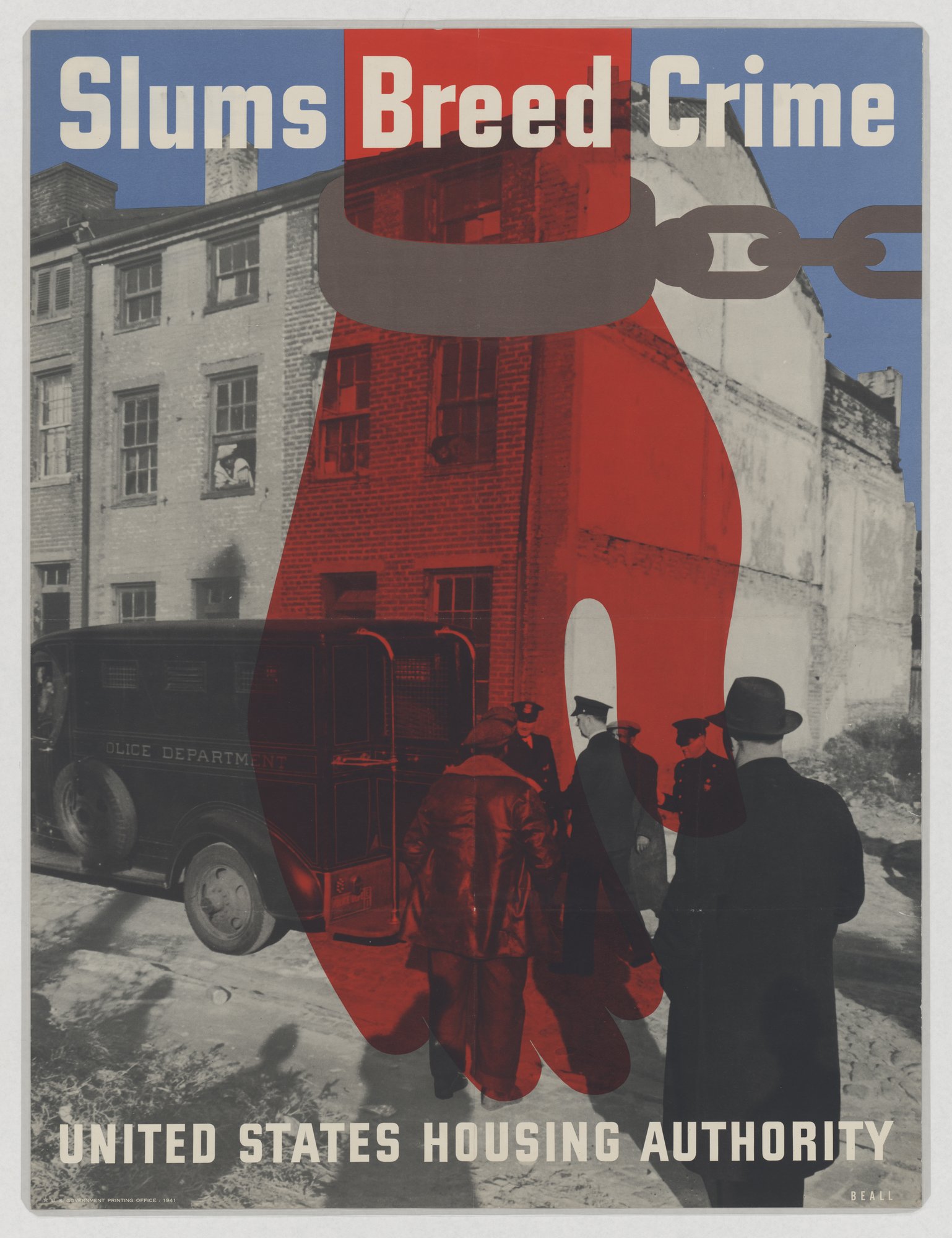
A 1941 United States Housing Authority poster, signed by the artist Beall, lays a red shackled hand and the headline "Slums Breed Crime" over a photograph of brick tenements, a police van, officers, and a man being taken in. It prints no figures or source. NAID 515429.
What the sheet prints
The photograph shows brick tenement fronts and a police wagon at the curb. Officers stand by it with a man in a leather jacket. Over the scene the designer laid a red hand in a shackle and three words of headline. Only the agency's name and the printer's line complete the text.
Slums Breed Crime
UNITED STATES HOUSING AUTHORITY
[on van:] [P]OLICE DEPARTMENT
[signature:] BEALL
[imprint:] U.S. GOVERNMENT PRINTING OFFICE : 1941
Who issued it
The United States Housing Authority is named on the sheet, and the Government Printing Office imprint gives 1941. The artist signed as Beall. The National Archives holds it in Record Group 44 as 44-PA-1757. The same data set holds a second USHA sheet by Beall, Cross Out Slums (NAID 513549), which paints a new housing block over a photograph of shacks. FRAME lists this poster's purpose as winning support and tags fear appeal and card stacking.
How to read it
The poster makes a causal claim in three words and offers no evidence for it. No crime rate, no comparison, no study. The proof is a picture of an arrest, and a picture of one arrest proves nothing about a neighborhood. That is the card stacking FRAME notes: the scene is chosen to carry a conclusion the text never supports.
There is a cost to the people in the picture, too. The poster's audience is asked to support public housing by being afraid of the places poor people live. The residents of those buildings appear only as the setting for a police van. Whatever the merits of clearing bad housing, an argument that works by teaching the public to see a whole block of neighbors as a source of crime does them a wrong. It also makes it easier to justify doing things to them rather than with them.
A fair reader can hold two thoughts at once. Bad housing is a real hardship. A government agency that wins support for its program by attaching handcuffs to a neighborhood has chosen fear over evidence. The Institute for Propaganda Analysis taught readers to ask for the missing figures; this sheet is a good place to practice.
Another New Deal agency poster of the same years, Electricity for Him, sells its program with hope instead. The Roosevelt administration essay covers the New Deal's own publicity, from the Blue Eagle to the government films.
Sources
- FRAME object record, Slums breed crime, 1941. United States Housing Authority; artist Beall.
- U.S. National Archives and Records Administration, Record Group 44, NAID 515429 (44-PA-1757), retrieved by the archive 4 October 2026. Rights as recorded: public domain (U.S. government work).