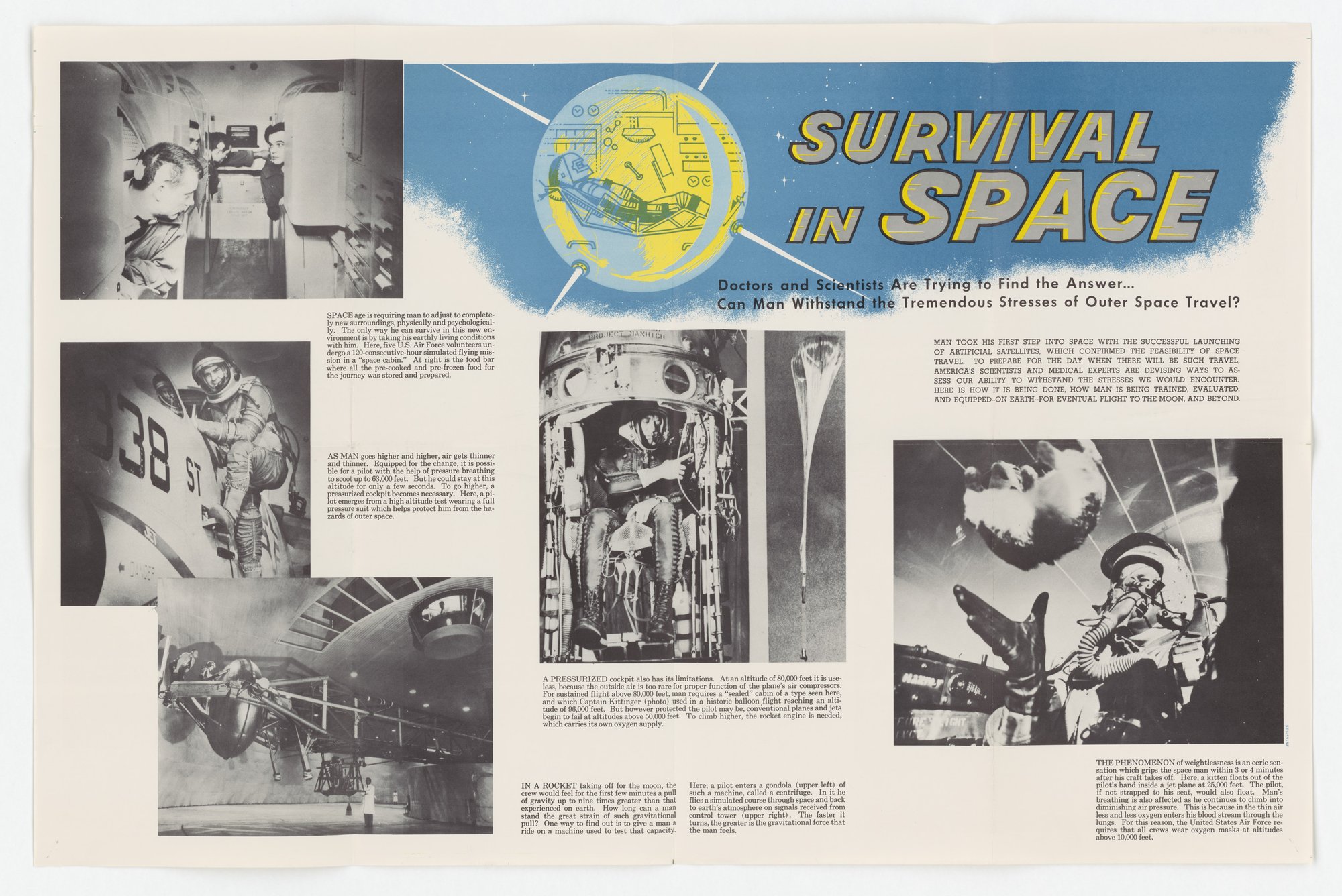
A two-page English photo poster from the U.S. Information Agency series for Asia, catalog date 30 October 1958. It shows Air Force volunteers in a simulated space cabin, a pressure suit, a sealed balloon capsule, a centrifuge and a weightless kitten, and says American scientists are preparing for flight to the moon (NAID 6949103).
What the sheet prints
A spread of photographs with long captions, laid out like a magazine feature. Each block takes one problem of flight above the atmosphere and shows the test meant to answer it: thin air, pressure, gravity on launch, weightlessness. The headline asks a question and the text says the work is under way.
SURVIVAL IN SPACE
Doctors and Scientists Are Trying to Find the Answer... Can Man Withstand the Tremendous Stresses of Outer Space Travel?
[...] Here, five U.S. Air Force volunteers undergo a 120-consecutive-hour simulated flying mission in a "space cabin." [...]
[...] a "sealed" cabin of a type seen here, and which Captain Kittinger (photo) used in a historic balloon flight reaching an altitude of 96,000 feet. [...]
[...] Here, a kitten floats out of the pilot's hand inside a jet plane at 25,000 feet. [...]
Who issued it
The National Archives files it in Record Group 306, the U.S. Information Agency's posters for Asia, Latin America and the Middle East, catalog date 30 October 1958. The archive also holds Tamil and Sinhalese editions distributed in Colombo in 1959. The transcription shows no agency imprint.
How to read it
Most of the text is description of tests, with numbers attached: 63,000 feet with pressure breathing, 80,000 feet as the ceiling for a pressurized cockpit, a pull up to nine times earth's gravity on a moon launch. FRAME tags the sheet transfer, the prestige of science lent to the country doing it. The opening sentence credits the satellites with confirming that space travel is feasible; it does not say whose satellites went up first.
This is the kind of state publicity that is easiest to defend and still worth reading carefully. The photographs show real people doing dangerous work, and a volunteer in a test cabin is a fair emblem of a free country. What the sheet leaves out is cost and failure, and it passes lightly over a fact in its own captions: the Air Force ran the tests. A poster is allowed to show its best side. A reader is allowed to notice which side that is. For an earlier promise about atomic science, see Atoms for Peace, page 1.
Sources
- FRAME object record, Survival in Space poster, English edition (English poster distributed in Asia). Catalog date October 30, 1958.
- U.S. National Archives, Record Group 306, Posters in Asia, Latin America, Middle East, item NAID 6949103, 306-PPB-196, catalog.archives.gov. Rights as recorded: public domain (U.S. government work).