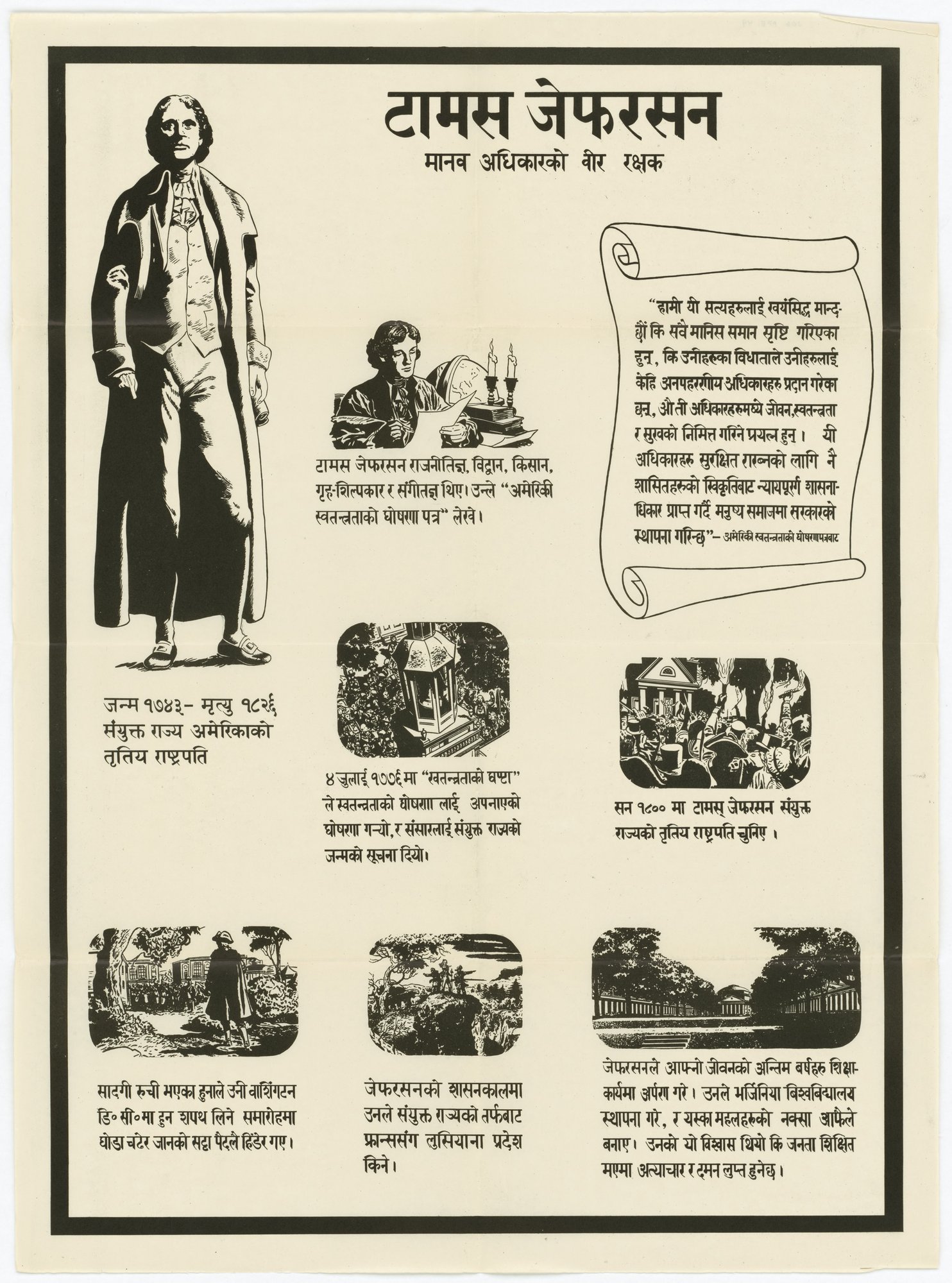
A Nepali-language biographical poster, number 49, filed with U.S. Information Agency posters for Asia, Latin America and the Middle East and dated about 1956. A scroll quotes the Declaration of Independence on equality and consent of the governed, beside scenes from 1776, the 1800 election, the walk to the inauguration, Louisiana and the University of Virginia (NAID 6948838).
The Declaration in Devanagari
This sheet argues mainly by quotation. Beside a standing figure of Jefferson, a scroll gives the Declaration of Independence in Nepali, from "all men are created equal" through the consent of the governed. Around it, the archive lists scenes of the Liberty Bell in 1776, the 1800 election, Jefferson walking to his inauguration, the Louisiana Purchase and the founding of the University of Virginia. The headline calls him a brave defender of human rights.
टामस जेफरसन
मानव अधिकारको वीर रक्षक
जन्म १७४३- मृत्यु १८२६
[...]
सादगी रुची भएका हुनाले उनी वाशिंगटन डि० सी०मा हुन शपथ लिने समारोहमा घोडा चढेर जानको सट्टा पैदले हिंडेर गए।
[...]
The archive's machine translation, which it says is unverified, renders the inauguration caption as "Because of his taste for simplicity, he walked to the swearing-in ceremony in Washington, D.C. instead of riding a horse." For the scroll, the archive follows the standard English wording of the Declaration and notes that some Nepali words are uncertain readings.
An undated sheet in the agency's files
The maker line names the U.S. Information Agency, with the State Department's information program as predecessor, in the series Propaganda Posters Distributed in Asia, Latin America and the Middle East. The rights line dates it "c. 1956 (undated)." FRAME classes the source as blurred and lists the theme as elections and party politics.
A founding text quoted past the easy part
FRAME tags glittering generalities, with the quoted Declaration as testimonial. The generalities are real: "Brave Defender" and "Human Rights" are labels, and the sheet's account of Jefferson is a list of virtues and achievements with no failing or defeat in it.
The quotation is the stronger part of the sheet, and it is quoted honestly. It does not stop at "unalienable Rights." It carries on to the clause that governments derive "their just powers from the consent of the governed," in the archive's English. That is the sentence a reader anywhere could turn on any government, the issuing one included. The closing caption makes the same point in a gentler key: Jefferson believed, the archive's translation says, that "if people were educated, tyranny and oppression would disappear."
The 1800 election on the poster was fought in a partisan press on both sides, as this site's case study on Adams, Jefferson and the press of 1800 records. Other sheets that carried American founding symbols abroad include a Heroes Day poster with Lincoln and a Dutch Independence Hall sheet.
Sources
- FRAME object record, Thomas Jefferson poster, 49: Defender of Human Rights (Nepali poster distributed in Asia). U.S. Information Agency (predecessor: State Department IIEP). Dated c. 1956 (undated).
- U.S. National Archives, RG 306, Propaganda Posters Distributed in Asia, Latin America and the Middle East, NAID 6948838, 306-PPB-49, catalog record, retrieved by the archive October 4, 2026. Rights as recorded: public domain (U.S. government work).