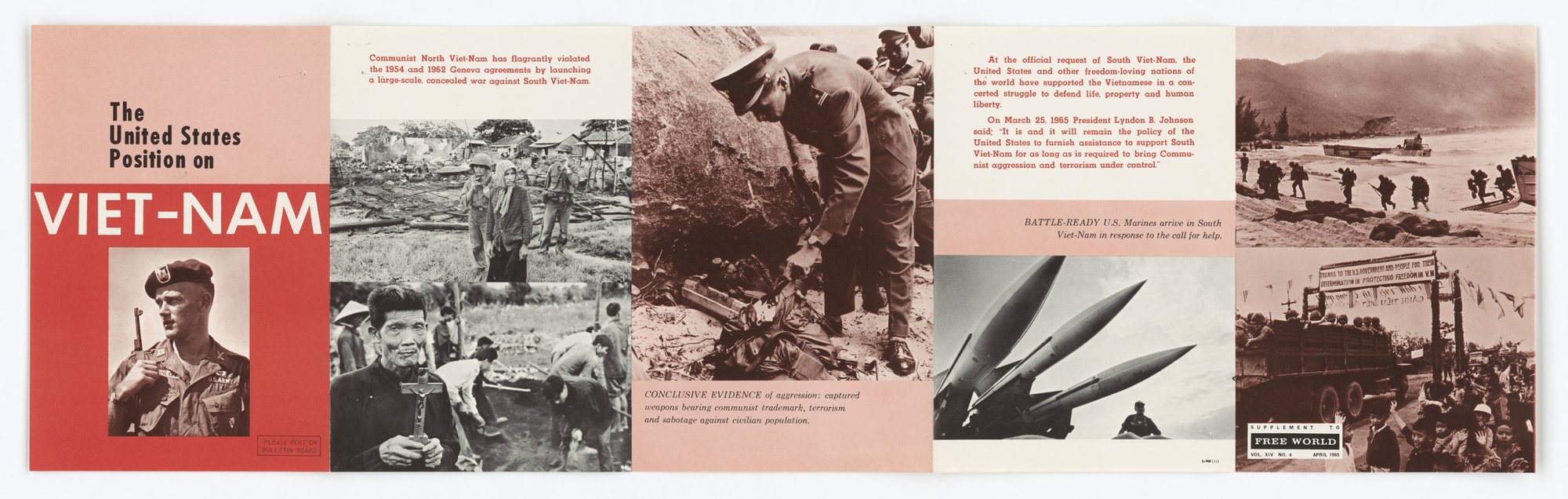
The United States Position on Viet-Nam is a five-panel English sheet issued as a supplement to Free World magazine in April 1965 and filed with U.S. Information Agency posters for Asia, Latin America and the Middle East, catalog date 23 April 1965. It quotes President Johnson's pledge of 25 March 1965 beside photographs of captured weapons and landing Marines (NAID 6949256).
The text
The sheet folds into five panels and asks to be pinned up. The photographs run from a soldier in a beret, through a ruined village and a grave, to an officer handling captured arms, missiles, and Marines on a beach. The text makes a legal claim, offers evidence, states a request, and closes on the president's words.
The United States Position on VIET-NAM
PLEASE POST ON BULLETIN BOARD
Communist North Viet-Nam has flagrantly violated the 1954 and 1962 Geneva agreements by launching a large-scale, concealed war against South Viet-Nam.
CONCLUSIVE EVIDENCE of aggression: captured weapons bearing communist trademark, terrorism and sabotage against civilian population.
[…]
On March 25, 1965 President Lyndon B. Johnson said: "It is and it will remain the policy of the United States to furnish assistance to support South Viet-Nam for as long as is required to bring Communist aggression and terrorism under control."
[…]
SUPPLEMENT TO FREE WORLD VOL. XIV NO. 4 APRIL 1965
Who issued it
The heading names "The United States," so a reader knew whose position this was. The issuing office is not printed; the sheet calls itself a supplement to Free World, and the National Archives files it in Record Group 306 with the U.S. Information Agency's posters for Asia, Latin America and the Middle East. FRAME classes the source as blurred.
How to read it
FRAME tags card stacking, fear appeal, and testimonial. The pictures are chosen to tell one story: an attack from the north, a call from the south, an answer from Washington. "Conclusive evidence" is a phrase that asks the reader to stop weighing. A captured weapon with a communist trademark is evidence of where that weapon came from. It is not, alone, proof of the whole claim printed above it.
The quotation from Johnson is real speech, given with a date, and the sheet does not tidy it. It is also open-ended: support "for as long as is required." A foreign reader in Manila was being told what the American government intended, in the president's own sentence, with his name and the date. Whatever one thinks of the policy, that is a policy announced, not a policy hidden, and on this sheet the government argued its case under its own country's name.
The same argument went out in other forms that year: the Why Viet Nam pamphlet from the embassy in London and the Defense Department film Why Vietnam?. A 1954 sheet from the same files, Come South, shows the line the argument began from.
Sources
- FRAME object record, U.S. Position on Viet-Nam poster, PPB-331 (English, Manila), catalog date 23 April 1965.
- U.S. National Archives, Record Group 306, Posters in Asia, Latin America, Middle East, NAID 6949256 (306-PPB-331), catalog.archives.gov, retrieved by the archive 4 October 2026. Rights as recorded: public domain (U.S. government work).