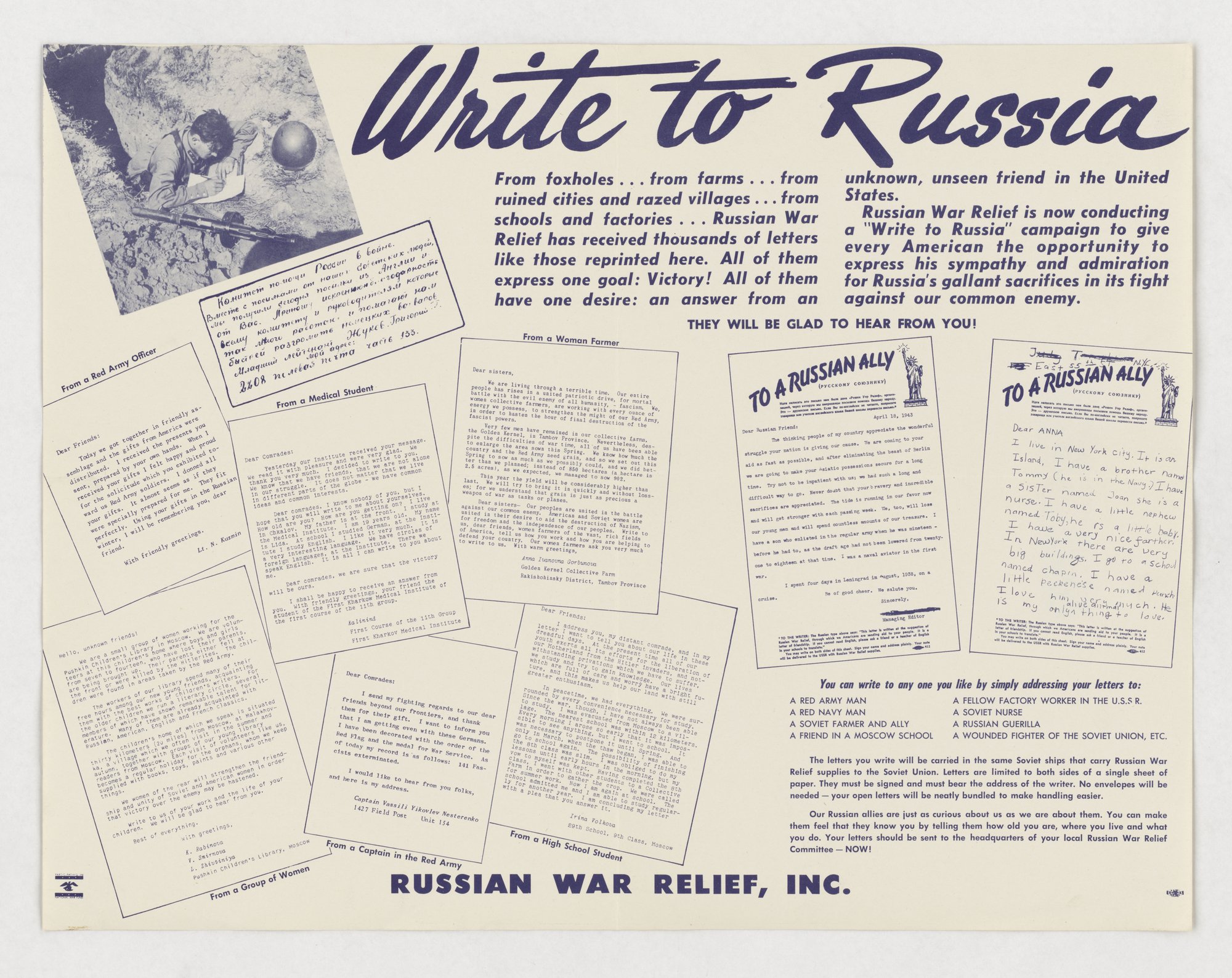
Write to Russia is a 1943 broadsheet of Russian War Relief, Inc., a private American charity. It reprints letters said to come from Red Army officers, a medical student, farmers and schoolchildren, and asks Americans to write open letters to "a Russian ally" that would travel on Soviet relief ships.
Letters and rules
The broadsheet is mostly reprinted letters. Each carries a label naming its writer's role, from a Red Army officer and a medical student to a woman farmer and a high school student, and the archive notes Russian handwriting and print among them. Sample forms headed "To a Russian Ally," in English and Russian, sit with the instructions. The pitch and the rules read:
Write to Russia
From foxholes . . . from farms . . . from ruined cities and razed villages . . . from schools and factories . . . Russian War Relief has received thousands of letters like those reprinted here. All of them express one goal: Victory! All of them have one desire: an answer from an unknown, unseen friend in the United States.
[...]
The letters you write will be carried in the same Soviet ships that carry Russian War Relief supplies to the Soviet Union. Letters are limited to both sides of a single sheet of paper. They must be signed and must bear the address of the writer. No envelopes will be needed - your open letters will be neatly bundled to make handling easier.
[...]
RUSSIAN WAR RELIEF, INC.
Who made it
The sheet is signed by Russian War Relief, Inc., which the archive classes as a nongovernmental organization in the United States, addressing the domestic public. It sends readers to their local Russian War Relief committee. The National Archives holds a copy in the World War II Foreign Posters series of Record Group 44. The archive's rights line says the broadsheet has no rights statement and is hosted by the archive owner's decision. The record names no individual author and no print run.
Open letters on Soviet ships
The archive tags testimonial and bandwagon: named roles vouch for the cause, and "thousands of letters" and "every American" invite the reader to join. It also notes that the sheet asks for letters, not money.
The rules deserve a careful reading. Letters must be signed, carry the writer's address, and travel open, without envelopes, on Soviet ships. The sheet even suggests what to write: your age, where you live, what you do. A private charity was entitled to run this campaign, and a letter of sympathy to a wounded soldier is a decent act. But the reader was being asked to send personal details, unsealed, onto Soviet ships, and the sheet does not say who would read the letters on the way or at the other end. Nothing in the record shows what became of them.
Within a decade, U.S. government posters described the same state very differently; see Kremlin's Words and Deeds from the State Department's 1952 Asia file. The Roosevelt administration essay sets out which wartime messages came from government offices and which did not.
Sources
- FRAME object record, Write to Russia (Russian War Relief, Inc.), 1943. Russian War Relief, Inc. (United States). Rights as recorded: held by NARA, Unrestricted; hosted by owner decision (US charity broadsheet, 1943, no rights statement).
- U.S. National Archives and Records Administration, Record Group 44, World War II Foreign Posters, local id 44-PF-884, catalog record, retrieved by the archive 3 October 2026.