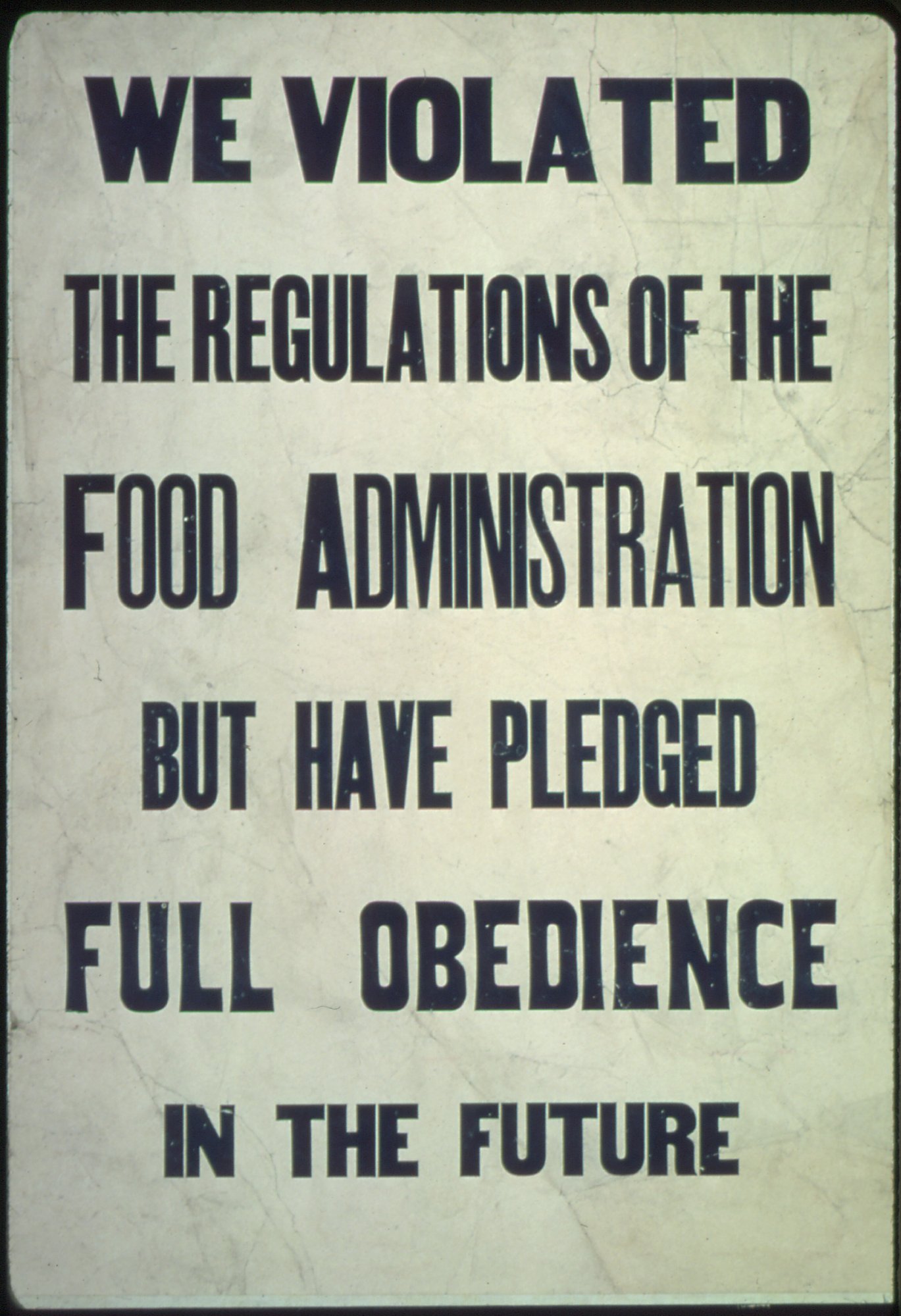
A plain 1918 U.S. Food Administration card, all capitals and no picture, states that whoever displays it broke the agency's regulations and has "pledged full obedience in the future." It is a penalty in the form of a public admission.
What the card says
Six lines of lettering, nothing else. The surface in the photograph is cracked; FRAME notes that the cracking is the card's own condition.
WE VIOLATED
THE REGULATIONS OF THE
FOOD ADMINISTRATION
BUT HAVE PLEDGED
FULL OBEDIENCE
IN THE FUTURE
Who made it
The agency named on the record is the U.S. Food Administration, 1918, and FRAME treats the source as openly identified. The National Archives copy is in Record Group 4, World War I Posters (series NAID 512439), catalog item 512528, local identifier 4-P-89. The record does not say which business, if any, displayed this copy, what it had done, or who decided that it should.
How to read it
The card is written in the first person plural, but the words are the agency's. A merchant who hung it was made to speak a sentence the government wrote: an admission of fault and a promise of obedience, facing the street. FRAME tags it fear appeal. The fear is aimed less at the person who displays it than at the next shopkeeper who reads it.
It belongs beside two other sheets in the same file. The Closed notice from the Enforcement Division shut a business for a stated number of days. A store card on sugar, Your Sugar Ration Is 2 lbs. per Month, calls the American allowance a "voluntary ration" while announcing that the store is pledged to conform to the agency's regulations. Herbert Hoover later described his agency's method as voluntary, as the Wilson administration page records. These three sheets show the method had an enforcement side, with closures and public confessions.
Fairness requires two limits on that reading. The record does not show how often cards like this were used, and one surviving card is not a count. Nor does it give the legal basis for the agency's rules, and this page will not supply one from memory.
The concern for liberty here is specific. A closure is a penalty on property. A compelled confession is a penalty on speech: it puts the state's words in a citizen's mouth and posts them on his own window. Whatever the merchant had done, a free country should be uneasy when the punishment includes saying, in public, that one will obey. The card does not tell us whether there was a charge, a hearing, or a chance to answer.
Sources
- FRAME object record, We Violated the Regulations of the Food Administration but Have Pledged Full Obedience in the Future, 1918. U.S. Food Administration.
- U.S. National Archives, RG 4, World War I Posters, series NAID 512439, catalog item 512528, local identifier 4-P-89, retrieved by the archive 3 October 2026. Rights as recorded: NARA unrestricted.