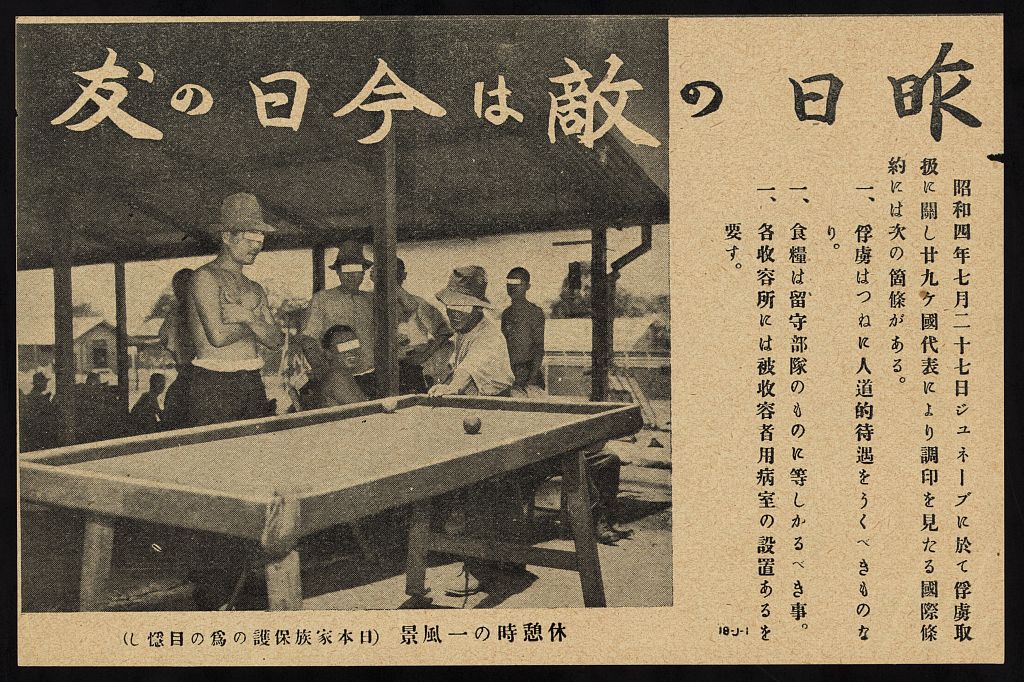
Leaflet 18-J-1, dated 1944, was printed in Japanese by the Psychological Warfare Branch of U.S. Army Forces, Pacific Area. It shows Japanese prisoners at a pool table, eyes masked, and cites the 1929 Geneva convention on the treatment of prisoners.
What the leaflet prints
A brushed title runs across the top. Under it is a photograph of prisoners, some shirtless and some in hats, crowded around a pool table under a thatched roof. Their eyes are blacked out. Vertical text at the side quotes a treaty.
昨日の敵は今日の友
昭和四年七月二十七日ジュネーブに於て俘虜取扱に關し廿九ケ國代表により調印を見たる國際條約には次の箇條がある。
一、俘虜はつねに人道的待遇をうくべきものなり。
一、食糧は留守部隊のものに等しかるべき事。
一、各收容所には被收容者用病室の設置あるを要す。
休憩時の一風景(日本家族保護の爲目隱し)
18-J-1
The archive gives an English gloss, which it labels a machine translation not verified by a fluent reader. In that gloss: "Yesterday's enemy is today's friend." The convention signed at Geneva on 27 July 1929 (Showa 4) by representatives of twenty-nine nations on the treatment of prisoners contains these articles: prisoners shall at all times be treated humanely; their food shall equal that of depot troops; each camp shall have an infirmary. The caption reads "A scene during the rest period (eyes covered to protect families in Japan)."
Who issued it
The issuer is the Psychological Warfare Branch, U.S. Army Forces, Pacific Area, APO 500, according to the archive. The code 18-J-1 is the leaflet's own number. The audience in the record is enemy forces.
How to read it
The leaflet never says "surrender." It says what happens after. The archive tags it card stacking: one easy scene stands for all of captivity. That is fair. A pool table is a selected picture.
The masked eyes are the most interesting detail. The caption says they protect the prisoners' families. It concedes, without saying so, that being known as a prisoner carried a cost at home. The leaflet's argument is aimed at that fear.
The treaty citation is the leaflet's strongest claim, because it can be checked. It binds the issuer to a public standard. Whether every camp met it is not shown here, and this page does not assert it either way. A promise of humane treatment in writing, under the issuing nation's name, is still a better thing to drop on an enemy than a threat.
Companion leaflets on this site are the air-raid advance notice and the Germany-to-Japan sheet. Propaganda aimed the other way, Japanese radio for American troops, is the background of the Tokyo Rose case study.
Sources
- FRAME object record, 'Yesterday's enemy is today's friend' (US leaflet 18-J-1 to Japanese troops), 1944. U.S. Army Forces, Pacific Area, Psychological Warfare Branch (APO 500). Library of Congress Prints and Photographs Division, LOT 8093, LC-DIG-ppmsca-13368, loc.gov/pictures/item/2007675054, retrieved by the archive 29 September 2026. Rights as recorded: US wartime military leaflet; LOC: no known restrictions on publication.