4 de Julio Independence Day poster (Spanish photo-sheet poster distributed in Latin America)
4 de Julio: the American founding in eleven Spanish captions, 1958
A 1958 USIA photo sheet for Latin America, "4 de Julio," sets the founding in eleven Spanish captions, from the first flag to Valley Forge. NAID 6948893.
Techniques named on the archive record
TransferGlittering generalities
Date
1958
Made by
U.S. Information Agency (predecessor: State Department International Information and Educational Exchange Program), Propaganda Posters Distributed in Asia, Latin America and the Middle East series
U.S. National Archives (NARA), RG 306, Posters Distributed in Asia, Latin America, Middle East , retrieved October 4, 2026
Source
Public domain (U.S. government work; NARA RG 306) U.S. Information Agency / Department of State, 1958. National Archives, Record Group 306 (NAID 6948893, 306-PPB-70).
Object, image, and catalog record from the FRAME archive. Text on this page is CC BY 4.0. Image rights are as the archive records.
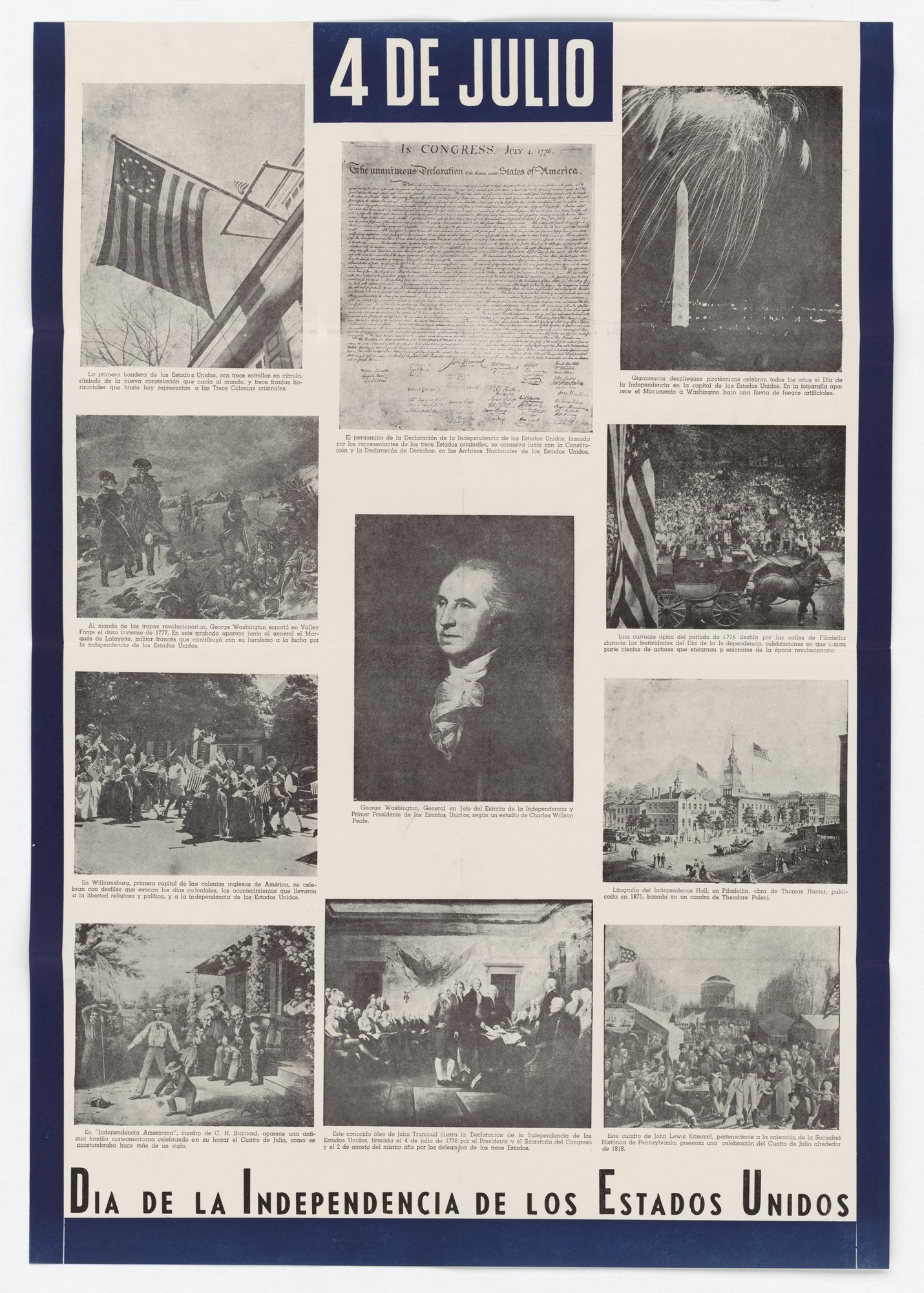
A Spanish-language photo sheet for United States Independence Day, filed with the U.S. Information Agency's posters for Latin America and dated 1958. Eleven captioned pictures surround the headline "4 DE JULIO": the first flag, the Declaration, Valley Forge, a Peale portrait of Washington, pageants and paintings of early Fourth celebrations (NAID 6948893).
Eleven pictures
The headline is a date, 4 DE JULIO, and a closing title line names the holiday. Around them run eleven pictures, each with a paragraph of Spanish. They mix documents, paintings and present-day photographs: the first flag with its circle of stars, the Declaration's parchment, fireworks over the Washington Monument, Washington and Lafayette at Valley Forge, Washington after Charles Willson Peale, pageants in Philadelphia and Williamsburg, an 1875 lithograph of Independence Hall, and three paintings of the signing and of early Fourth of July scenes.
4 DE JULIO
La primera bandera de los Estados Unidos, con trece estrellas en círculo, símbolo de la nueva constelación que nacía al mundo, y trece franjas horizontales que hasta hoy representan a las Trece Colonias originales.
El pergamino de la Declaración de la Independencia de los Estados Unidos, firmada por los representantes de los trece Estados originales, se conserva junto con la Constitución y la Declaración de Derechos, en los Archivos Nacionales de los Estados Unidos.
[...]
DIA DE LA INDEPENDENCIA DE LOS ESTADOS UNIDOS
[English, as given by the archive, the second caption in summary:] the parchment Declaration of Independence kept with the Constitution and Bill of Rights in the U.S. National Archives [...] INDEPENDENCE DAY OF THE UNITED STATES
Record
The sheet is in Record Group 306 at the National Archives, filed with the U.S. Information Agency's posters for Asia, Latin America and the Middle East. FRAME and the rights line both give the year 1958 and nothing finer. The archive's title says it was distributed in Latin America without naming a country. No sender is transcribed from the face, and the source is classed as blurred. The purpose field reads "Commemorate."
Exporting the founding
FRAME tags transfer and glittering generalities: founding-era symbols lend their weight to the holiday, and the first caption's "new constellation" is pure uplift. That is a fair description, and it is also a mild charge. Most of the sheet is history a reader could check, with painters, dates and places named.
One caption is worth a second look for what it chose to stress. It tells Latin American readers that the Declaration is kept beside the Constitution and the Bill of Rights in the National Archives. A government's information service, pointing foreigners to the documents that limit that same government, is promoting the right things. Another caption, on Williamsburg, ties the holiday to religious and political liberty.
FRAME object record, 4 de Julio Independence Day poster (Spanish photo-sheet poster distributed in Latin America), 1958. U.S. Information Agency (predecessor: State Department International Information and Educational Exchange Program), Propaganda Posters Distributed in Asia, Latin America and the Middle East series.
U.S. National Archives and Records Administration, Record Group 306, NAID 6948893 (306-PPB-70), retrieved by the archive 4 October 2026. Rights as recorded: public domain (U.S. government work).