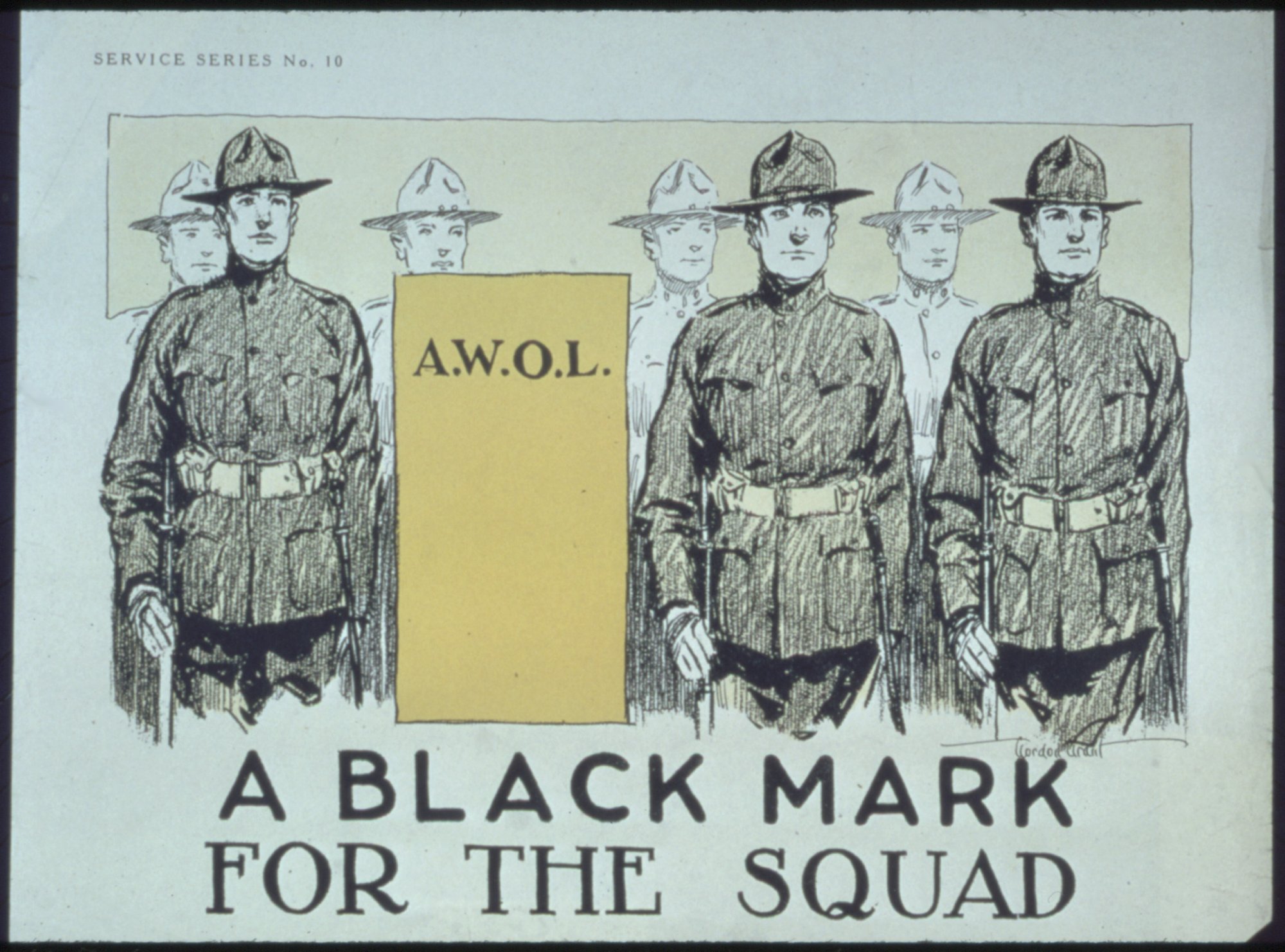
A Black Mark for the Squad is U.S. Army Service Series No. 10, signed Gordon Grant. A squad stands at attention with a blank yellow panel marked "A.W.O.L." where one man should be. The archive dates it to 1918 only from the uniforms.
The gap in the line
The picture is a squad of uniformed American soldiers at attention. Where one of them should stand, there is a blank yellow panel with four letters on it. The text is short enough to give whole.
SERVICE SERIES No. 10
A.W.O.L.
A BLACK MARK
FOR THE SQUAD
Gordon Grant
Who it spoke to
The issuer is the U.S. Army, and the audience field reads "Own forces." This is a poster for men already in uniform, with the purpose recorded as "Mobilize or secure compliance." The record dates it 1918, and says that date is an inference from the uniforms; nothing printed on the sheet gives a year. The National Archives copy is filed in Record Group 4, the Food Administration's World War I Posters series (NAID 512439), local identifier 4-P-263.
The World War I home-front hub leaves the Army's "Service Series" posters out of its gallery and describes them as addressed to soldiers already in uniform.
How it works
The archive tags identity fusion and fear appeal. The missing man is not shown being punished. His absence is shown as a stain on everyone who stayed, and the phrase "black mark" is aimed at the squad, not at him. The pressure the poster applies comes from the men beside him.
A soldier who has taken an oath owes his post, and an army may remind him of it. What the sheet leaves out is worth noting all the same: it cites no article of war, names no penalty, and gives no reason a man might be absent. It works through shame and loyalty to the unit. A later Army sheet, The Little Jap Is a Big Job!, was also issued as an official Army poster, with a different target. For civilians the pressure in 1918 was rougher: the Wilson administration essay describes a volunteer league that joined the "slacker" raids on draft evaders that year.
Sources
- FRAME object record, A Black Mark for the Squad: A.W.O.L., 1918 (date inferred from uniforms). U.S. Army, Service Series No. 10, artist Gordon Grant. Source classed as openly identified.
- U.S. National Archives, RG 4, World War I Posters, series NAID 512439, catalog item 512701, local identifier 4-P-263, retrieved by the archive 3 October 2026. Rights as recorded: NARA unrestricted.