A New Quest for Union poster, Free World supplement (English, Manila)
A New Quest for Union: peace, Vietnam, and a war against poverty on one 1965 sheet
A January 1965 Free World supplement for Manila sets Johnson's "war against poverty and disease" beside support for Viet-Nam under one headline.
Techniques named on the archive record
Glittering generalitiesTestimonial
Date
February 8, 1965
Made by
U.S. Information Agency (predecessor: State Department International Information and Educational Exchange Program), Propaganda Posters Distributed in Asia, Latin America and the Middle East series
U.S. National Archives (NARA), Record Group 306, Posters in Asia, Latin America, Middle East , retrieved October 4, 2026
Source
Public domain (U.S. government work; NARA RG 306) U.S. Information Agency / Department of State, February 8, 1965. National Archives, Record Group 306 (NAID 6949247, 306-PPB-322).
Object, image, and catalog record from the FRAME archive. Text on this page is CC BY 4.0. Image rights are as the archive records.
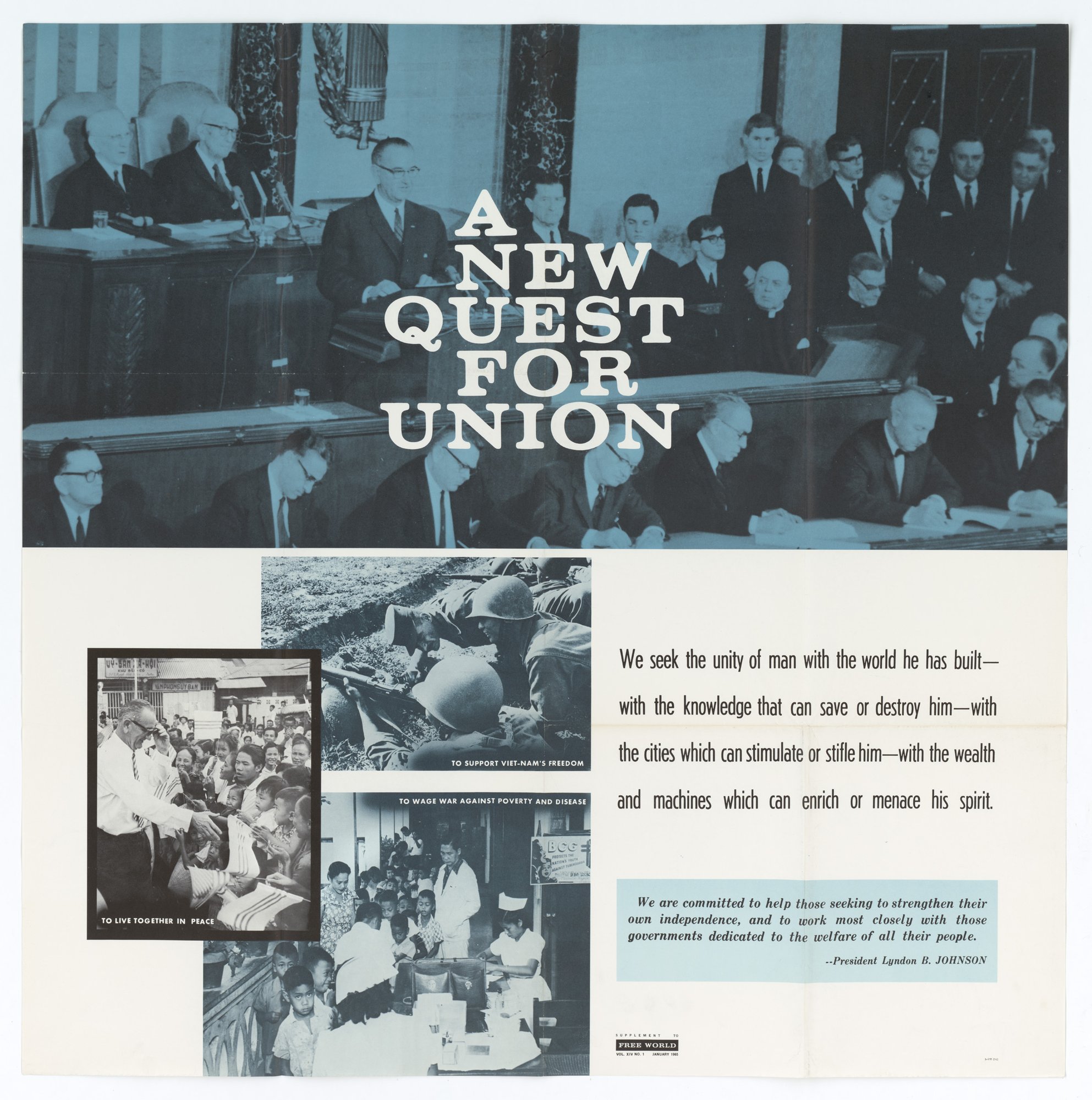
A supplement to the U.S. Information Agency's Free World magazine, dated January 1965 and cataloged 8 February 1965, built on a photograph of President Johnson before Congress. Three captions follow: to live together in peace, to support Viet-Nam's freedom, and to wage war against poverty and disease (NAID 6949247).
The sheet
The President stands at the rostrum before Congress in the large photograph. Under the headline, three smaller pictures each carry one aim. In the first he greets a crowd waving small flags. In the second, helmeted soldiers hold a rifle. In the third, children wait in line at a clinic. Two quotations from Johnson close the sheet.
A NEW QUEST FOR UNION
TO LIVE TOGETHER IN PEACE
TO SUPPORT VIET-NAM'S FREEDOM
TO WAGE WAR AGAINST POVERTY AND DISEASE
We seek the unity of man with the world he has built—with the knowledge that can save or destroy him—with the cities which can stimulate or stifle him—with the wealth and machines which can enrich or menace his spirit.
We are committed to help those seeking to strengthen their own independence, and to work most closely with those governments dedicated to the welfare of all their people.
--President Lyndon B. JOHNSON
SUPPLEMENT TO FREE WORLD / VOL. XIV NO. 1 JANUARY 1965
Who made it
Free World is the pictorial named on several of this agency's sheets in the archive, from Manila to Taipei. This is a wall supplement to it, filed by the National Archives with the U.S. Information Agency's posters. The sheet names the magazine and the President. It does not name the agency, and FRAME classes the source as blurred. Which speech the quotations come from is not recorded.
How to read it
FRAME tags it glittering generalities and testimonial. The headline and the three aims are virtue words, and the President's name is the authority behind them. The quotations are broad enough that almost any reader could agree with them.
The arrangement says more than the words. Peace, a war in Vietnam, and a war on poverty are set in a row under one headline as parts of a single program. On this sheet the war against poverty is offered to readers in Asia, and the signs in the photographs, one of them in Vietnamese, suggest it was illustrated with aid work there rather than with anything in the United States. A reader who distrusts war metaphors for civilian policy has a reason to look twice. A war is the one public project in which dissent is easiest to call disloyalty, and a government that labels a program a war is asking for that kind of support. In Vietnam the same figure of speech turned up on a JUSPAO poster that called a village cadre a soldier in the war against poverty.
None of that makes the clinic or the vaccine sign less real. Children lining up for a tuberculosis shot is a good thing to photograph. The fair point is narrower: the sheet asks its readers to accept a war and a welfare program as one package of good intentions. A Washington newspaper drew a different picture of the poverty debate four years earlier, when a Berryman cartoon called a Democratic "depressed areas" bill a "gravy train." The period is gathered on US civil rights era messaging, 1954–1969, and the war's own messaging on US Vietnam War messaging, 1954–1975.
Sources
FRAME object record, A New Quest for Union poster, Free World supplement (English, Manila), catalog date 8 February 1965; the sheet is dated January 1965.
U.S. National Archives, Record Group 306, Posters in Asia, Latin America, Middle East, NAID 6949247 (306-PPB-322), retrieved by the archive 4 October 2026. Rights as recorded: public domain (U.S. government work).
FRAME object record, What does he know about "Depressed Areas?", 13 March 1961. Jim Berryman, Washington Evening Star. NAID 5743288.