U.S. National Archives (NARA), RG 306, Propaganda Posters Distributed in Asia, Latin America and the Middle East , retrieved October 4, 2026
Source
Public domain (U.S. government work; NARA RG 306) U.S. Information Agency / Department of State, c. 1956 (undated). National Archives, Record Group 306 (NAID 6948836, 306-PPB-47).
Object, image, and catalog record from the FRAME archive. Text on this page is CC BY 4.0. Image rights are as the archive records.
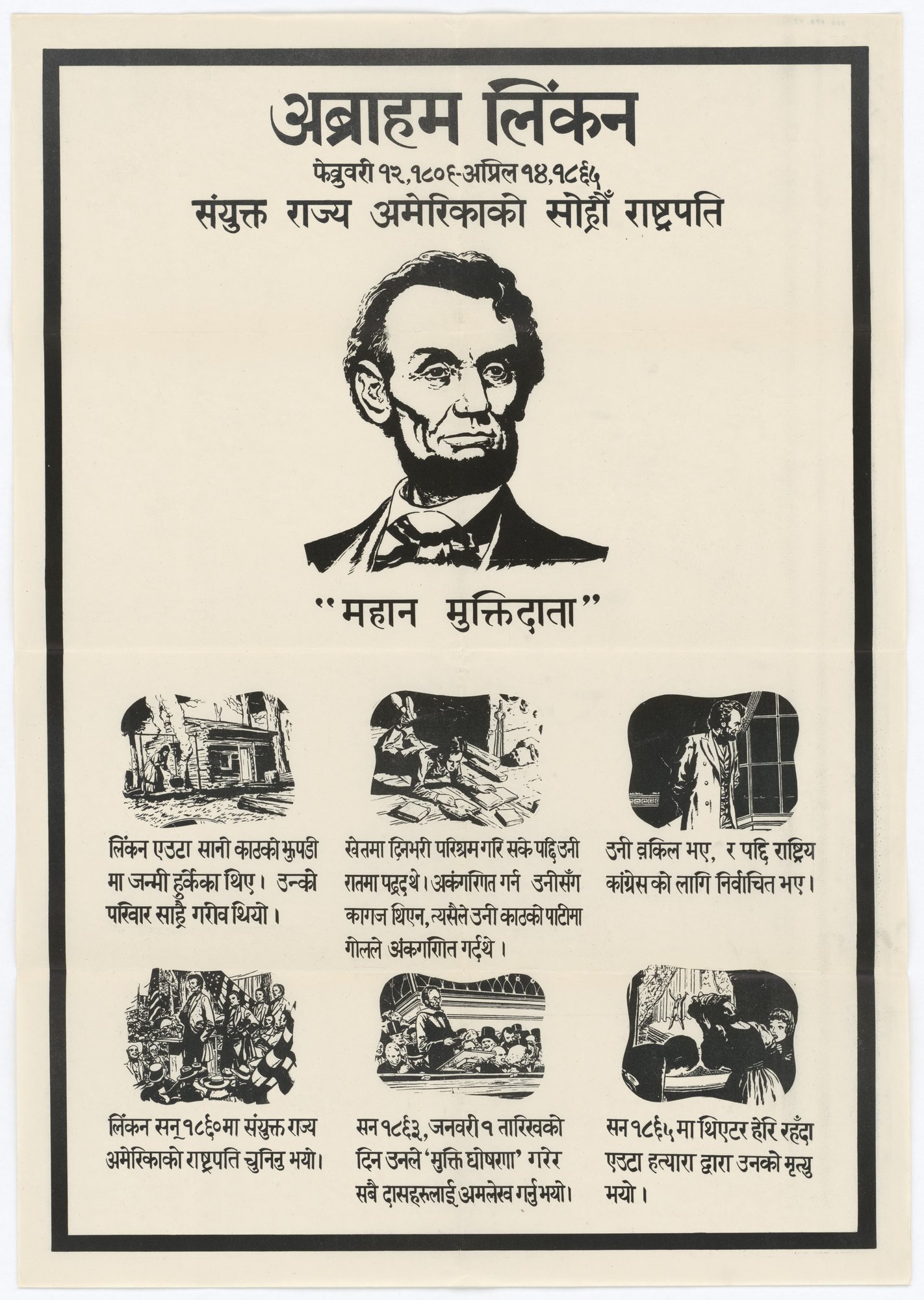
A Nepali-language biographical poster of Abraham Lincoln, numbered 47 in the U.S. Information Agency file and dated about 1956. A large portrait heads six captioned drawings that run from a log hut to the Emancipation Proclamation to his death at a theatre (NAID 6948836).
A life in six pictures
A big portrait of Lincoln takes the top of the sheet, with his dates and his number among the presidents. Below, six small drawings tell the story in order, each with a short Nepali caption: the poor family, reading at night after a day in the fields, the lawyer and congressman, the 1860 election, the proclamation, and the theatre.
अब्राहम लिंकन
फेब्रुवरी १२,१८०९-अप्रिल १४,१८६५
संयुक्त राज्य अमेरिकाको सोह्रौं राष्ट्रपति
"महान मुक्तिदाता"
[...]
सन १८६३, जनवरी १ तारिखको दिन उनले 'मुक्ति घोषणा' गरेर सबै दासहरूलाई अमलेख गर्नु भयो।
[English, as given by the archive:] Abraham Lincoln / February 12, 1809 - April 14, 1865 / Sixteenth President of the United States of America / "Great Liberator" [...] On January 1, 1863, he issued the 'Emancipation Proclamation' and freed all the slaves.
Dating and sender
The National Archives files the poster in Record Group 306, with the agency's posters distributed in Asia, Latin America and the Middle East, as item 306-PPB-47. The rights line calls it "c. 1956 (undated)," and FRAME's date field reads 1956. The English title, "The Great Emancipator," is the catalog's; the archive renders the Nepali epithet on the sheet as "Great Liberator." No sender appears in the transcription, and the source is classed as blurred.
The proclamation caption
FRAME tags glittering generalities and testimonial, and lists race and ethnicity among the themes. Most of the sheet is the familiar self-made story: a log hut, arithmetic done with charcoal on a board for lack of paper, the law, Congress, the presidency. It is an American story worth telling, and telling it abroad was a fair use of a public information service.
The fifth caption carries the weight. As the archive translates it, the proclamation "freed all the slaves" on 1 January 1863. The site's Civil War print case study gives a longer sequence: the proclamation took effect on that date, and the 1864 Republican platform called for an amendment abolishing slavery. A one-line caption cannot hold that much, and the archive flags this line as approximate, but the version a Nepali reader got is the shorter and tidier one.
The same file sent Lincoln to Asia more than once. A 1954 Heroes Day sheet put him over one line, "All men are created equal." Both sheets are among the agency's Lincoln posters in the civil rights era gallery.
Sources
FRAME object record, Abraham Lincoln poster, 47: The Great Emancipator (Nepali poster distributed in Asia), c. 1956 (undated). U.S. Information Agency (predecessor: State Department IIEP), Propaganda Posters Distributed in Asia, Latin America and the Middle East series.
U.S. National Archives and Records Administration, Record Group 306, NAID 6948836 (306-PPB-47), retrieved by the archive 4 October 2026. Rights as recorded: public domain (U.S. government work).