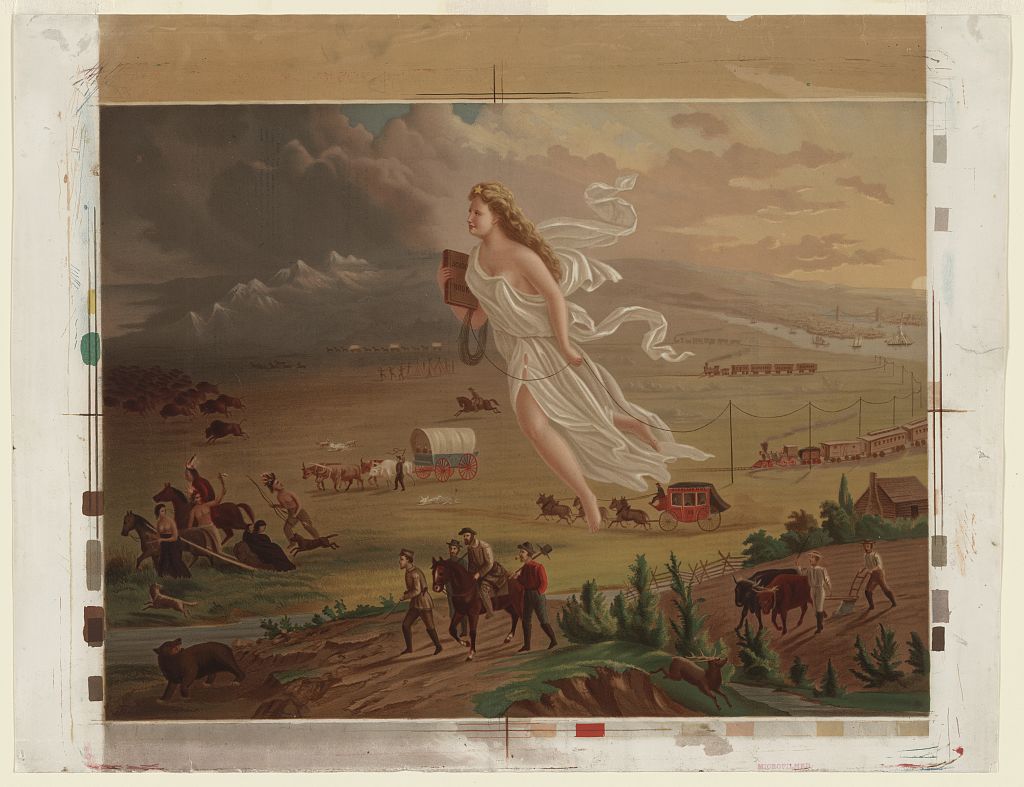
George A. Crofutt published this 1873 chromolithograph after John Gast's painting American Progress. A floating woman in white carries a schoolbook and a telegraph wire west, with settlers and railroads behind her and Native riders and bison moving away ahead of her.
What the picture shows
Content note: the print shows Native people and animals retreating before the advance it celebrates. This page describes the image as published.
A woman in white drapery, a star on her forehead, floats westward across the plains. She holds a schoolbook in one hand. From the other she strings a telegraph wire behind her. Under and behind her come railroad trains, wagons, and farmers with ploughs. In front of her, bison, bears, and Native riders move away into a darkening sky.
No words appear on the picture side. The archive checked and found only printer's color bars, registration marks, and a library microfilm stamp in the margins. The title "American Progress" belongs to the publisher. The back of the sheet carried an advertisement for Crofutt's Western World, which is not part of the image the archive hosts.
Who made it
John Gast painted the original, dated 1872 in the record. George A. Crofutt, publisher of Crofutt's Western World, copyrighted the chromolithograph in 1873. The archive lists him as the issuer and files the print under the Grant administration. It is a commercial product, not a government commission.
How to read it
The archive tags the print for glittering generalities and transfer, and notes that it rests on a virtue word and the prestige of a classical figure "rather than on any stated claim." That is the key. A poster that says "take the land" can be argued with. A goddess cannot. The print never states a policy. It shows a direction of travel and calls it progress.
What the picture leaves out is the argument. The people retreating into the dark were not a weather system. They were nations with claims to the land, and the question of how the United States dealt with them was a question of treaties, force, and law. The allegory turns that question into scenery. A reader can admire the railroad and the school, which were real achievements, and still see that the print arranges human beings beside the bison as part of the wilderness to be cleared. That arrangement was wrong.
A quarter century later a related move, civilization as a load carried uphill by the strong, appears in Judge's White Man's Burden cartoon.
Sources
- FRAME object record, "American Progress" (John Gast, chromolithograph for George A. Crofutt, 1873).
- Library of Congress, Prints and Photographs Division, LC-DIG-ppmsca-09855; verso advertisement in LOC record LC-DIG-cph-3a20596. loc.gov/pictures/item/97507547, retrieved by the archive 2 October 2026. Rights as recorded: public domain, no known restrictions on publication.