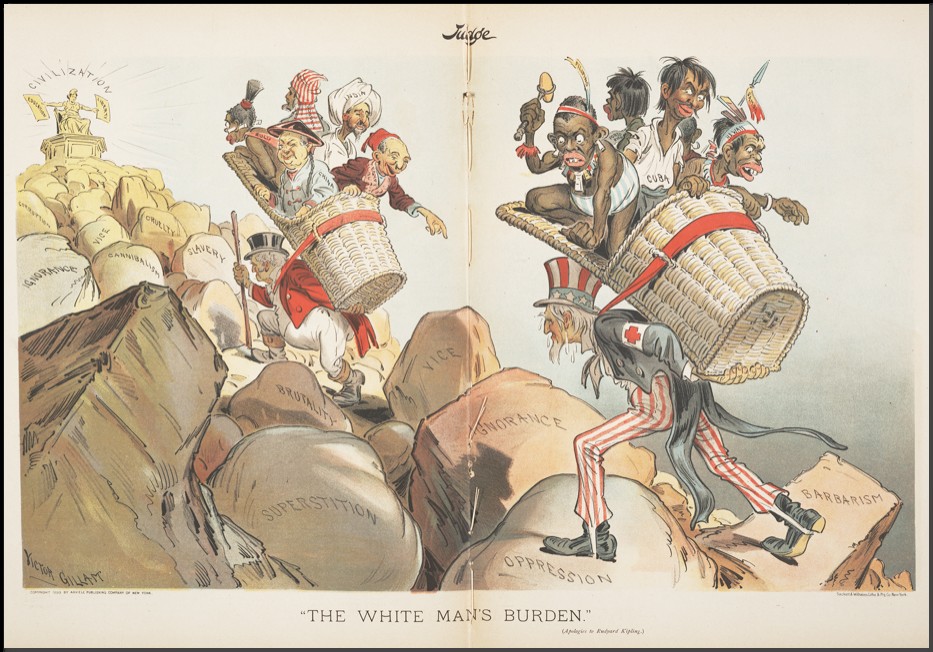
"The White Man's Burden (Apologies to Rudyard Kipling)" (Judge, 1899)
Uncle Sam and John Bull carry their "burden" uphill, Judge, April 1899
Victor Gillam's 1899 Judge cartoon shows Uncle Sam and John Bull carrying caricatured colonial peoples up a slope toward "Civilization." Public domain.
Techniques named on the archive record
TransferGlittering generalities
Date
April 1, 1899
Made by
Judge magazine
Medium
Cartoon
Country
United States
Regime
Mckinley Administration
Source
Identified Openly sourced: the speaker is who they say they are
Source
Wikimedia Commons , retrieved September 27, 2026
Source
Public domain (published in the U.S. in 1899) Victor Gillam, "The White Man's Burden (Apologies to Rudyard Kipling)", Judge, 1 April 1899
Object, image, and catalog record from the FRAME archive. Text on this page is CC BY 4.0. Image rights are as the archive records.
Victor Gillam's cartoon for Judge of 1 April 1899 shows Uncle Sam and John Bull hauling baskets of racially caricatured colonial peoples up a rocky slope toward "Civilization," borrowing the title of Kipling's poem.
What the cartoon shows
Content note: the figures in the baskets are racist caricatures of the peoples named on them. This page lists the labels as printed and does not repeat the drawing's features.
Two men climb a steep, rocky path, Uncle Sam and John Bull, each carrying a basket. The figures in the baskets carry labels: Zulu, India, China, Hawaii, Cuba, Porto Rico. The rocks along the way are lettered with vices. At the top of the slope are the words Civilization, Education, and Liberty.
"THE WHITE MAN'S BURDEN." (Apologies to Rudyard Kipling.)
Who made it
Victor Gillam drew it for Judge, the New York humor weekly, which ran it on 1 April 1899. The archive files it under the McKinley administration and the Philippine-American War, and the scan comes from Wikimedia Commons. It is a private magazine's cartoon, not a government poster. The same artist drew the Remember the Maine album page for Judge a year earlier.
How to read it
The archive tags the cartoon for transfer and glittering generalities. The title borrows the prestige of Kipling's poem. The summit borrows three of the best words a republic has, Liberty among them. Then the picture spends them on a claim the words do not support: that the people in the baskets are cargo, unable to climb, and that carrying them is a sacrifice by the carriers.
That framing hides the most important fact about the moment. The Philippines is not among the labels, yet the archive files the cartoon under the Philippine-American War, and for good reason: a burden carried uphill is a gentler picture than a war. In the Philippines, Americans were fighting a government that had declared itself independent, as the site's case study on benevolent assimilation sets out. A basket has no room for a republic.
The racism is the method, not a side detail. Every vice on the rocks is placed on the path of the carried peoples, none on the carriers. Liberty at the top is something to be delivered, not something the people in the baskets might already claim. That was wrong in 1899, and Americans at the time said so. The cartoon's free publication was part of the same open argument.
Sources
FRAME object record, "The White Man's Burden (Apologies to Rudyard Kipling)," Judge, 1 April 1899. Victor Gillam.
Wikimedia Commons, "The White Man's Burden" Judge 1899, retrieved by the archive 27 September 2026. Rights as recorded: public domain, published in the U.S. in 1899.
FRAME case study on the Philippine-American War, as summarized on this site.