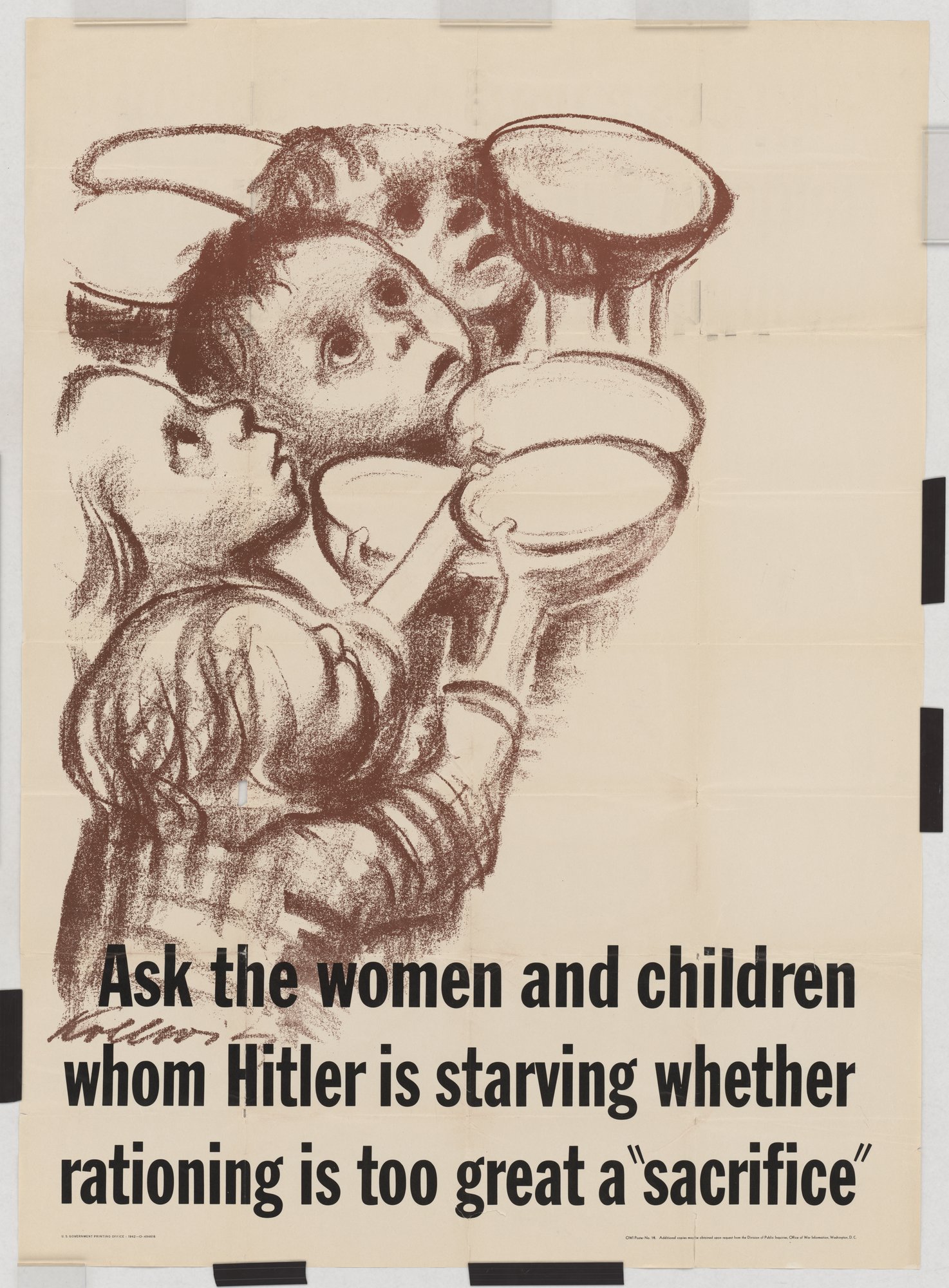
OWI Poster No. 18, printed in 1942, sets a brown crayon drawing of gaunt children holding up empty bowls above a question: ask the women and children whom Hitler is starving whether rationing is too great a "sacrifice." The drawing carries the signature Kollwitz (NAID 513836).
The sheet
Most of the space is the drawing: children with hollow eyes and thin faces, bowls held up and empty, done in brown crayon. The question runs beneath them in three lines. The word "sacrifice" sits inside quotation marks on the poster itself.
Ask the women and children
whom Hitler is starving whether
rationing is too great a "sacrifice"
[signature: Kollwitz (handwritten, partly legible)]
[imprint: U. S. GOVERNMENT PRINTING OFFICE : 1942—O—494616]
[imprint: OWI Poster No. 18. Additional copies may be obtained upon request from the Division of Public Inquiries, Office of War Information, Washington, D. C.]
Origin
The Office of War Information numbered it Poster No. 18 and offered additional copies on request from its Division of Public Inquiries; the Government Printing Office imprint gives 1942. The National Archives copy is in Record Group 44, World War II Posters, 44-PA-384 (NAID 513836). The archive notes that the drawing is attributed by its signature to an artist outside the poster's issuer. The record does not say how the drawing reached the OWI, and the signature is only partly legible.
The quotation marks
FRAME tags fear appeal and transfer. The comparison is the argument. Next to children who have nothing, an American ration book looks small, and that is a fair point. The American sheets in this file speak of allowances and point values; the 1942 Share the Meat table, for one, asked adults to keep to 2½ pounds of meat a week.
The quotation marks around "sacrifice" do a second job. They do not answer the complaint; they mock the word the complainer used. A shopper who grumbled about a meat allowance, or about a particular rule, is shown up as petty against the starving. The poster leaves no room for a citizen who supported rationing and still thought one rule was badly made.
That is where the libertarian reading parts from the poster without rejecting its point. The point that others had far less stands. Grumbling at a rule is still not disloyalty, and in a republic the people who live under a rule are entitled to call it a sacrifice, with or without quotation marks. The Office of Price Administration's own sheets made the case on fairness instead, as in Rationing Means a Fair Share for All of Us. A later OWI rationing sheet, Poster No. 37 of 1943, Do with less - so they'll have enough!, asked through a smiling soldier with a tin cup instead of a reproach.
Other OWI posters are indexed at the Office of War Information hub, and the rationing sheets on the rationing and price control hub.
Sources
- FRAME object record, Ask the women and children whom Hitler is starving whether rationing is too great a "sacrifice", 1942. Office of War Information (OWI Poster No. 18), drawing signed Kollwitz. Rights as recorded: public domain (U.S. government work).
- U.S. National Archives and Records Administration, Record Group 44, World War II Posters, 44-PA-384, NAID 513836, retrieved by the archive 4 October 2026.