Rationing, price ceilings and the OPA, 1941–1947
During the Second World War and for a year after it, the Office of Price Administration and its partner offices printed posters, counter cards and notices about ration books, ceiling prices, rents and the black market. This hub gathers 68 of those sheets from the FRAME snapshot, with eight new object pages and the essays already on this site.
A war bond could be refused. A ration could not. Between the first gasoline and tire rules and the last price posters of 1946, the federal government told Americans how much meat, sugar, gasoline and shoes they could buy, what a grocer could charge for a loaf of bread, and in some counties what a landlord could charge for a room. The Office of Price Administration, the OPA, ran most of it. Its posters explained the rules, asked for cooperation, and by 1946 called the buyers who paid over the ceiling suckers. This hub collects what the FRAME snapshot holds from that effort and reads it with one question in view: where the sheet was asking, and where it was telling.
Where to start
The gallery has 68 sheets in date order. Twenty-nine name the Office of Price Administration in their maker line. Four carry the seven-key plan of the Office of Economic Stabilization. Nine come from the Office of War Information, six of them cartoon drawings by Charles Alston and Charles Shows. Three come from the War Production Board and the War Food Administration. Eleven name no agency at all; eight of those carry a Government Printing Office imprint. Six were made for campaigns run with merchants: four sponsor sheets for the Share the Meat program, each with a blank panel for local firms, and two from the Grocer-Consumer Anti-Inflation Campaign. The last six are private: a trade association's recapping guide, a bankers' postage emblem, a meat industry advertisement, a Minnesota bank's sheet, and two newspaper cartoons by Jim Berryman.
Fifty-nine of the 68 come from one National Archives series, World War II Posters in Record Group 44. The OWI drawings are in Record Group 208, the Berryman cartoons in the National Archives' Senate records, and one Office of Economic Stabilization poster comes from the University of North Texas. The archive dates eleven sheets to 1941; the gallery keeps the archive's years and does not re-date anything.
The offices
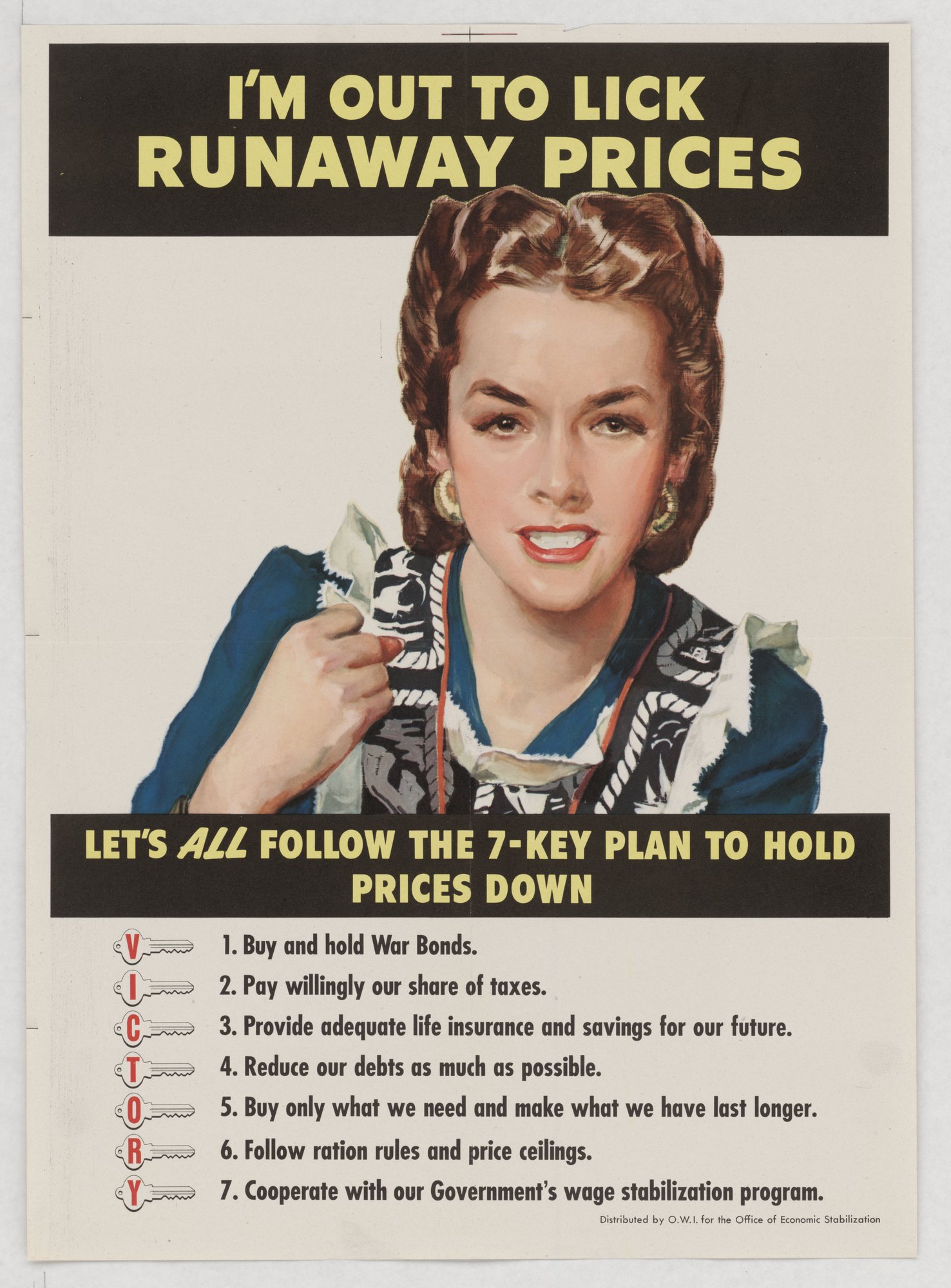
The OPA signed its posters and its notices alike, and the file shows its range: a public chart of gasoline rations, a counter card for pumps, a rent notice for one corner of Washington State, price lists for grocers, and slogans for everyone. The Office of Economic Stabilization spoke through one recurring device, seven keys spelling VICTORY, that bundled war bonds, taxes, savings, debt, thrift, ration rules and wage stabilization into one list. The OWI distributed for both and drew its own rationing cartoons. The War Production Board's Foods Requirement Committee issued the 1942 Share the Meat table, and the War Food Administration put rationing on a kitchen checklist that asked families to score themselves on "accepting rationing cheerfully."
Ration books, coupons and points
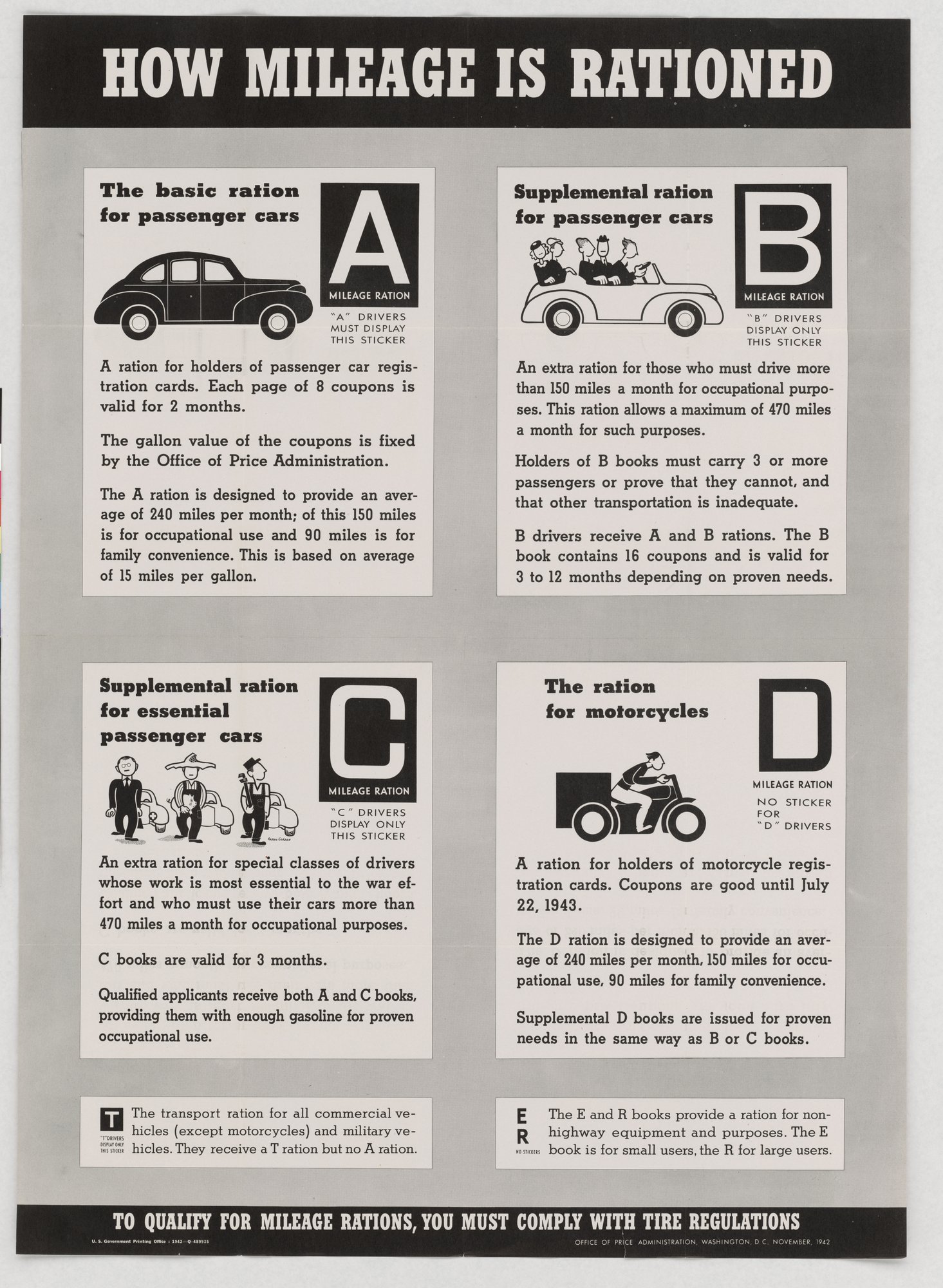
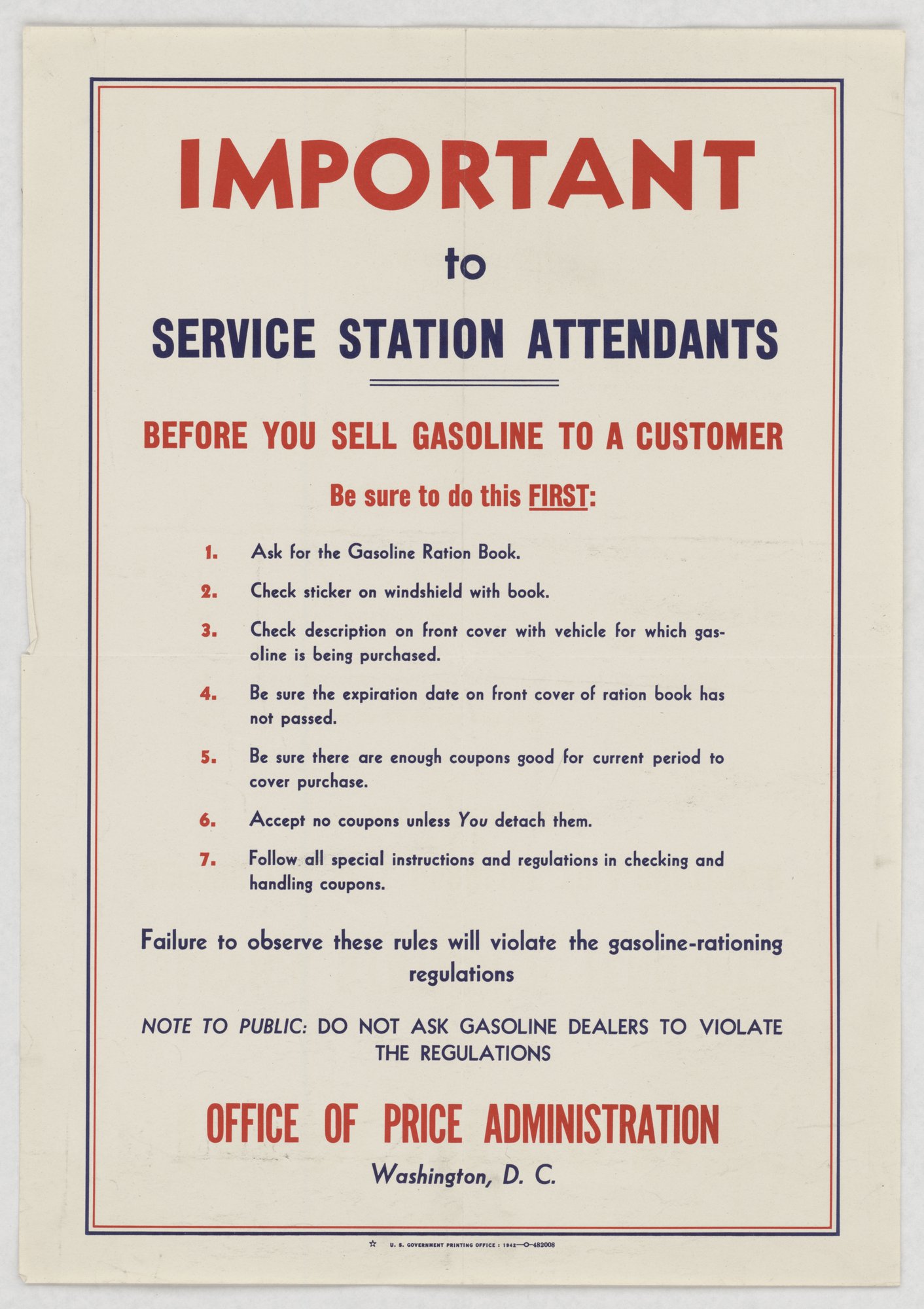
The clearest rationing sheets are the dullest to look at. How Mileage Is Rationed lays out the A, B and C gasoline books, with their windshield stickers, the 240-mile monthly average behind the basic ration, and the proof a driver needed for more. Important to Service Station Attendants turns the pump attendant into the checker. How to Shop with War Ration Book Two explains blue point stamps for canned and frozen foods. An OPA tire sheet dated 1941 by the archive offers an official tire inspection for 25 cents and an attendant's signature on the "Tire Inspection Record."
Meat was handled more softly at first. The War Production Board's poster Americans! Share the Meat said that "a Government order limits the amount of meat delivered to stores and restaurants," and then asked civilians to hold to 2½ pounds a week. The merchant sheets for the same program, among them Share the Meat, called it "America's Honor System." The American Meat Institute's advertisement spoke of a "voluntary rationing plan." By 1943 meat had point values, and Alston's OWI cartoon "Equal Protection for All" holds up Ration Book Two in front of the official point table. The record shows the same food moving from request to rule.
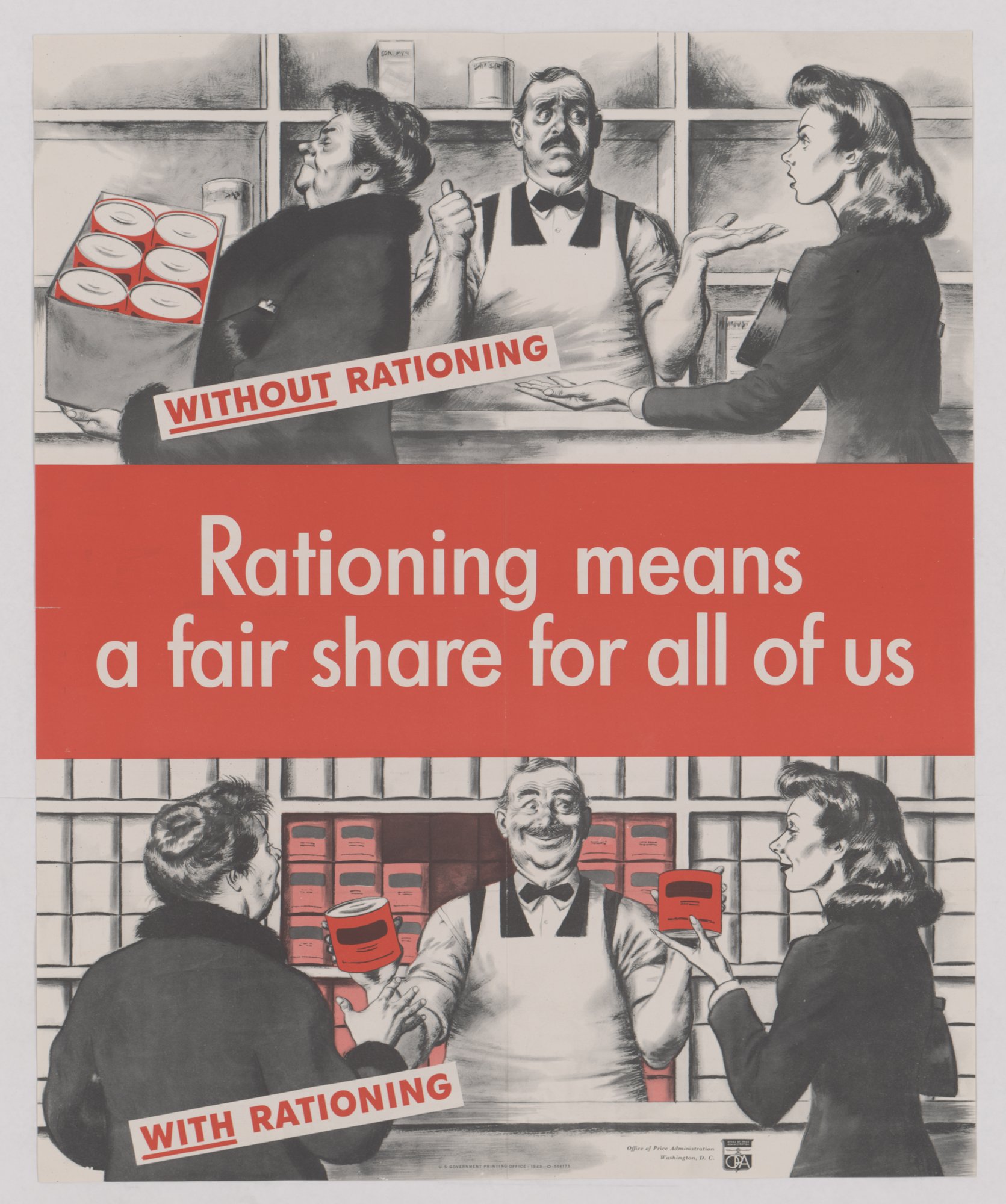
The persuasion posters argued for the rule on fairness. Rationing Safeguards Your Share promised protection with an empty basket beside full shelves. Rationing Means a Fair Share for All of Us set a shopper carrying off a box of cans against a grocer serving two women alike. One OPA sheet is type alone: "Rationing is sharing with our fighters and neighbors." The OWI's Ask the Women and Children Whom Hitler Is Starving argued on comparison instead, and put "sacrifice" in quotation marks.
Ceilings, price lists and rents
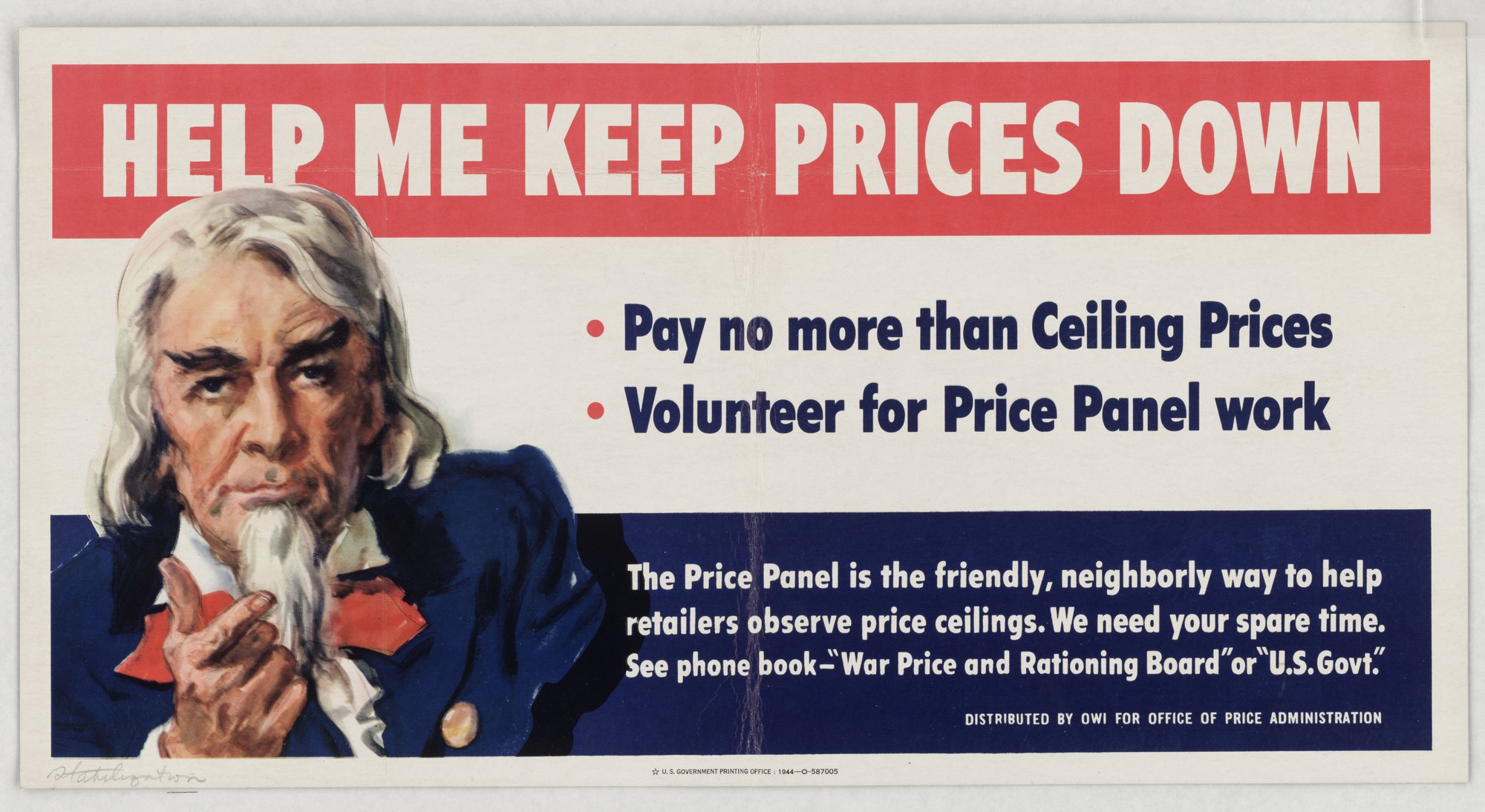
Price control asked the shopper to become an inspector. An OPA leaflet the archive dates to 1941, How to Keep Your Food Bill Down, tells her to clip the agency's list of top legal prices from the paper, compare it in the store, and mail any overcharge to the rationing board, where a price panel would ask the retailer to comply. It also prints the maximum penalty for wilful violators: one year in jail and a $5000 fine. Store banners such as "We post 'em, you check 'em" and the OPA's "New Ceiling Price Lists Are Here!" put the lists on the wall. Help Me Keep Prices Down asked readers to staff the price panels as volunteers.
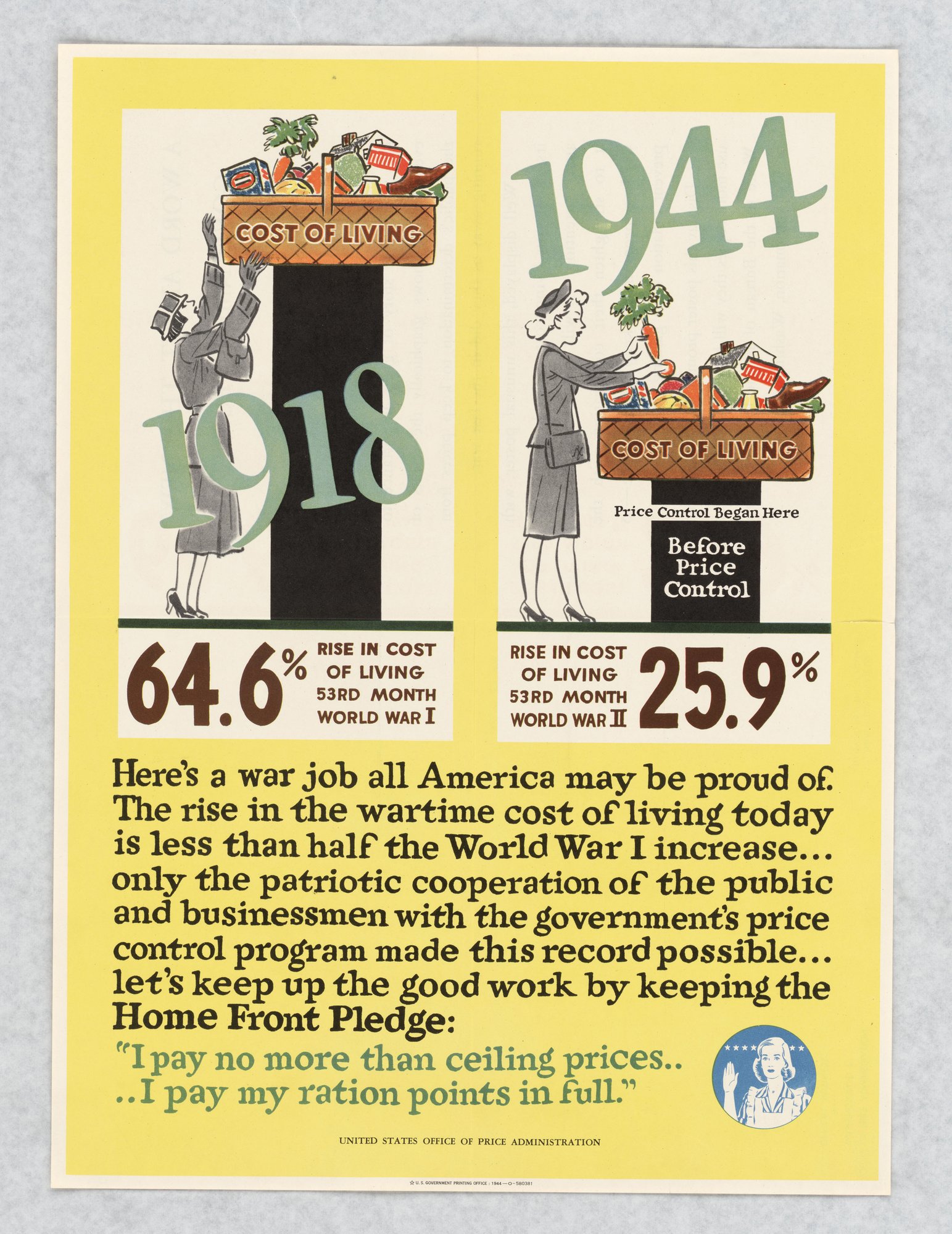
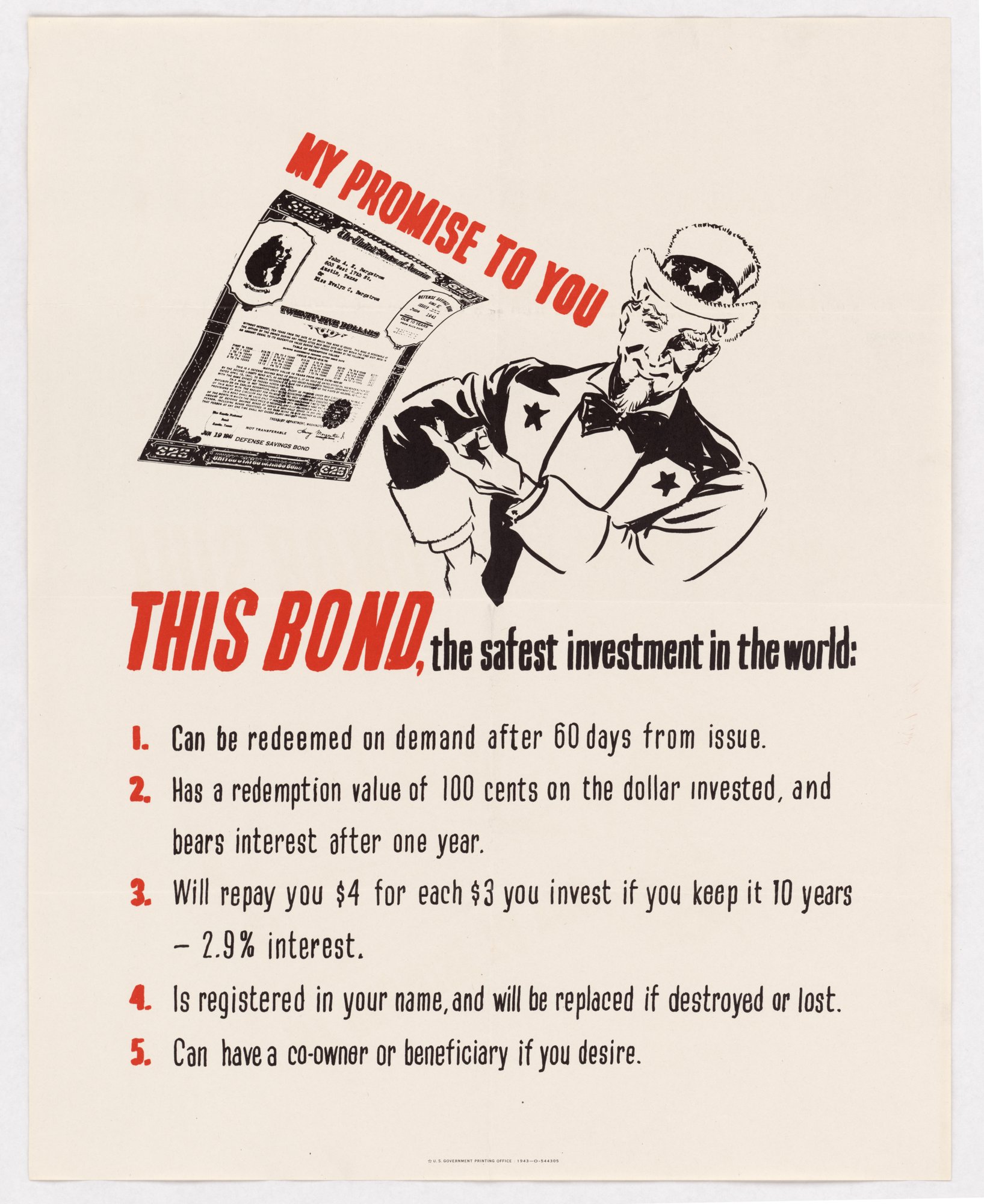
Merchants were enlisted by pledge. A shopkeeper in shirt and bow tie raises his hand over "I charge no more than Top Legal Prices," and a woman in an apron makes the matching consumer pledge. The Grocer-Consumer Anti-Inflation Campaign gave stores a window emblem with clasped hands and the promise "We charge only ceiling prices or less." The OPA's 1944 Cost of Living poster then claimed the result: a 25.9 percent rise by the 53rd month of this war against 64.6 percent in the last.
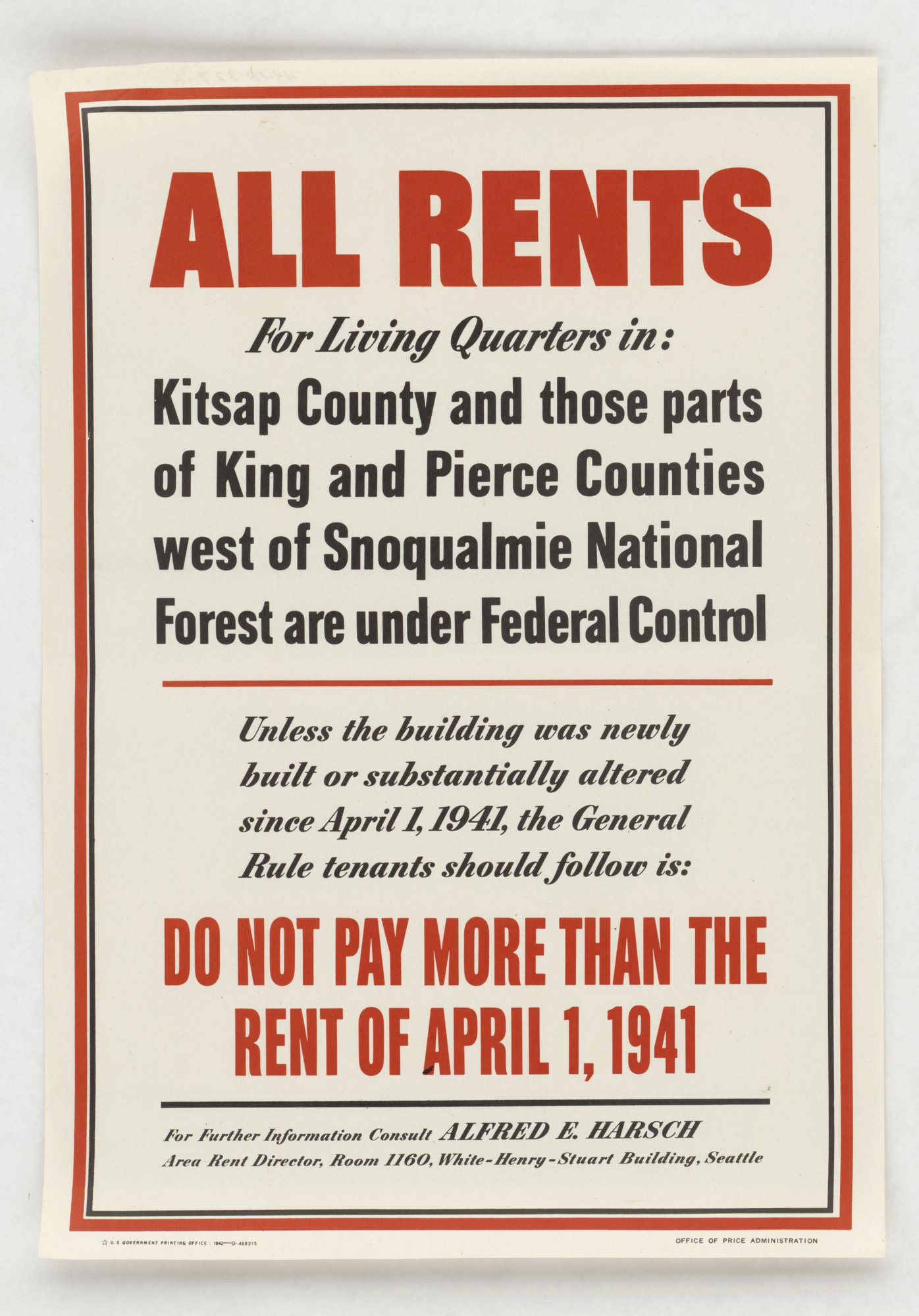
Rent control appears once, but plainly. All Rents Under Federal Control told tenants in Kitsap County and parts of King and Pierce Counties not to pay more than the rent of April 1, 1941, and named the area rent director and his room number in Seattle.
The black market
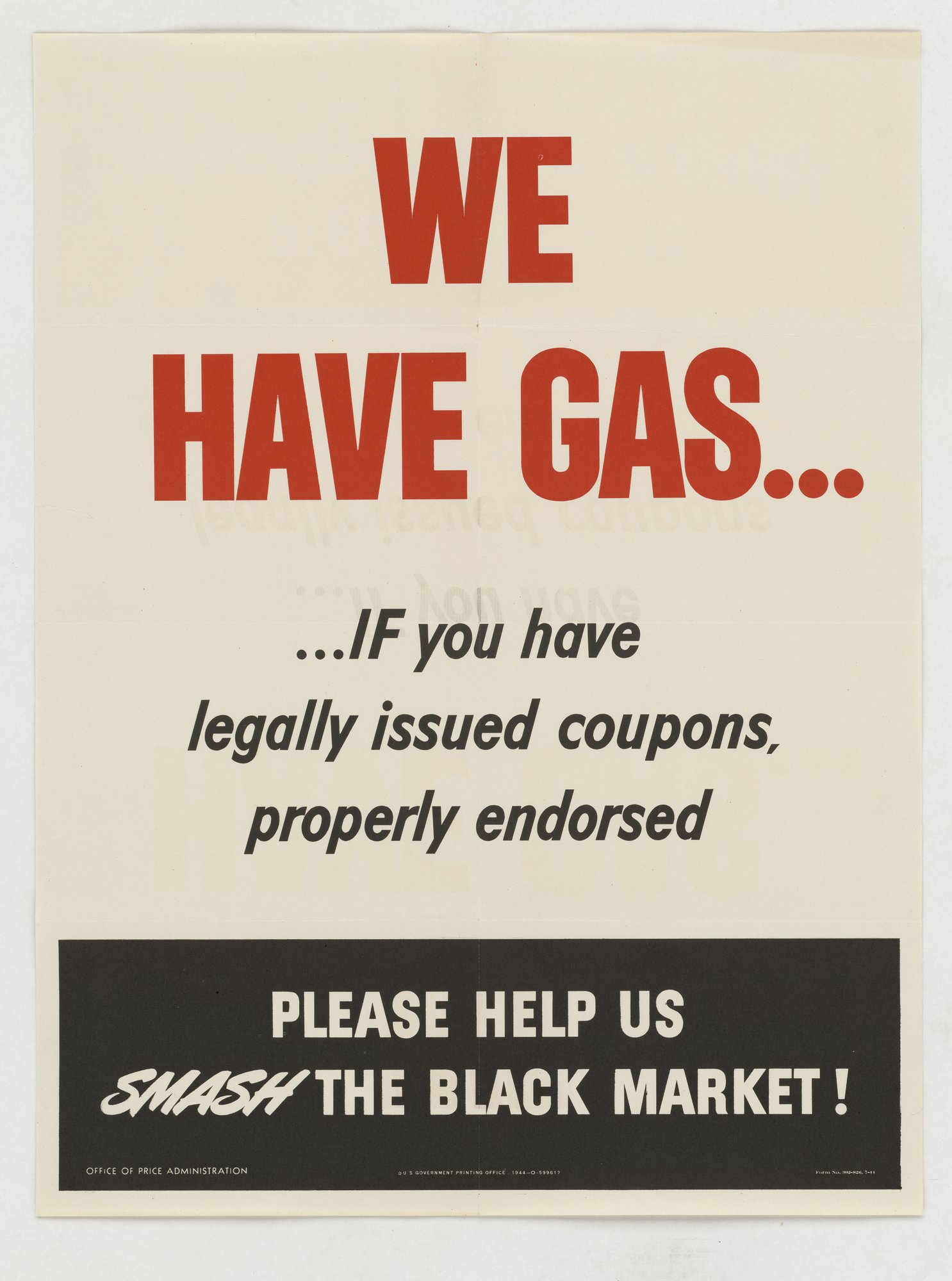
As far as these sheets go, the black market meant a sale above the ceiling, or a sale of rationed goods without stamps or coupons. None of the posters says how large it was. They show that the OPA and the OWI treated it as real enough to fight in print, from the war years into 1946. In 1943 government sheets told buyers to "Kill the black market with your ration stamps" and added, "It takes two to make a black market." Stamp Out Black Markets drew the dealer as a green-skinned caricature. Alston's OWI cartoons put Hitler over a black-market doorway and, in Turn the Spotlight on the Traitor!!, called the dealer a traitor. In 1944 the OPA's filling-station cards asked customers to help "smash the black market," and We Have Gas sold fuel only for "legally issued coupons, properly endorsed."
The 1946 posters went further. Sucker! shows a $2.00 tag stuck in a carton stenciled "OPA ceiling price $1.00." Sucker! If You Pay Over Ceiling Prices slides a black-market steak toward a five-dollar bill. Don't Feed Black Market Greed lists the goods being swallowed, from meat and nylons to refrigerators. The two Sucker! sheets aim the insult at the buyer.
After the shooting stopped
The OPA kept printing. Its 1946 sheets no longer mention the troops; they talk about overcharges and inflation. Help Your OPA Fight Inflation runs a chain from rising prices to lost jobs, and Report Over Ceiling Prices to the OPA promises "The goods are coming." The newspaper cartoons in the gallery catch the public mood from outside the agency. In Jim Berryman's February 1946 cartoon for the Washington Evening Star, an Arizona cowboy asks who would arrest him for butchering his own beef: "TH'O.P.A. OR THEM F.B.I. BOYS?" In November 1947 Berryman put "J. Public" in a ring against two opponents, "Inflation at Home" and "Communism in Europe." The latest sheet in the file that the OPA itself signed is dated 1946.
How this site reads the record
Three questions are honestly open, and on each the site takes the reading that looks hardest at coercion. It is this site's reading, not a finding of the archive.
First, compulsion and shared sacrifice. Both words are true of this file. Rationing was a rule backed by penalties, and the OPA's plainer notices said so. It was also a real answer to real shortages, and the fairness posters made an honest case: without a ration, the woman who could shop only after work found the meat gone, as the Share the Meat sheet Play Fair drew it. A citizen could accept that case. The libertarian point is that accepting it does not turn a rule into a free choice, and posters that spoke of honor systems and pledges sometimes blurred which was which.
Second, the vocabulary of the black market. Paying over a ceiling was against the law, and the sheets were entitled to say so. "Traitor" and "Sucker!" are another matter. One borrows the name of the only crime the Constitution defines and pins it on a price offense; the other mocks the citizen the agency needed on its side. Neither was necessary to state the rule.
Third, informing. The price-control system ran on shoppers checking prices and reporting stores, and on volunteer panels hearing the cases. That is local self-government, and it deserves credit. It also put neighbors in charge of policing neighbors' businesses, with federal penalties behind them, and a 1944 poster called it "friendly, neighborly." Both descriptions belong in the record.
What this hub does not cover
Salvage and scrap drives, fat collection, tire conservation sheets from the Army and the Office of Defense Transportation, car-sharing and travel-restraint posters, and victory gardens are left out unless the sheet names rationing or prices; America Needs Your Scrap Rubber and Use It Up, Wear It Out, Make It Do! are on this site as separate pages. Wartime housing appeals, such as War Workers Need Rooms, are not rent control and are not in the gallery. War bonds are at their own hub, except the one inflation sheet the two campaigns share. The World War I Food Administration's sugar card and penalty notices are on the World War I home-front hub, and the office that distributed many of these posters is at the Office of War Information hub. The offices around the OPA, from the Office of Censorship to the OWI, are set out in the Roosevelt administration essay.
 United StatesUS rationing and price-control poster gallery
 United StatesHow Mileage Is Rationed
 United StatesImportant to Service Station Attendants
 United StatesWe Have Gas... If You Have Coupons (1944)
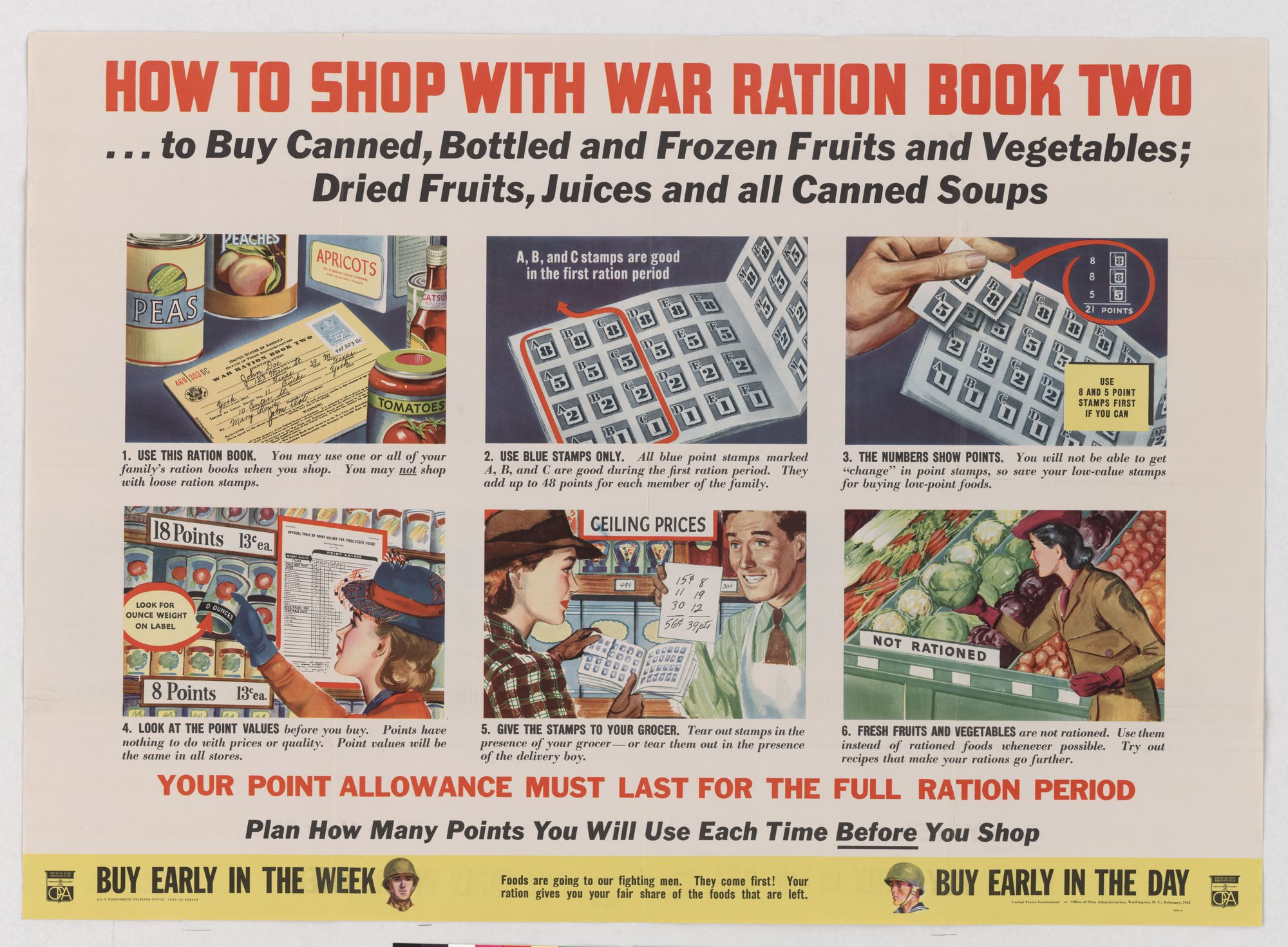 United StatesHow to Shop with War Ration Book Two
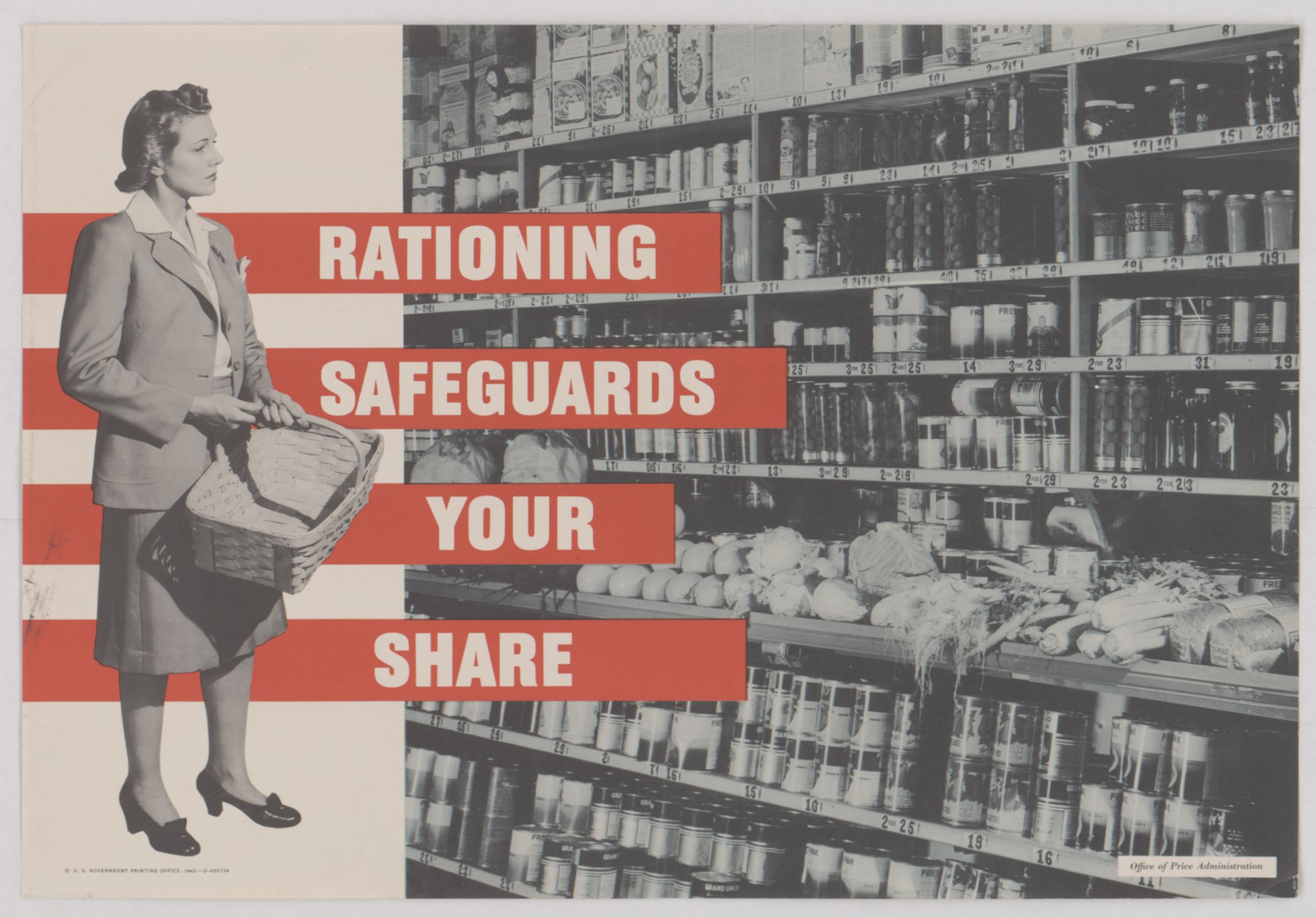 United StatesRationing Safeguards Your ShareUnited StatesRationing Means a Fair Share
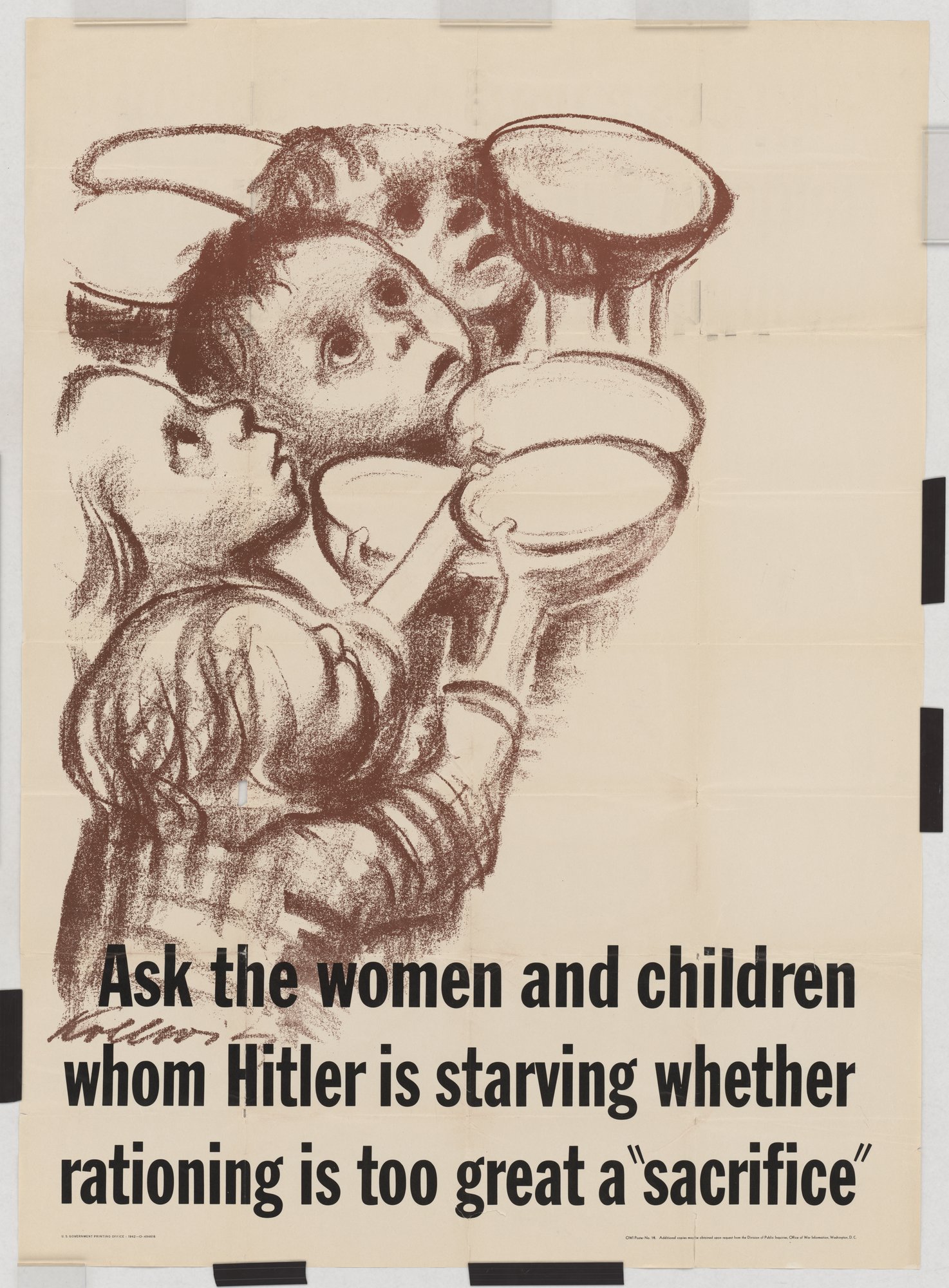 United StatesAsk the Women and Children Whom Hitler Is Starving
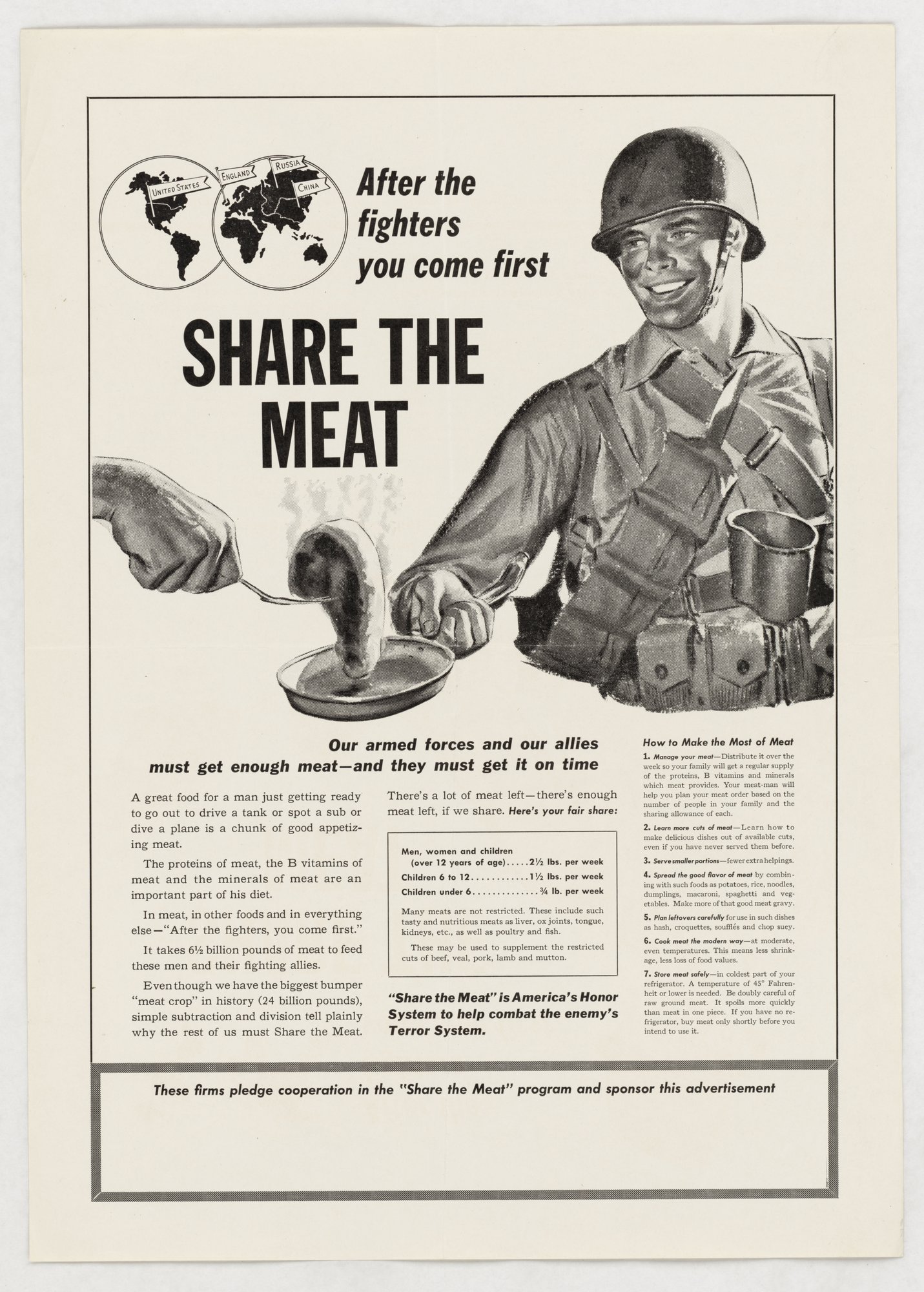 United StatesShare the Meat
 United StatesAll Rents Under Federal Control (Kitsap County)
 United StatesHelp Me Keep Prices Down
 United StatesCost of Living, 1918 and 1944
 United StatesI'm Out to Lick Runaway Prices
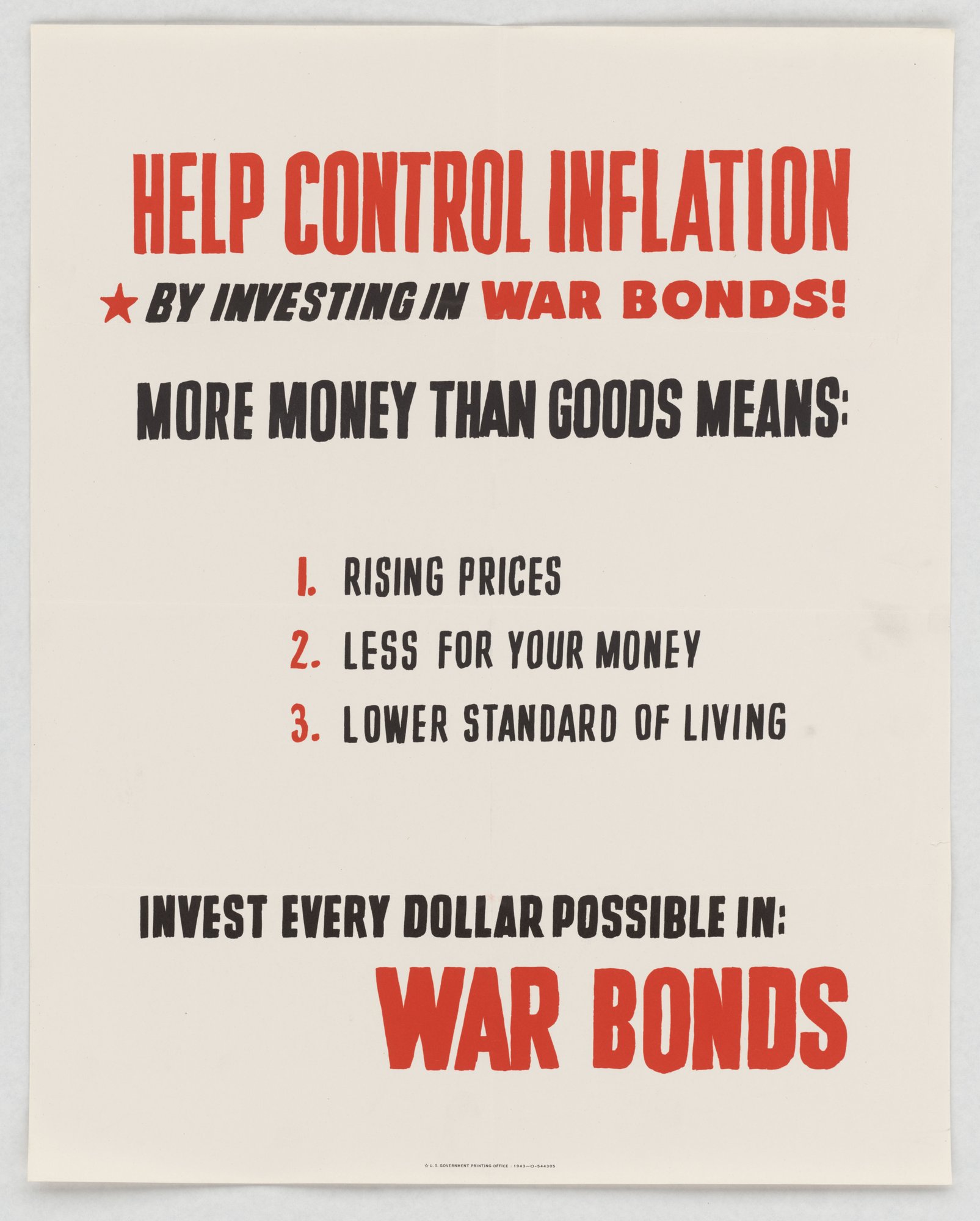 United StatesHelp Control Inflation by Investing in War Bonds!
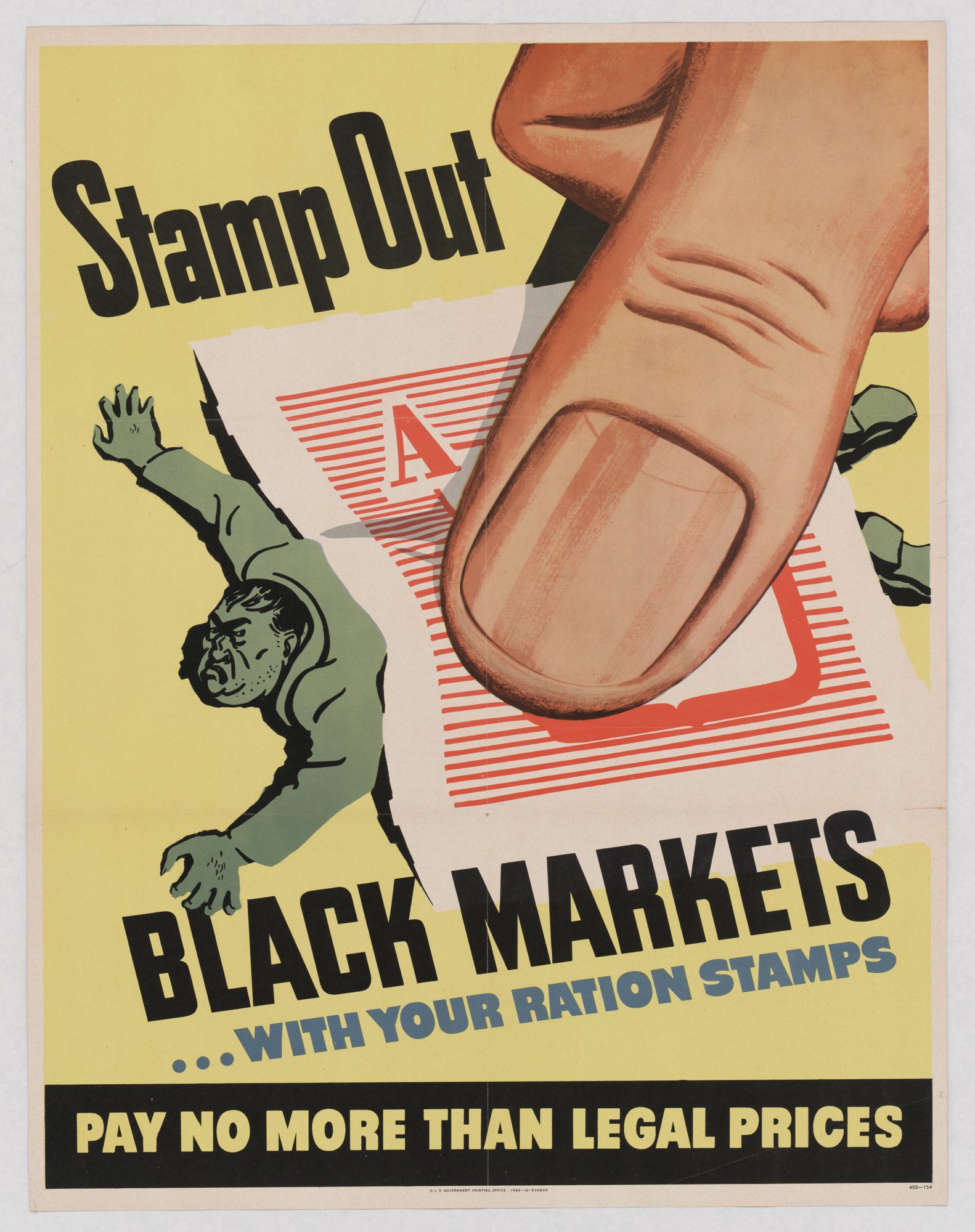 United StatesStamp Out Black Markets
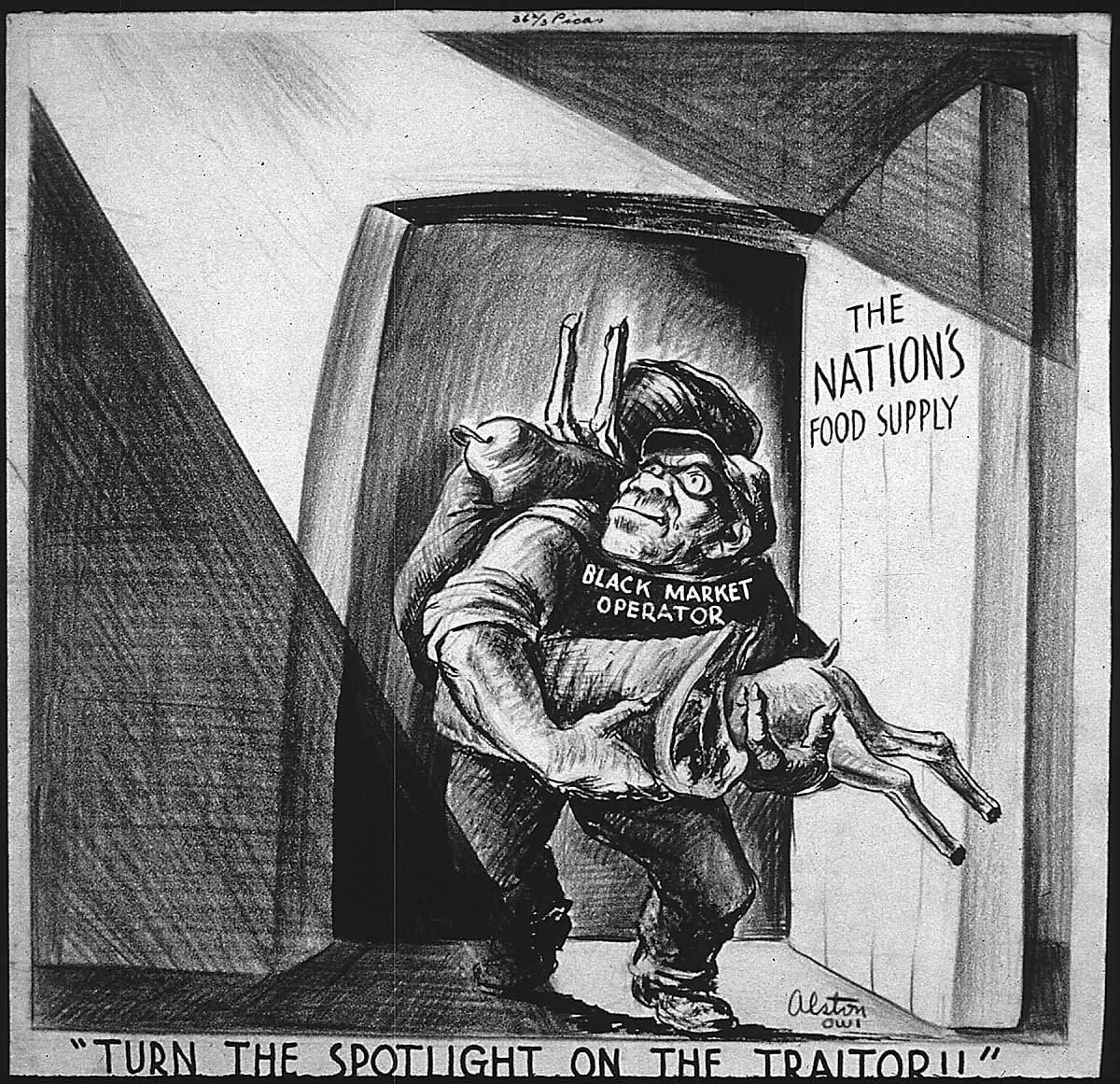 United StatesTurn the Spotlight on the Traitor!!
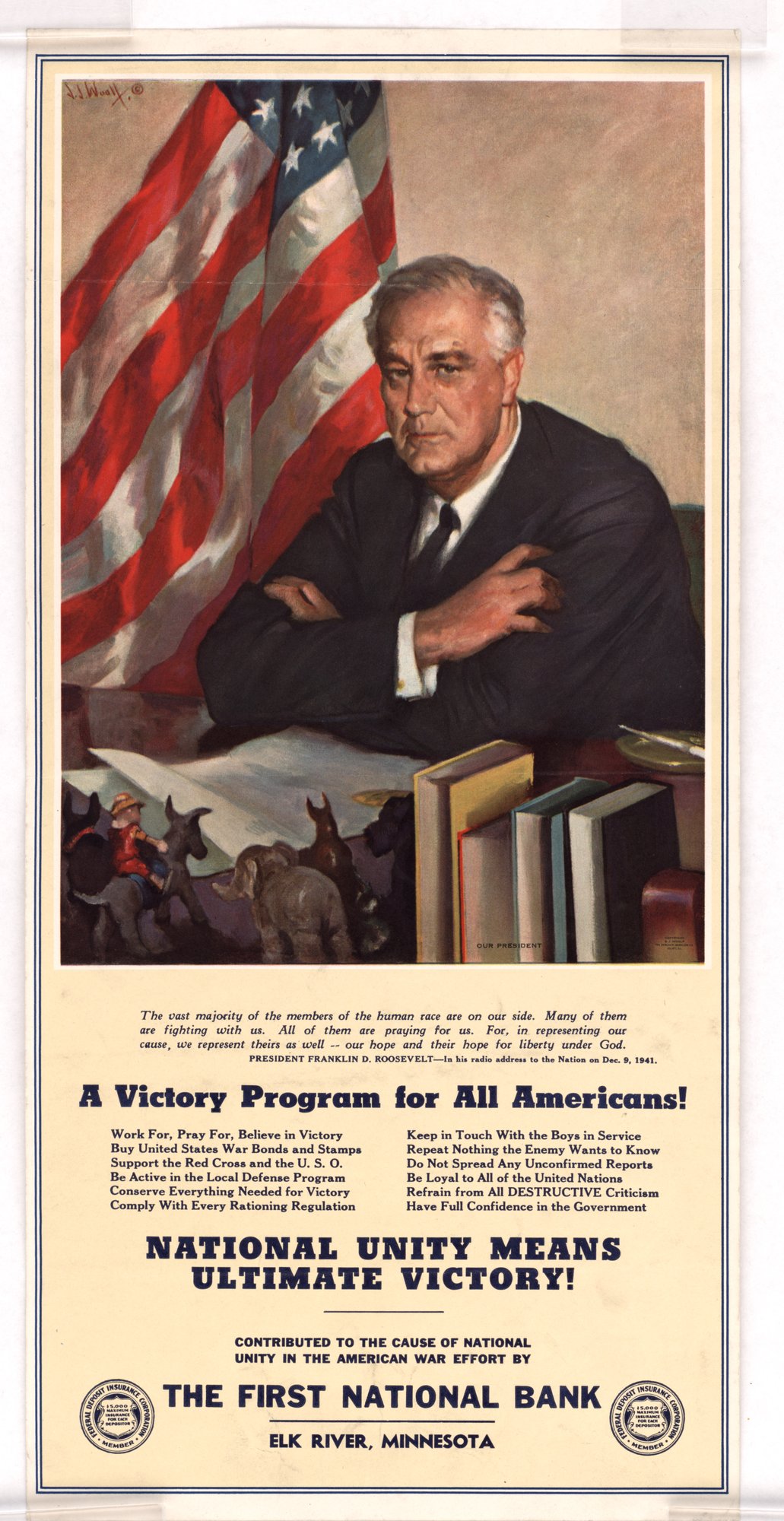 United StatesNational Unity Means Ultimate Victory!
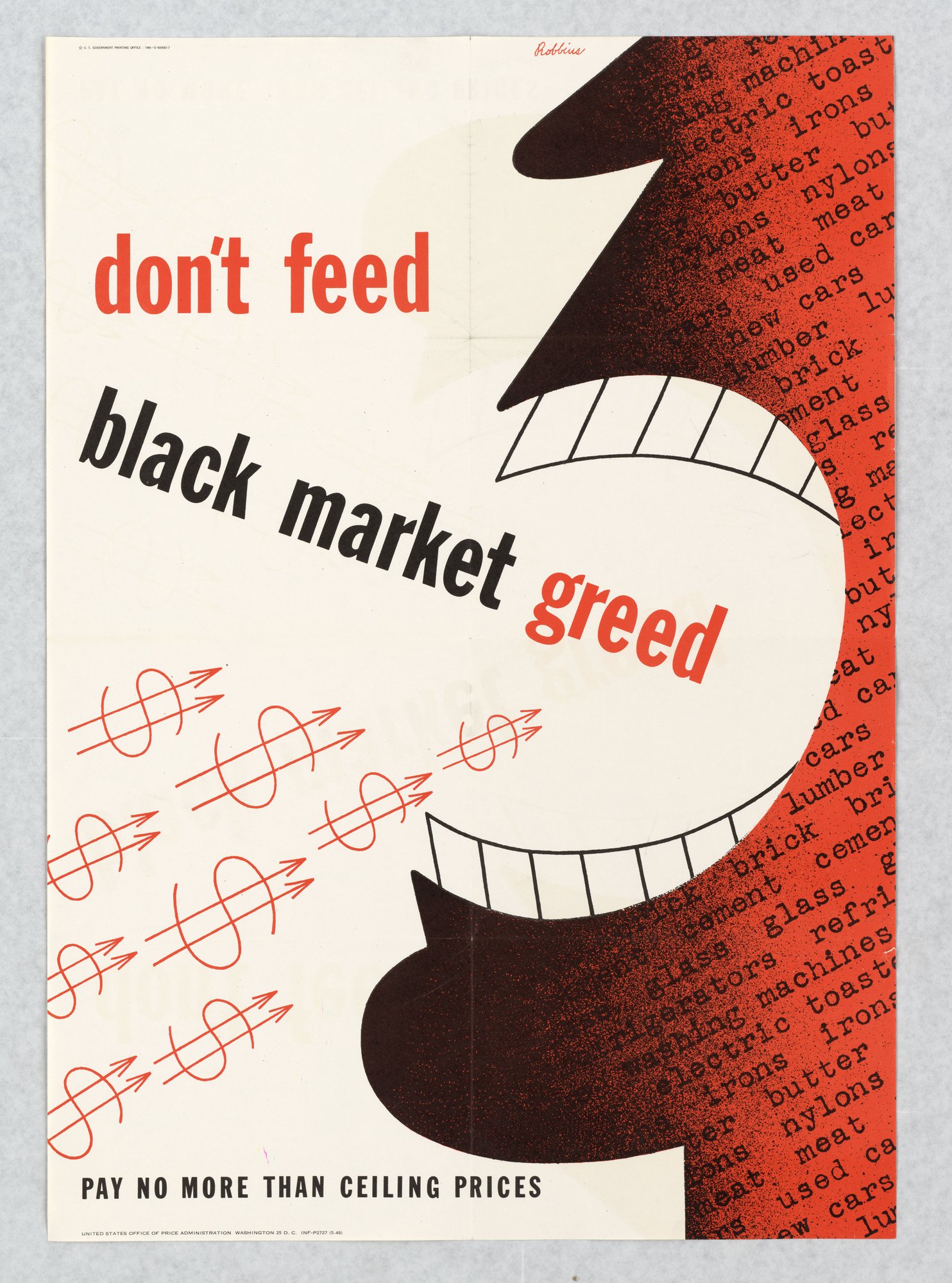 United StatesDon't Feed Black Market Greed (1946)
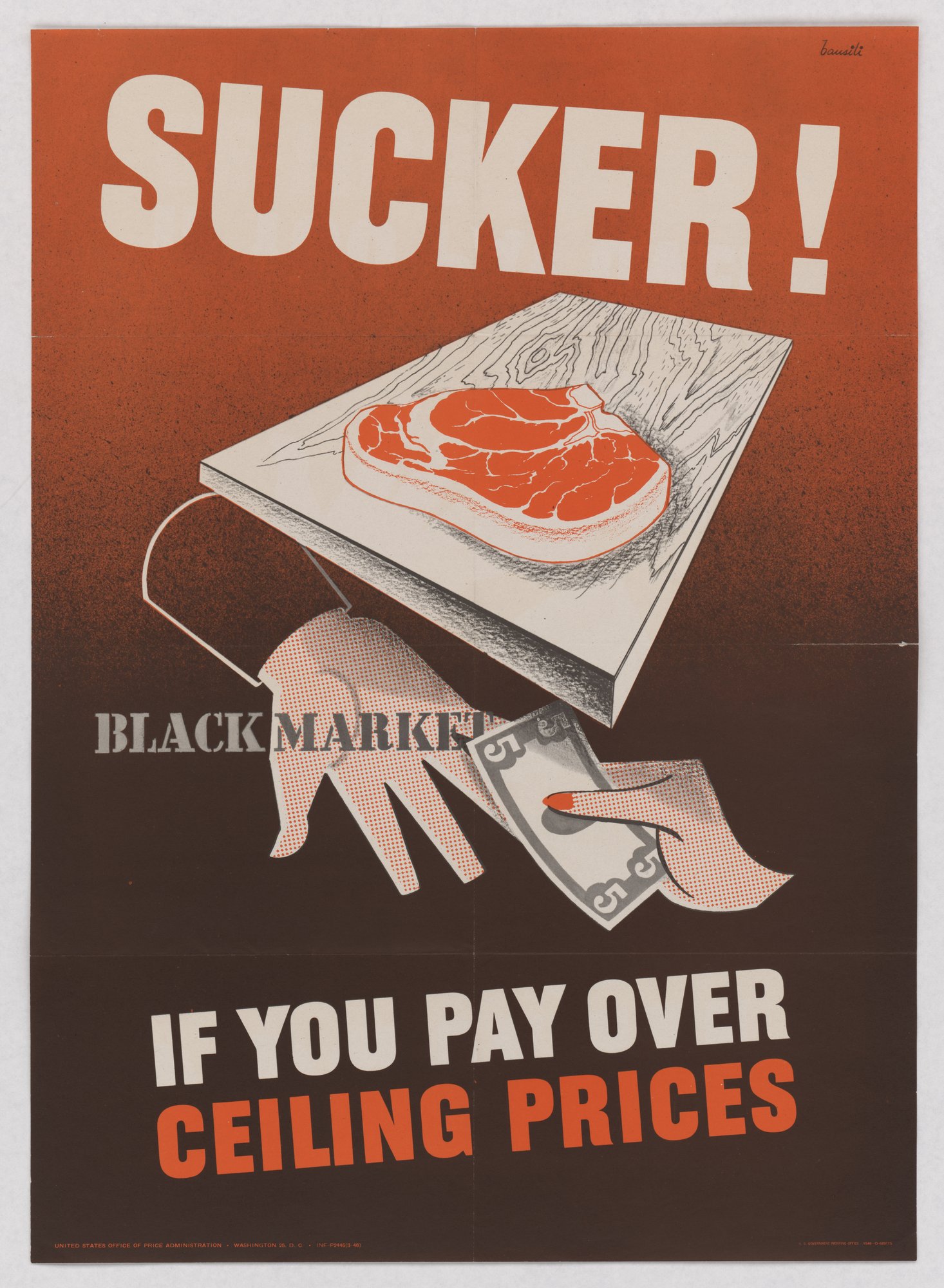 United StatesSucker! If You Pay Over Ceiling Prices
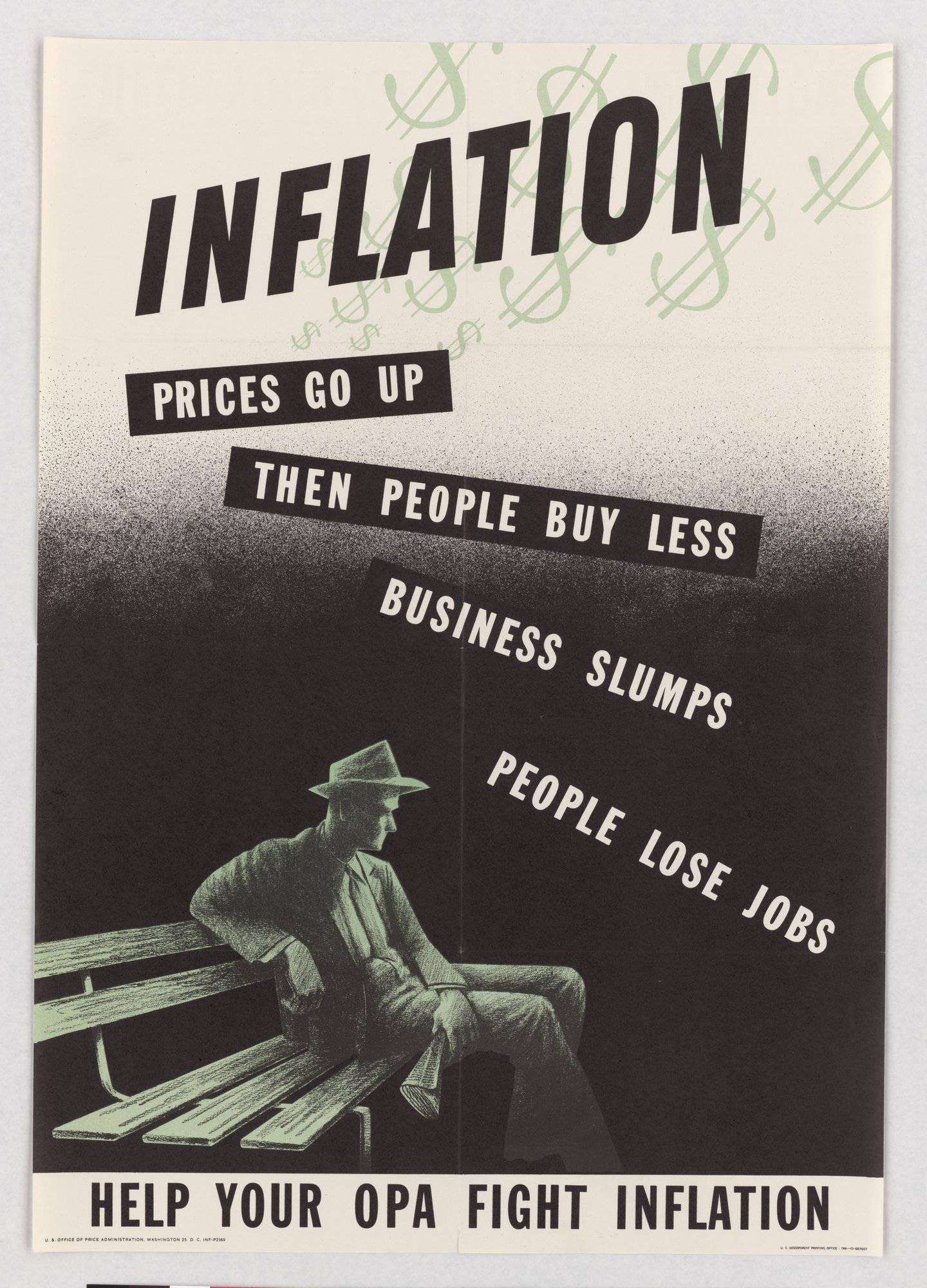 United StatesHelp Your OPA Fight Inflation
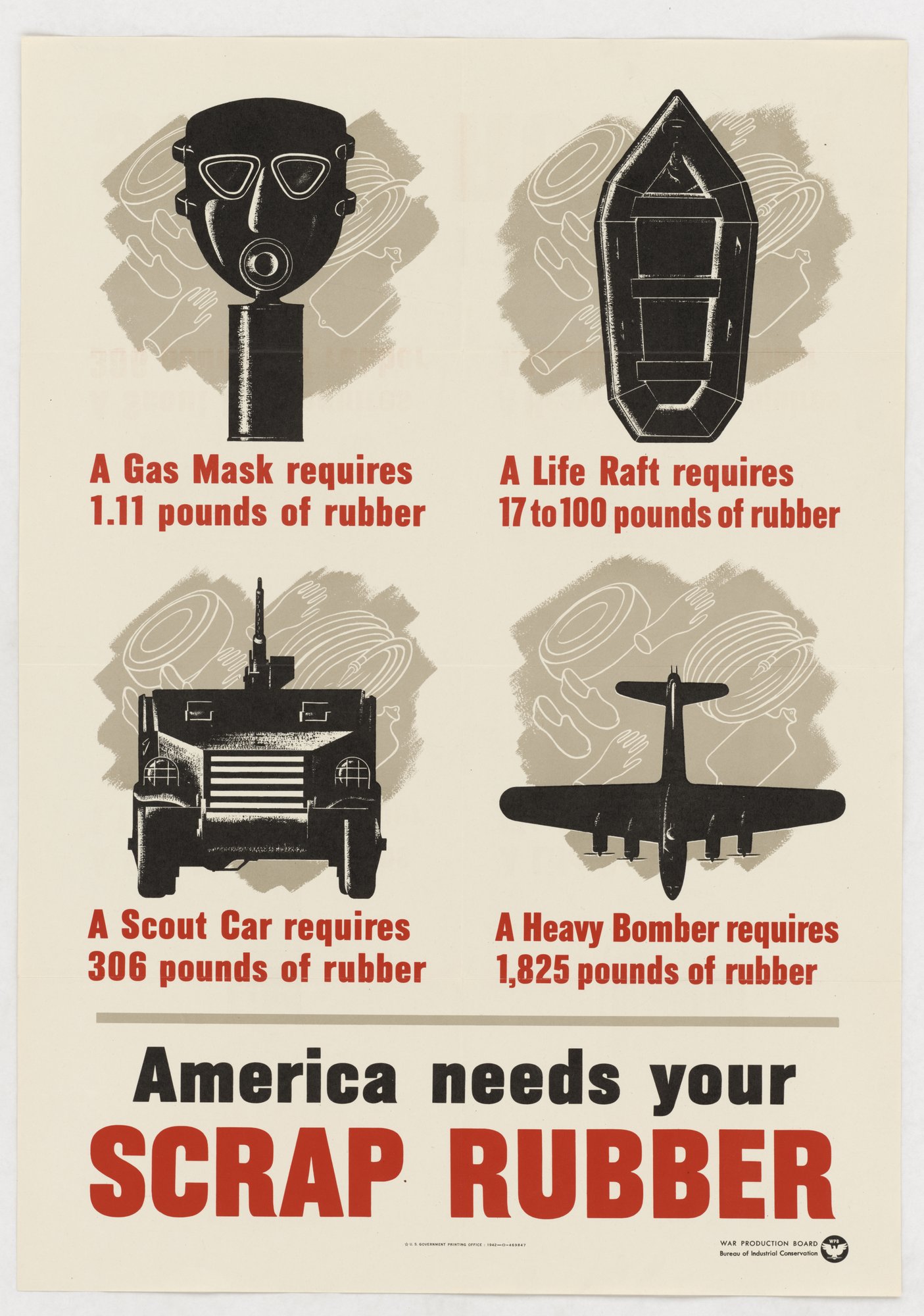 United StatesAmerica Needs Your Scrap Rubber
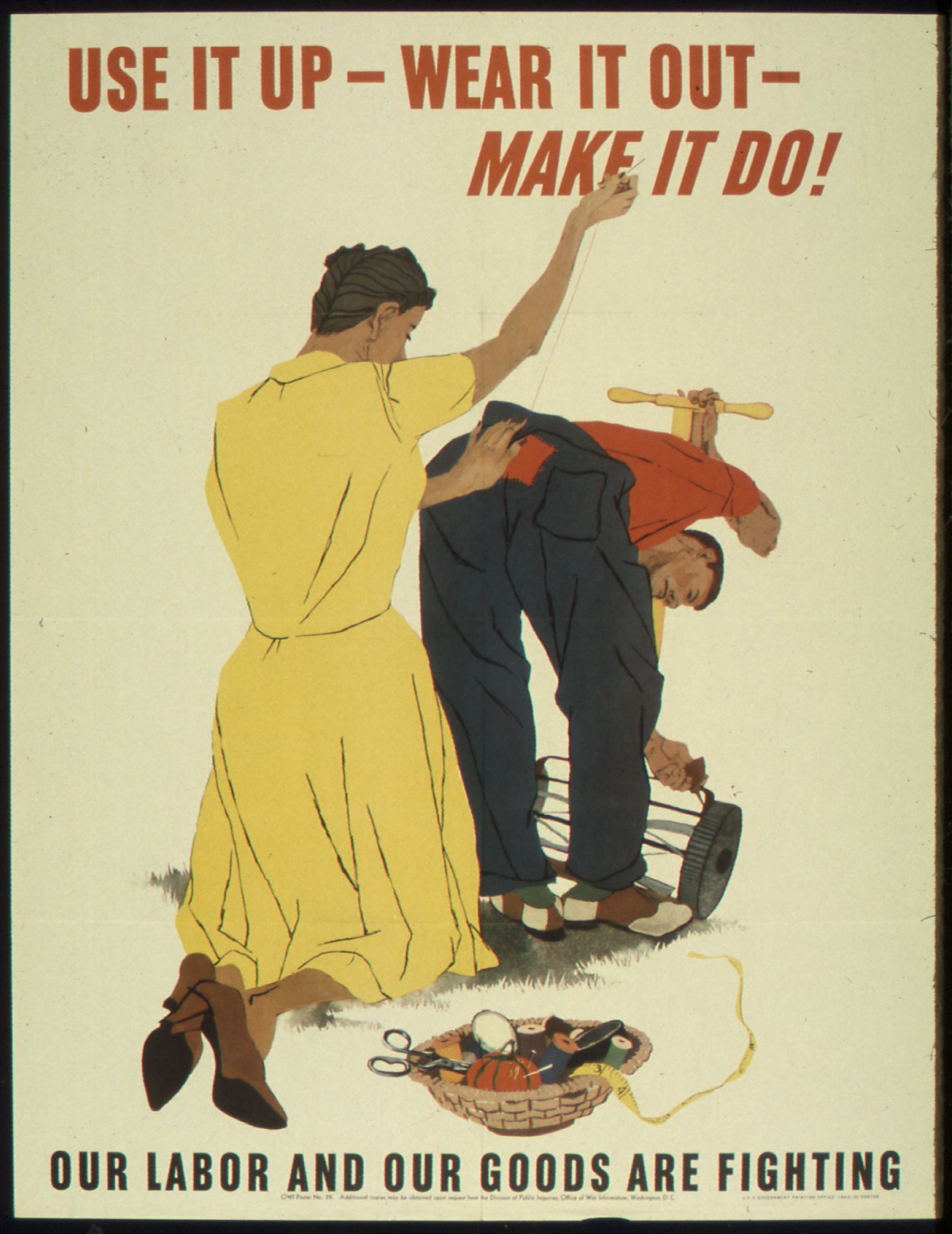 United StatesUse It Up, Wear It Out, Make It Do
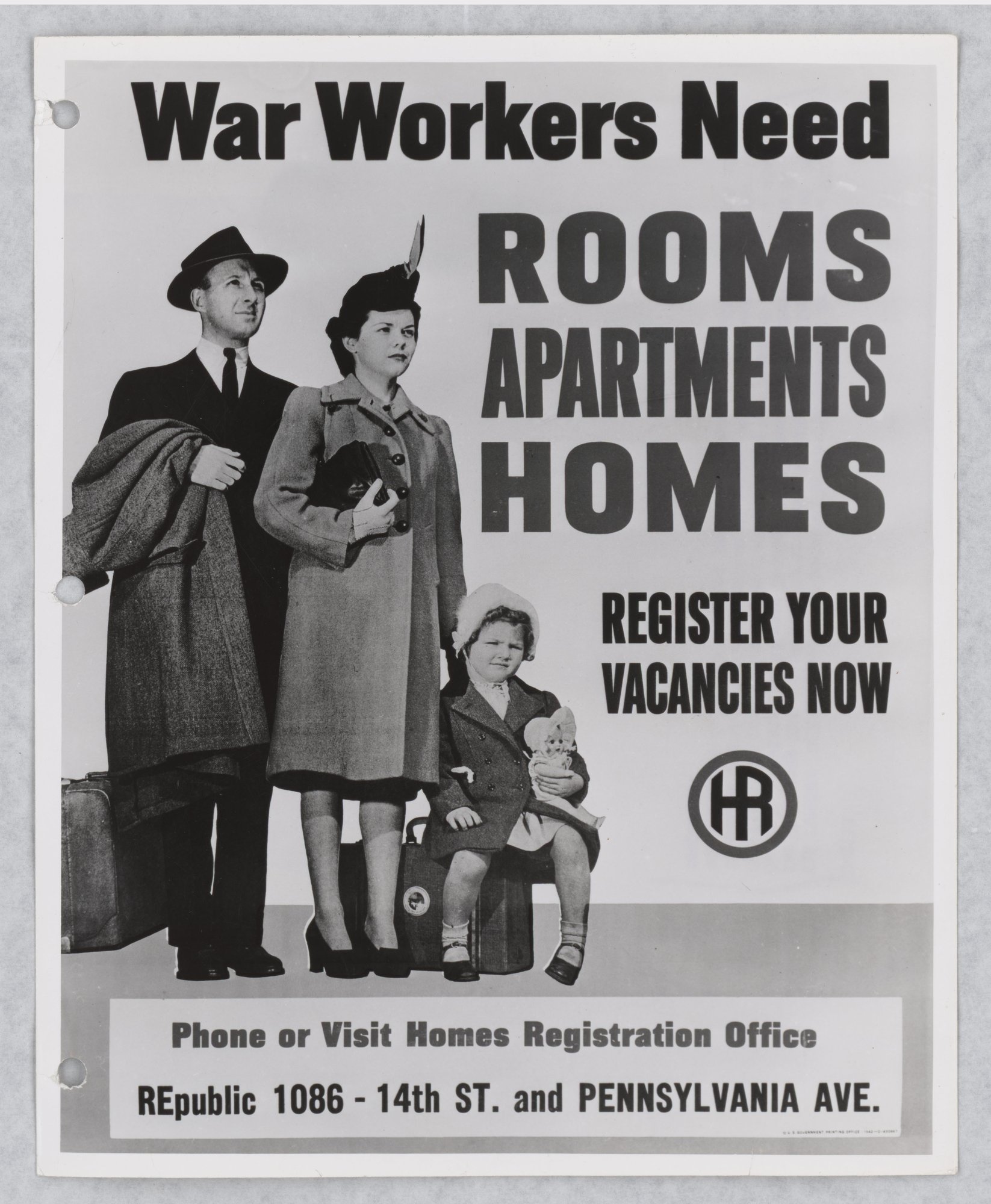 United StatesWar Workers Need Rooms, Apartments, Homes
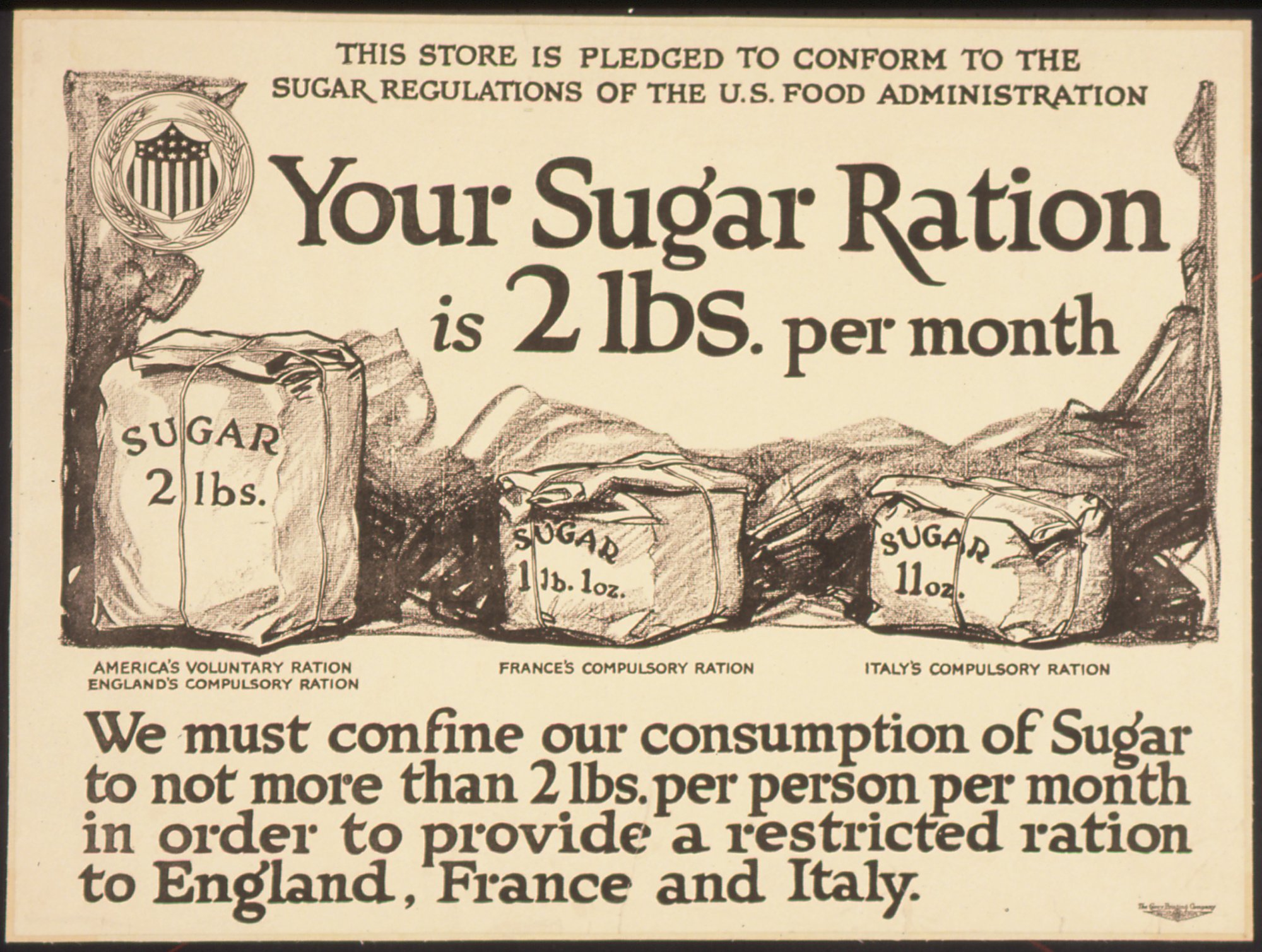 United StatesYour Sugar Ration Is 2 lbs. per Month
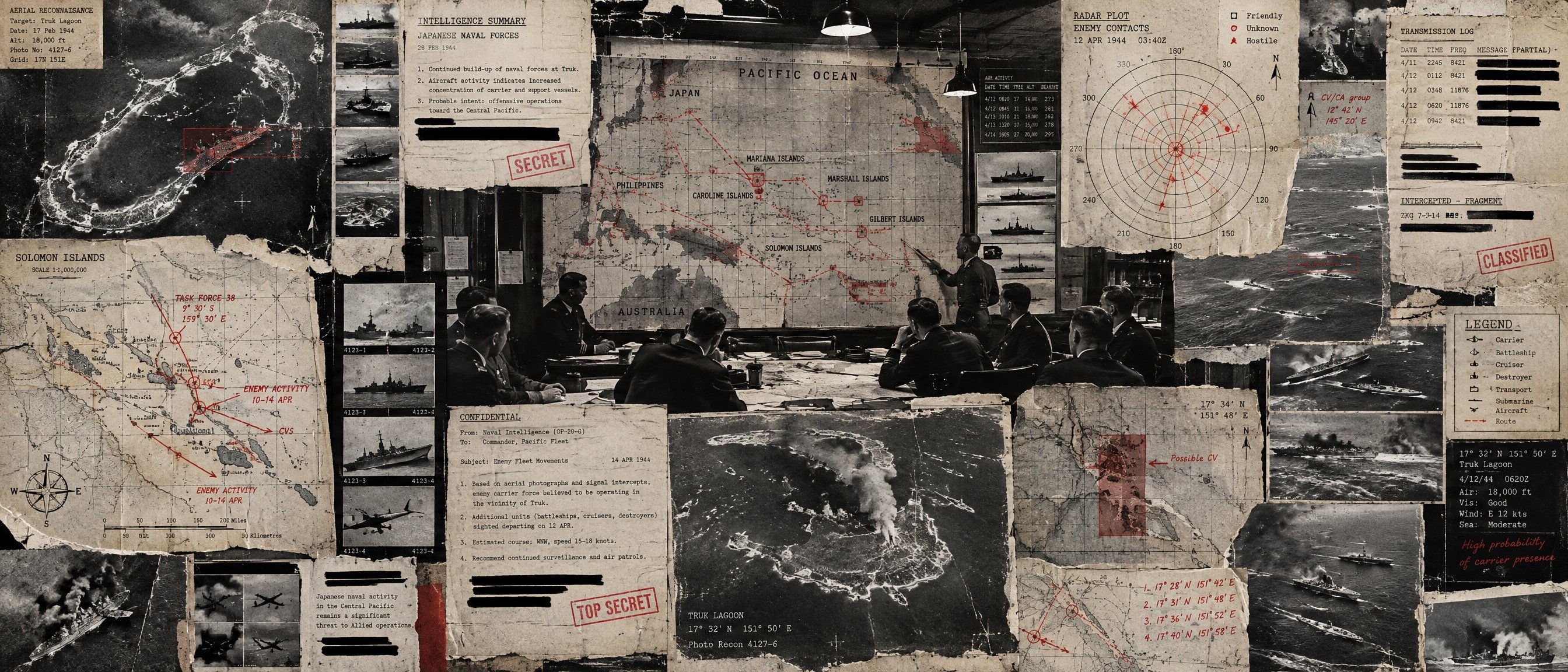 United StatesElmer Davis was hired to inform the country. Congress and his own writers revolted.
 United StatesBoston printed the rumor next to the answer. Washington thought that made things worse.
 United StatesRoosevelt administration, 1933–1945
 United StatesOffice of War Information
 United StatesWorld War II war bonds and war stamps
 United StatesLiberty Loans and the CPI, 1917–1919