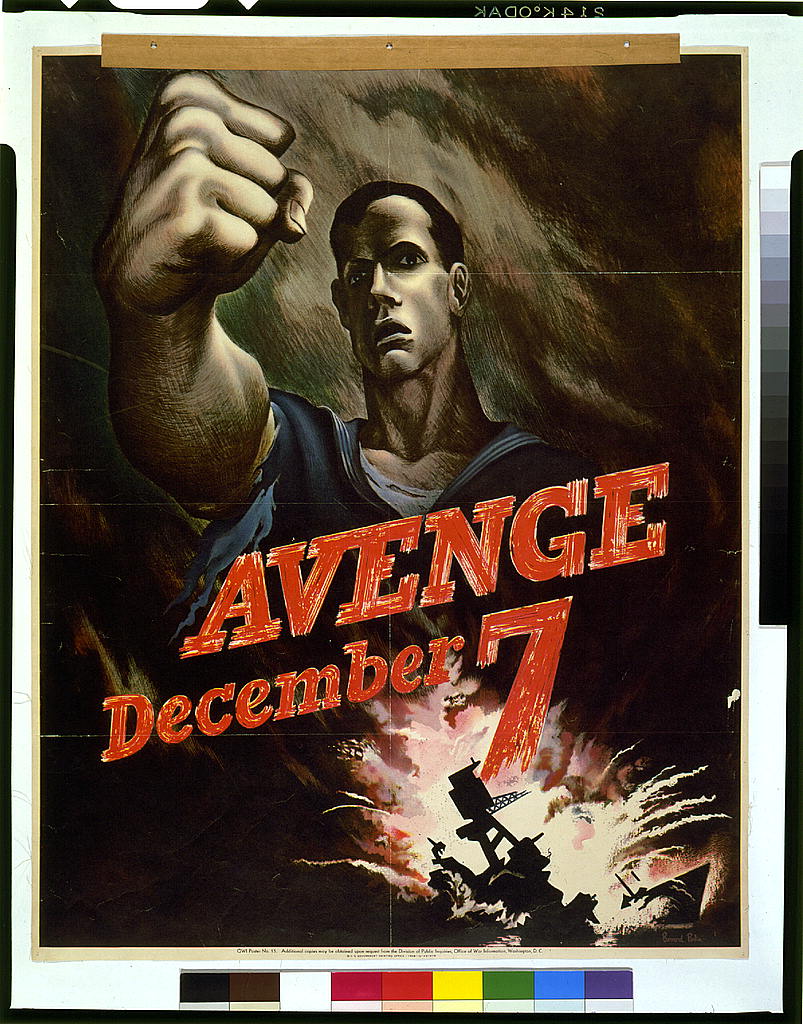
Avenge December 7 (1942), Bernard Perlin's sailor over a burning ship
Bernard Perlin's OWI Poster No. 15 (1942) sets a sailor's clenched fist over a burning warship under a verb and a date. Library of Congress copy.
Techniques named on the archive record
Transfer
Date
1942
Made by
Office of War Information, OWI Poster No. 15 (artist signed Bernard Perlin)
Medium
Poster
Country
United States
Regime
Roosevelt Administration
Source
Identified Openly sourced: the speaker is who they say they are
Source
Library of Congress, Prints and Photographs Division (POS - WWII - US .J4 1942) , retrieved October 2, 2026
Source
Public domain (U.S. government work: Office of War Information poster) Library of Congress, Prints and Photographs Division (digital id cph.3g01663). Library of Congress rights statement: 'No known restrictions on publication.'
Object, image, and catalog record from the FRAME archive. Text on this page is CC BY 4.0. Image rights are as the archive records.
Avenge December 7 is OWI Poster No. 15, signed Bernard Perlin and dated 1942. A sailor with a torn sleeve raises a clenched fist above a burning, exploding warship, and the only slogan is a verb and a date. The copy in the record is a Library of Congress scan.
A verb and a date
One verb and one date are the whole slogan. In the archive's description, a sailor whose sleeve is torn thrusts his fist toward the viewer while a warship behind him burns and explodes. The script signature in the lower right corner reads Bernard Perlin.
AVENGE
December 7
OWI Poster No. 15. Additional copies may be obtained upon request from the Division of Public Inquiries, Office of War Information, Washington, D.C.
U.S. GOVERNMENT PRINTING OFFICE [illegible]
Which copy this is
The issuer is the Office of War Information, and the sheet is No. 15 in its numbered series. The record's audience field reads "Domestic public" and its purpose field "Mobilize or secure compliance." The scan comes from the Library of Congress (digital id cph.3g01663), not the National Archives, so the record carries no NAID. The Library's rights statement reads "No known restrictions on publication." Nothing in the record gives a print run or says where the sheet was posted.
What the poster leaves out
The sheet prints the date without a year. Japan attacked Pearl Harbor on 7 December 1941, and Roosevelt asked Congress for war the next day; the Roosevelt administration essay sets out that sequence. The archive holds the neighboring OWI Poster No. 14 as well, titled "Remember Dec. 7th!"
The sheet names no enemy, no country, and no task. To avenge is to punish, and the poster leaves the viewer to decide who should be punished and by what means. A civilian passing it on a wall was asked for a feeling rather than an act. The archive tags the technique as transfer: the weight of the attack is lent to a demand the poster never spells out.
FRAME object record, Avenge December 7, 1942. Office of War Information, OWI Poster No. 15, artist's signature Bernard Perlin. Rights as recorded: public domain (U.S. government work: Office of War Information poster).
Library of Congress, Prints and Photographs Division, POS - WWII - US .J4 1942, digital id cph.3g01663, catalog record, retrieved by the archive 2 October 2026.