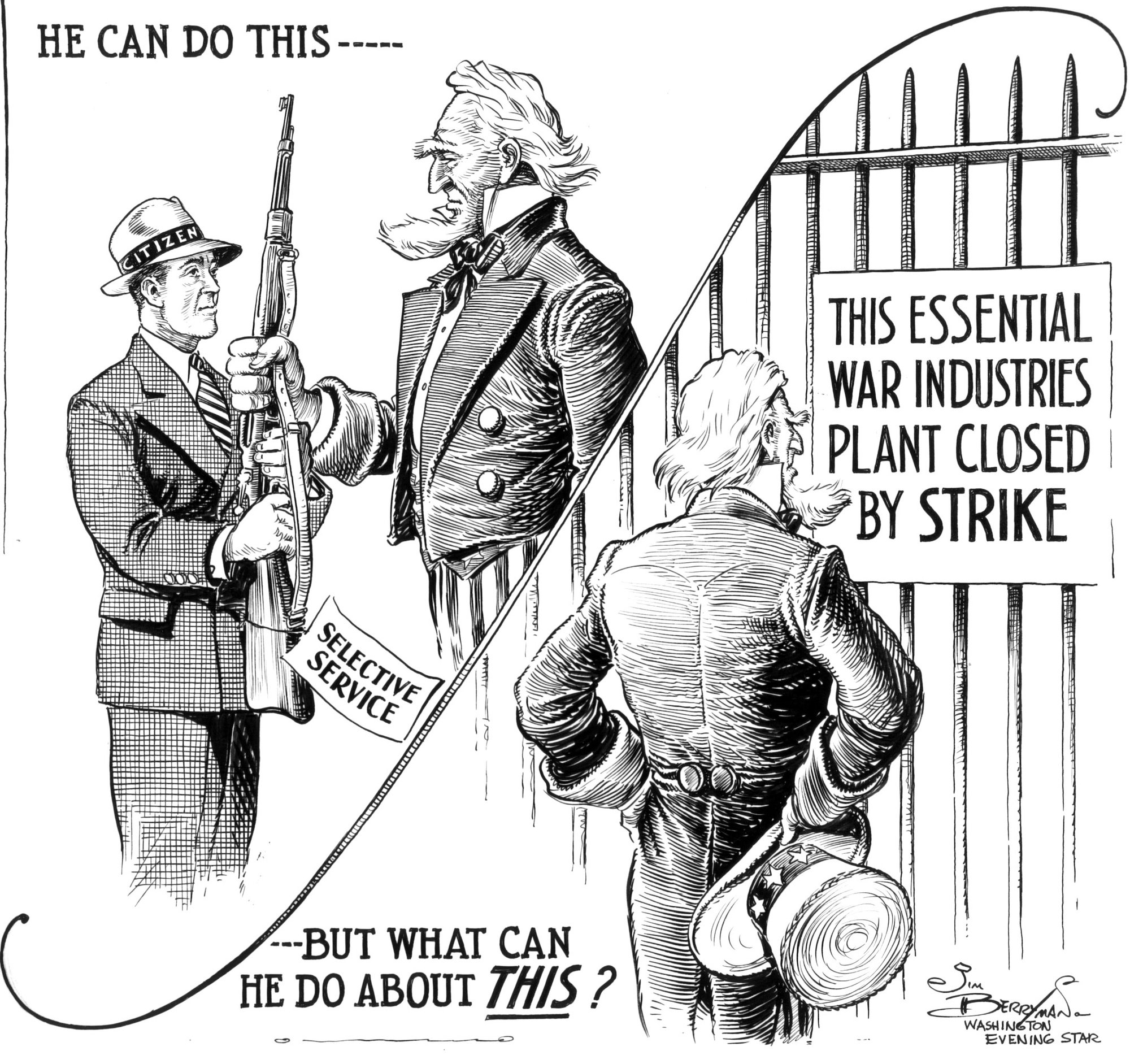
Jim Berryman's 1940 cartoon of the draft beside a strike-bound war plant
Jim Berryman's November 1940 cartoon pairs a "Selective Service" rifleman with a war plant "closed by strike" and asks what Uncle Sam can do. Senate
Techniques named on the archive record
Card stacking
Date
November 18, 1940
Made by
Washington Evening Star (cartoonist Jim Berryman)
Medium
Cartoon
Country
United States
Regime
Roosevelt Administration
NARA
NAID 5730852; NAID 5743123
Source
Identified Openly sourced: the speaker is who they say they are
Source
U.S. National Archives (NARA), Records of the U.S. Senate, Jim Berryman Political Cartoons (NAID 5730852) , retrieved October 3, 2026
Source
Public domain (U.S. government work) Jim Berryman, Washington Evening Star. National Archives and Records Administration, Records of the U.S. Senate, 5743123 (NAID 5743123).
Object, image, and catalog record from the FRAME archive. Text on this page is CC BY 4.0. Image rights are as the archive records.
A Washington Evening Star cartoon by Jim Berryman, dated 18 November 1940. On one side of a curved line Uncle Sam stands beside a citizen holding a rifle tagged "Selective Service"; on the other he faces a gate with a sign saying an essential war industries plant is closed by strike.
but what can he do about this?"
last_updated: 2026-10-12
date: November 18, 1940
---
What the cartoon shows
The panel is cut in two by a curve. In the first half Uncle Sam has a man in a hat lettered CITIZEN at his side, and the man carries a rifle with a SELECTIVE SERVICE tag. In the second half Uncle Sam is seen from behind, at a closed gate. The caption runs across both halves as one question.
HE CAN DO THIS-----
CITIZEN
SELECTIVE SERVICE
THIS ESSENTIAL WAR INDUSTRIES PLANT CLOSED BY STRIKE
---BUT WHAT CAN HE DO ABOUT THIS ?
The argument
The cartoon asks why a government able to put a rifle in a citizen's hands cannot keep a factory open. It is dated November 1940, more than a year before Pearl Harbor, and the plant on the sign is already called essential to war industries. The drawing does not name the plant, the union or the dispute, and the FRAME record does not either.
FRAME tags it card stacking: two pictures chosen to make one side of a question look obvious. That is accurate. The strikers are not drawn, so their reasons are not in the picture. Only the closed gate is.
The larger power
The comparison can be run the other way, and the libertarian reading does. The first panel shows the larger power. Taking a man from his job and putting him under arms is the strongest thing a government asks of a citizen; the cartoon treats it as settled and wonders why the state cannot also order men back to the factory floor. A free country answers that the second power is the one it ought to lack. Workers who refuse to work, and owners who refuse to settle, are using a liberty the conscript has already been asked to set aside, and the cartoon's question is what would justify taking that one away too.
None of that makes the cartoon dishonest. It is a newspaper's opinion, signed, printed under the paper's name, and open to answer by anyone who disagreed. Berryman came back to the subject in 1944, when The Thinker...and Some of his Thoughts had Uncle Sam wondering aloud whether wartime strikes were costing soldiers' lives. The rest of his 1940 run, from Coventry to the Axis carving the globe, is on the Berryman cartoons hub.
Sources
FRAME object record, He can do this --- but what can he do about this?, 18 November 1940. Washington Evening Star, cartoonist Jim Berryman.
U.S. National Archives, Records of the U.S. Senate, Jim Berryman Political Cartoons (series NAID 5730852), item NAID 5743123, catalog.archives.gov, retrieved by the archive 3 October 2026. Rights as recorded: public domain (U.S. government work).