Tango no sekku (Boys' Day) carp-banner leaflet (I07-J-1)
Tango no sekku, a 1944 US leaflet that speaks to Japanese soldiers about their sons
A 1944 US leaflet in Japanese, I07-J-1, on the Boys' Day carp streamers: a festival story that ends in sympathy for enemy soldiers' love of their children.
Techniques named on the archive record
Transfer
Date
1944
Made by
U.S. Army Forces, Pacific, Psychological Warfare Branch
Public domain (U.S. government work; LOC: No known restrictions on publication) U.S. Army Forces, Pacific, Psychological Warfare Branch (LOT 8093 main entry); Library of Congress Prints and Photographs Division.
Object, image, and catalog record from the FRAME archive. Text on this page is CC BY 4.0. Image rights are as the archive records.
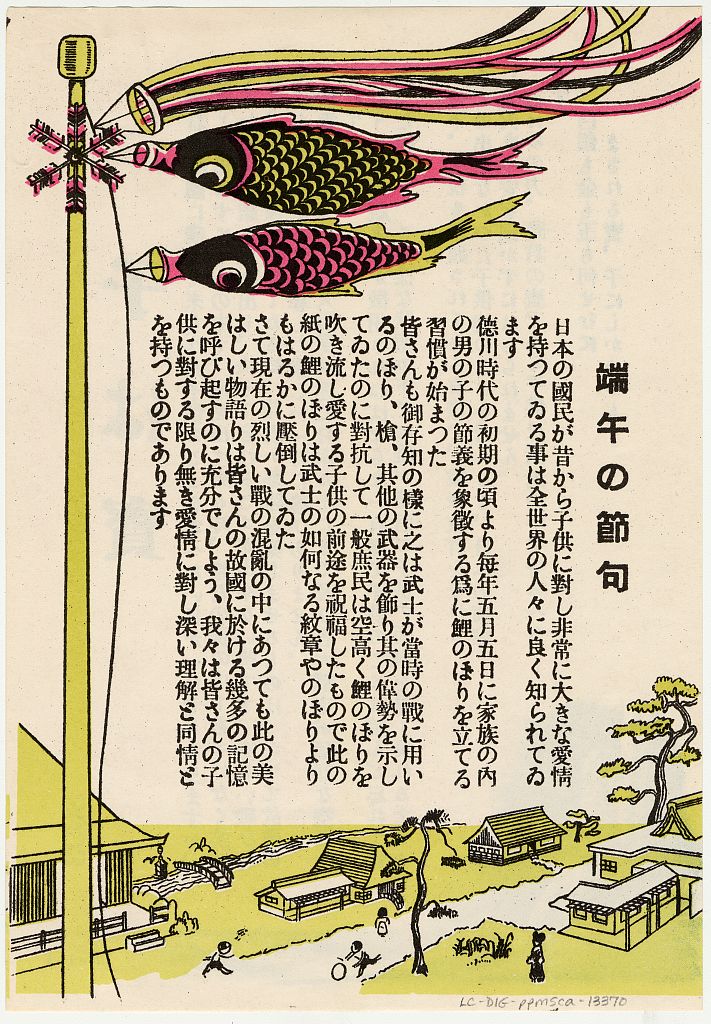
Tango no sekku (Boys' Day) is a 1944 Japanese-language leaflet, I07-J-1, catalogued under the Psychological Warfare Branch of U.S. Army Forces, Pacific. Two carp streamers fly over a village, and the text recalls the Boys' Day custom and closes with sympathy for the reader's love of his children.
The leaflet
Two carp streamers fly from a pole over a village drawn in yellow-green line. The heading names the Boys' Day festival of 5 May. Below it are four short paragraphs of Japanese. The face carries no surrender instruction and no sender's name.
The archive's English version is a machine reading and translation by Claude from the Library of Congress image, not checked by a fluent reader. In it, the leaflet opens by saying the whole world knows the Japanese people's great love for their children. The middle paragraphs tell how, from the early Tokugawa period, families raised carp streamers on 5 May, and how the commoners' paper carp outshone the banners and weapons of the warriors. The close reads: "Now, even amid the confusion of the present fierce war, this beautiful tale should be enough to call up many memories of your homeland. We have deep understanding and sympathy for your boundless love for your children."
Who made it
The Library of Congress files the leaflet under the Psychological Warfare Branch of U.S. Army Forces, Pacific, and the archive lists the audience as enemy forces. The archive also classes the source as unidentified, its category for a blurred source, and its description notes that no sender appears on the face. The English text on the back is not on the archive's image.
A leaflet that asks for nothing
The archive tags transfer: the warmth of a family festival is carried over to whoever sent the paper. That is the whole of the technique. There is no threat, no instruction, and no claim about the war except that it is fierce.
Its quiet line of argument is in the middle. Commoners' carp, flown for children, outshine the warriors' banners and spears. A soldier reading it is invited to set his family above his army without being told to.
The unsigned face is the point to weigh. A reader who does not know the sender cannot judge the sender's motive, and this leaflet leaves him to guess. That is fair to note in any propaganda. Measured against the rest of a shooting war, though, a message that appeals to a man's love for his sons is a humane way to speak to an enemy. Compare Yesterday's Enemy Is Today's Friend, which put the Geneva convention in front of the same readers, and Japan's Life Line, which argued from a map.
Sources
FRAME object record, Tango no sekku (Boys' Day) carp-banner leaflet (I07-J-1), 1944. U.S. Army Forces, Pacific, Psychological Warfare Branch. English translation in the record: machine reading and translation by Claude, not checked by a fluent reader.
Library of Congress, Prints and Photographs Division, LOT 8093 main entry, loc.gov/item/2007675056, retrieved by the archive 2 October 2026. Rights as recorded: public domain (U.S. government work; LOC: no known restrictions on publication).