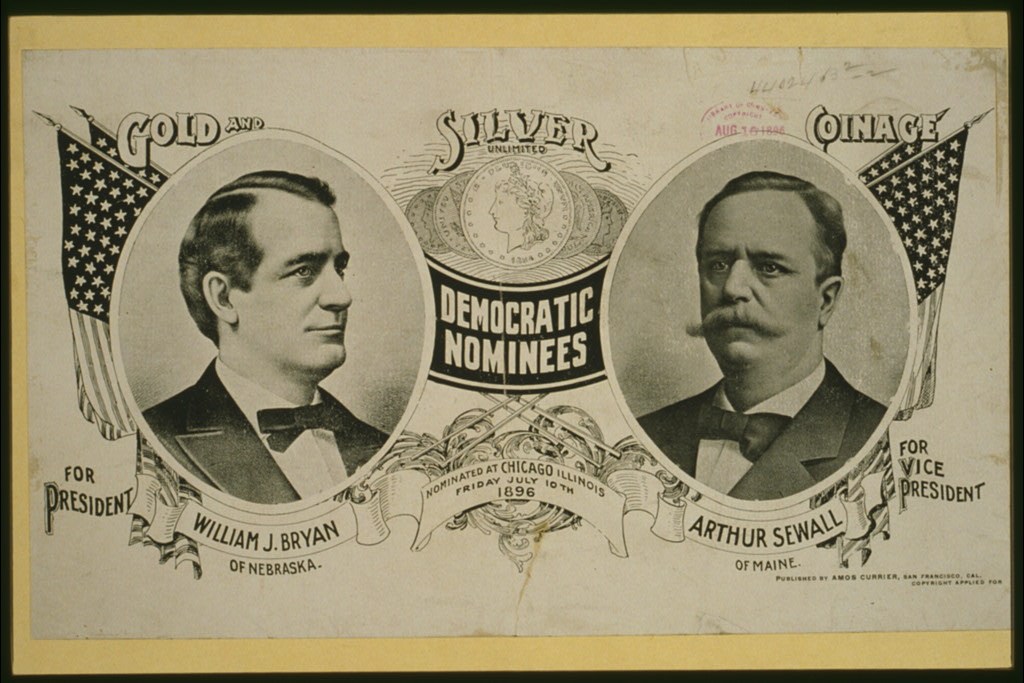
Amos Currier of San Francisco published this 1896 broadside for the Democratic ticket nominated at Chicago on 10 July, setting oval portraits of William J. Bryan and Arthur Sewall on either side of a coin and the words "Gold and Silver Unlimited Coinage."
What the sheet shows
Two oval busts, one for president and one for vice president. On the left is William J. Bryan of Nebraska, on the right Arthur Sewall of Maine. Crossed flags sit above them. Between them, where a party emblem might go, the printer put a coin and a phrase: gold and silver, unlimited coinage. The archive does not give a transcription of the rest of the lettering.
Who made it
Amos Currier, a San Francisco publisher, issued the broadside for the Democratic ticket chosen at the party's Chicago convention on 10 July 1896. The archive files it under Grover Cleveland's second administration, which was also a Democratic one.
How to read it
The archive tags it for transfer. The flags lend the ticket the nation, and the coin lends it the campaign's single issue. The Library of Congress reads the coinage wording as a nod to Bryan's "Cross of Gold" speech. That is a fair reading of a sheet that puts money at the center of a portrait page, but the broadside does not quote the speech, so neither does this page.
What makes the sheet worth a look is how little it argues. "Unlimited coinage" is a policy, not a slogan, and the broadside states it without explaining it. A voter who already followed the silver debate knew what it meant: coin silver freely alongside gold, as W. H. Harvey's Coin's Financial School had argued in 1894 at sixteen to one. A voter who did not would learn nothing here except which side the ticket was on.
The Republican answer that year used the same form. Its shield placard put McKinley and Hobart under "Protection and Sound Money." Two parties, two portrait pairs, two phrases about money. Neither placard is false. Both are a candidate's name tied to a monetary position, offered as if the position needed no defense. Four years later McKinley's side would print McKinley Was Right, claiming the economy's recovery as proof.
Sources
- FRAME object record, Democratic nominees Bryan and Sewall broadside, 1896. Amos Currier, San Francisco.
- Library of Congress, Prints and Photographs Division. loc.gov/item/2001697077, retrieved by the archive 2 October 2026. Rights as recorded: public domain by age; no known restrictions on publication.