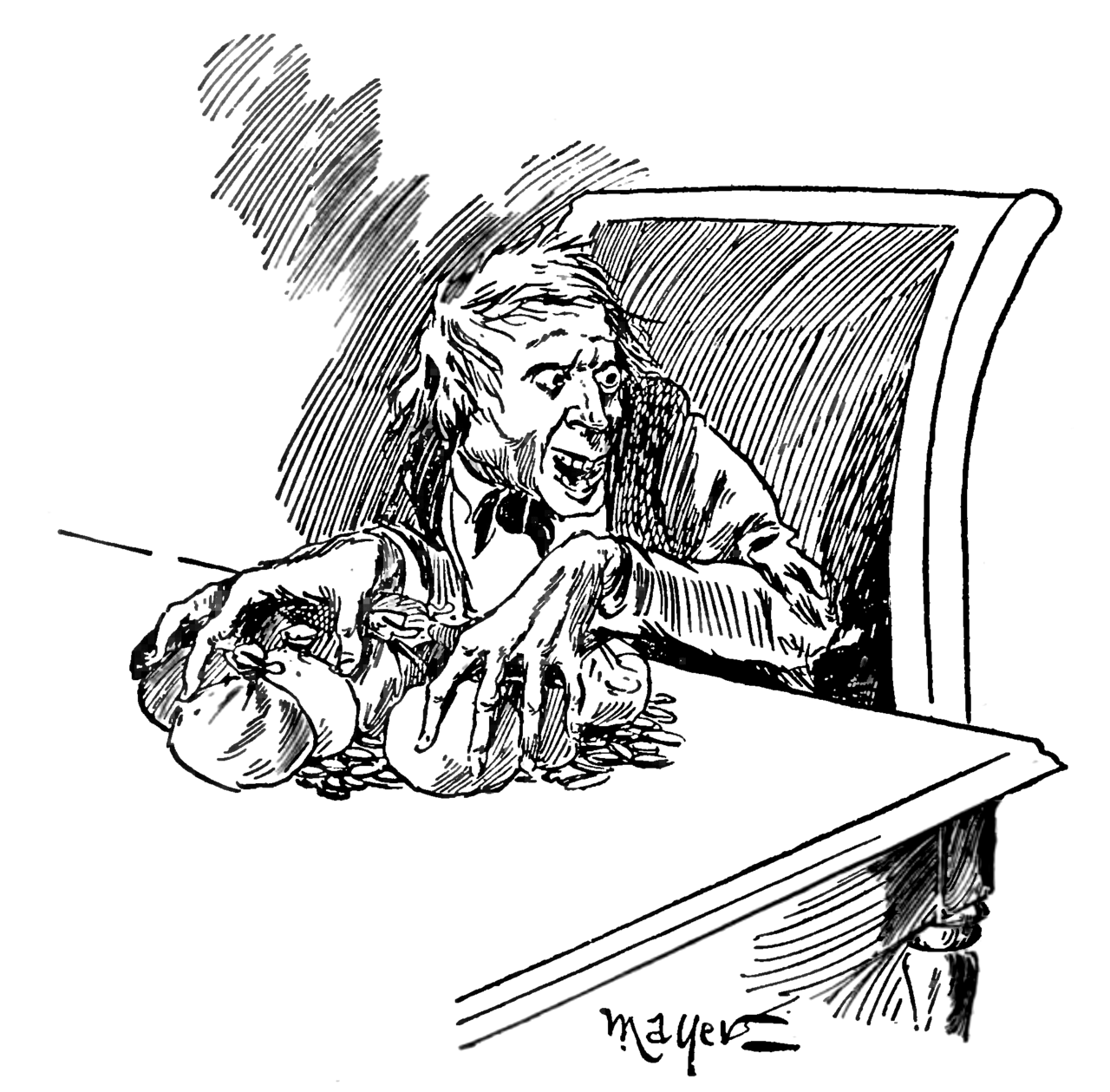
A full-page illustration signed Mayer in W. H. Harvey's Coin's Financial School (Chicago, 1894) shows a gaunt, wild-eyed man clutching bags of money over a pile of coins. The pamphlet argued for free coinage of silver at 16 to 1.
What the plate shows
A thin, staring man sits hunched over a heap of coins, both arms wrapped around money bags. The plate is titled "Greed" and signed Mayer. It is one full-page picture in a book of argument, and it does something the book's text cannot: it gives the opposing side a body, and an ugly one.
The archive gives no transcription for this plate beyond its title, so this page quotes nothing else from it.
Who made it
W. H. Harvey wrote and published Coin's Financial School through his Coin Publishing Company in Chicago in 1894, during Grover Cleveland's administration. The archive lists Harvey as an individual issuer. His device was a fictional lecture series in which a boy called "Coin" explains the case for bimetallism, coining silver and gold at a ratio of 16 to 1. The archive records that the pamphlet circulated widely in the silver campaign of 1896, and that opponents answered it with many replies in 1895 and 1896.
The scan comes through Wikimedia Commons from the Wikisource transcription of the book; an Internet Archive copy from the University of California is marked not in copyright.
How to read it
The archive tags the plate for name-calling, and a picture can call names as well as a word. Monetary policy is a hard subject. It involves prices, debts, and the value of a dollar held by a farmer and by a bank. Harvey's text at least sets out to argue it, through its schoolroom fiction. The "Greed" plate skips the argument. In a free-silver book, the miser stands in for the other side, hoarding for its own sake.
That is a cheap move, and its appeal is easy to see: a reader who cannot follow a lecture on coinage can still recognize a miser. The liberty point is simple. Harvey had every right to publish, sell, and caricature, and his critics had every right to answer, which the record says they did, at length. That open quarrel over money, carried on by argument rather than by suppressing a pamphlet, is the system working. The plate itself is the weakest part of it.
For an earlier fight over money and banks drawn as a fight between animals, see Old Jack, the New Orleans mouser.
Sources
- FRAME object record, "Greed," illustration from Coin's Financial School, 1894. W. H. Harvey, Coin Publishing Company, Chicago.
- Wikimedia Commons, File:Coin's Financial School - Greed.png, from the Wikisource transcription of the 1894 book, retrieved by the archive 2 October 2026. Rights as recorded: public domain by age; Internet Archive (University of California copy) marked NOT_IN_COPYRIGHT.