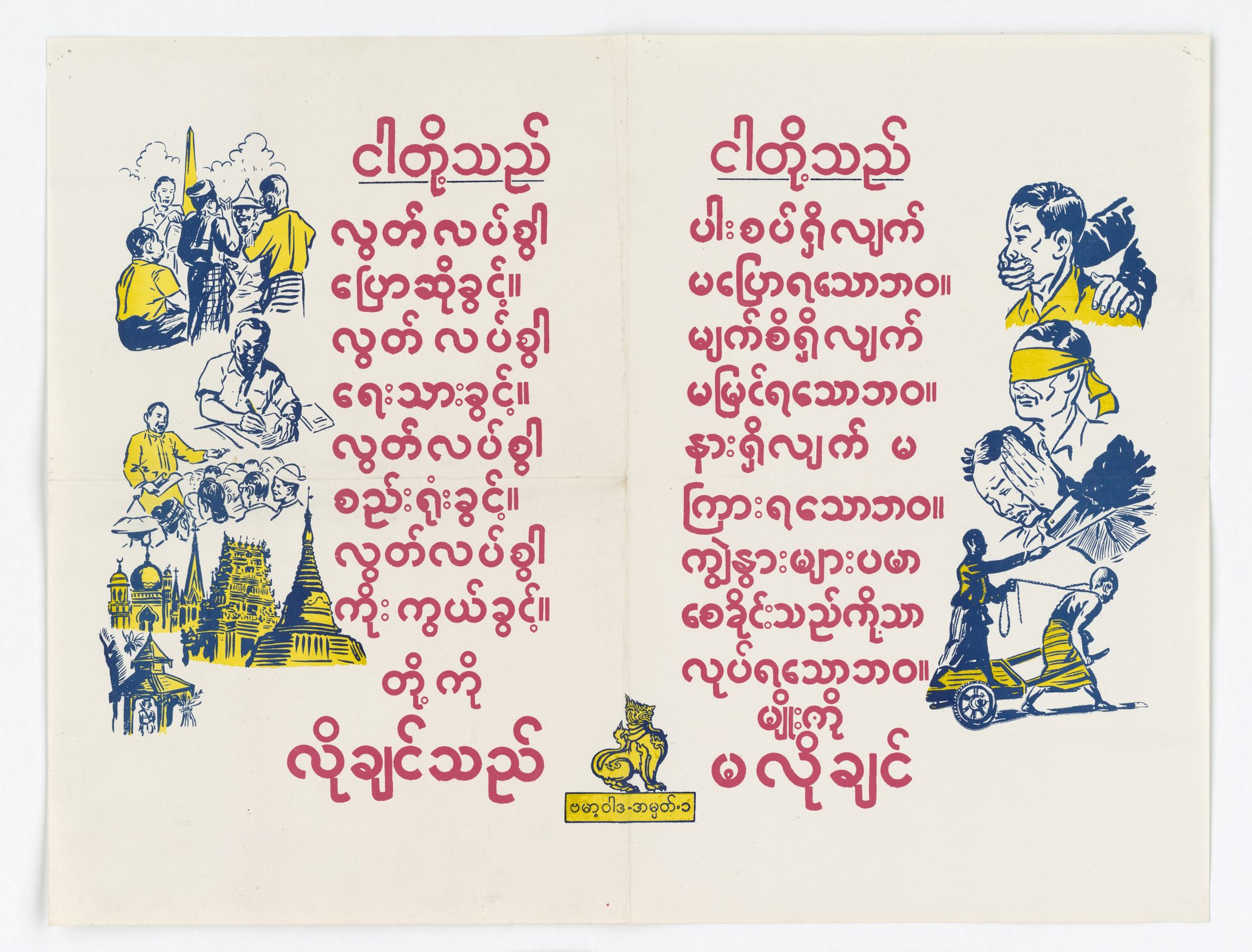
We Want / We Do Not Want: Burma Civil Liberties (Burmese-language poster distributed in Burma)
We Want / We Do Not Want, a 1951 civil liberties poster for Burma
1951 Burmese-language U.S. information poster contrasting freedom of speech, press, assembly, and worship with a gagged, ordered life. NARA NAID 5729921.
Techniques named on the archive record
Glittering generalitiesFear appeal
Date
April 4, 1951
Made by
U.S. Information Agency (predecessor: State Department International Information and Educational Exchange Program), Propaganda Posters Distributed in Asia series
U.S. National Archives (NARA), Record Group 306, Propaganda Posters Distributed in Asia , retrieved October 3, 2026
Source
Public domain (U.S. government work; NARA RG 306) U.S. Information Agency / Department of State, April 4, 1951. National Archives, Record Group 306 (NAID 5729921, 306-PPA-22).
Object, image, and catalog record from the FRAME archive. Text on this page is CC BY 4.0. Image rights are as the archive records.
We Want / We Do Not Want is a Burmese-language poster from the State Department's information program, dated 4 April 1951 in the National Archives file. One panel lists freedoms of speech, writing, organizing, and worship; the other lists the life of a gagged, blindfolded, commanded man (NAID 5729921).
What the poster prints
The sheet is split down the middle in red, blue, and yellow. On the left, small scenes show a street meeting, a man writing, a speaker, and buildings of worship. On the right are a man with a gag, a man with a blindfold, and one man hauling another in a cart. The text is a pair of plain sentences.
We want freedom of speech, freedom of writing, freedom of assembly/organising, freedom of worship.
We do not want a life of having a mouth but not being allowed to speak, having eyes but not being allowed to see, having ears but not being allowed to hear, and doing only what one is ordered to do like a slave.
How to read it
Readers of this site will recognize the left panel. Speech, writing, organizing, and worship line up closely with liberties in the First Amendment, set out here for a Burmese audience in the first person plural. The poster does not name the United States, the Soviet Union, or any party. It names freedoms and their absence.
The archive tags it with glittering generalities and fear appeal. The fear appeal is in the right panel, and it is fair as far as it goes: a gag and a blindfold are what censorship is. The generalities are on the left, where the freedoms are stated without any account of who would guarantee them or how. That is the limit of a poster. It can name a right; it cannot build the courts and the habits that keep one.
Who issued it
The record names the State Department's international information program, later the U.S. Information Agency, in the "Propaganda Posters Distributed in Asia" series. Nothing legible on the sheet credits the United States, and the archive classes the source as blurred. There is a real tension in a government promoting free speech abroad without signing its name. The message is one this site agrees with. The method, an unsigned state message, is the kind the First Amendment tradition teaches citizens to ask about.
Compare the American freedoms as the Four Freedoms posters put them at home, and, on the question of who pays for a message about freedom, the archive's Congress for Cultural Freedom study.
Sources
FRAME object record, "We Want / We Do Not Want: Burma Civil Liberties (Burmese-language poster distributed in Burma)," 4 April 1951. U.S. Information Agency (predecessor: State Department International Information and Educational Exchange Program).
U.S. National Archives, Record Group 306, Propaganda Posters Distributed in Asia, 306-PPA-22, NAID 5729921, retrieved by the archive 3 October 2026. Rights as recorded: public domain (U.S. government work).