Buy This Man a Hari-Kari Kit (1944), a priced joke for Pearl Harbor Day
Buy This Man a Hari-Kari Kit (1944): a Pearl Harbor Day war bond sheet that prices a ritual-suicide kit at $75.00 beside a caricatured Japanese soldier.
Techniques named on the archive record
Name-calling
Date
1944
Made by
War-bond poster for Pearl Harbor Day 1944 (issuer not named on the object); held in the OWI poster file
Medium
Poster
Country
United States
Regime
Roosevelt Administration
NARA
NARA 513999; Record Group 44
Source
Identified Openly sourced: the speaker is who they say they are
Source
U.S. National Archives and Records Administration (NARA 513999, local id 44-PA-520), Records of the Office of Government Reports, Record Group 44, series 'World War II Posters' , retrieved October 2, 2026
Source
Public domain (U.S. publication without copyright notice; NARA 'Unrestricted') U.S. National Archives and Records Administration
Object, image, and catalog record from the FRAME archive. Text on this page is CC BY 4.0. Image rights are as the archive records.
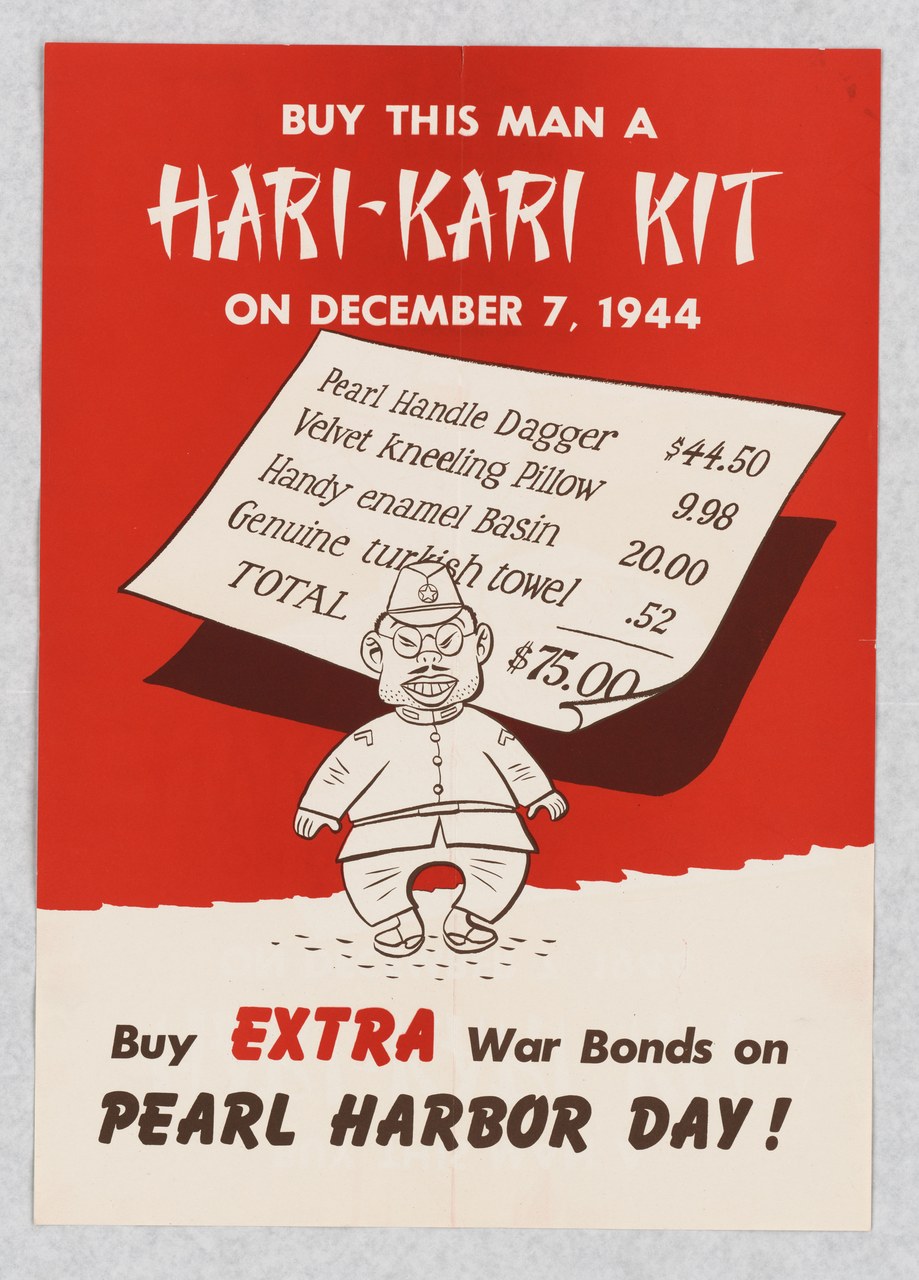
Buy this man a Hari-Kari Kit on December 7, 1944 is a war bond sheet for Pearl Harbor Day with no issuer printed on it. A cartoon soldier with round glasses and bared teeth stands beside an itemized bill for a suicide kit totaling $75.00 (NARA 513999).
An itemized bill for a death
Content note: the sheet is a racial caricature and a joke about suicide, described here as printed.
The sheet is laid out like a store bill. A small cartoon soldier with round glasses, bared teeth and a peaked cap stands in front of it. The bill lists four items and a total, and a further line turns the joke into a sales request for the anniversary of the attack.
BUY THIS MAN A
HARI-KARI KIT
ON DECEMBER 7, 1944
Pearl Handle Dagger $44.50
Velvet kneeling Pillow 9.98
Handy enamel Basin 20.00
Genuine turkish towel .52
TOTAL $75.00
Buy EXTRA War Bonds on
PEARL HARBOR DAY!
The four prices add up to the printed total. The first item, a "Pearl Handle Dagger", puns on the day the sheet names.
No maker on the sheet
Nothing on the poster says who printed it. The archive describes it as a war bond poster for Pearl Harbor Day 1944, held in the Office of War Information poster file, and sets the issuer type to "Mixed". The National Archives keeps it in Record Group 44, World War II Posters. FRAME records the purpose as "Fundraise" and the themes as war, economy and finance, and race and ethnicity. Its one technique tag is name-calling: in the archive's words, "the caricature stands for the whole nation."
Selling bonds with a suicide joke
A bond drive on the anniversary of Pearl Harbor is an ordinary piece of civic salesmanship. Buying a bond was a loan the buyer chose to make. This sheet asked for that loan by inviting the reader to pay for an enemy's death by his own hand, and by drawing the enemy as a set of racial features. The drawing does not name a government or a commander. It stands for a people.
That was wrong, and it was wrong in a year when Americans of Japanese ancestry were held in the camps that the Roosevelt administration essay describes. The record does not show who ordered the sheet or how widely it hung.
The site's war bonds hub quotes this poster in its section on the enemy, beside other bond sheets that used slurs. The anti-Japanese propaganda hub collects sheets of the same kind, and So the Jap's a Snap? is an Army poster from the same year.
Sources
FRAME object record, Buy This Man a Hari-Kari Kit on December 7, 1944. War-bond poster for Pearl Harbor Day 1944; issuer not named on the object. Rights as recorded: public domain (U.S. publication without copyright notice; NARA "Unrestricted").
U.S. National Archives and Records Administration, Records of the Office of Government Reports, Record Group 44, World War II Posters, local id 44-PA-520, NARA 513999, retrieved by the archive 2 October 2026.