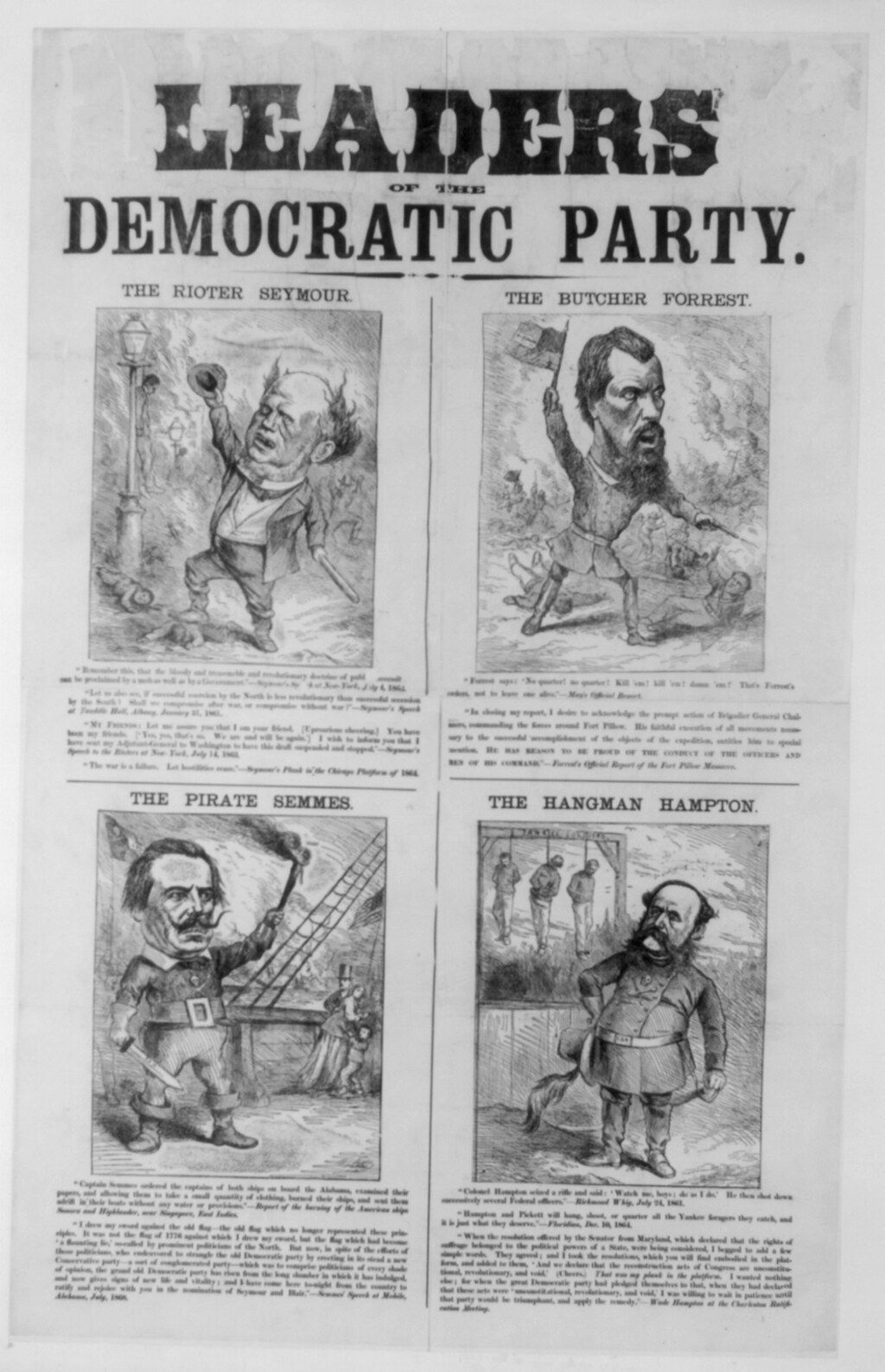
A four-panel 1868 campaign broadside signed by Thomas Nast caricatures Horatio Seymour, Nathan Bedford Forrest, Raphael Semmes, and Wade Hampton as "Leaders of the Democratic Party," each above printed extracts from his own speeches or from official reports.
Content note: the broadside labels its subjects "Butcher" and "Hangman" and cites the report on Fort Pillow. This page describes it in outline.
What the sheet shows
Four panels, four men, four one-word titles. Horatio Seymour, the Democratic nominee for president in 1868, is "The Rioter." Nathan Bedford Forrest is "The Butcher." Raphael Semmes is "The Pirate." Wade Hampton is "The Hangman." The archive describes the last three as Confederate officers. Under each caricature the broadside prints text the archive identifies as drawn from the man's own record: Seymour's speeches of 1863, the report on Fort Pillow, and a speech Semmes gave at Mobile in July 1868, among others.
Who made it
The sheet is signed by Thomas Nast. No publisher is named. The archive files it under the Andrew Johnson administration as a broadside of the 1868 campaign, Grant against Seymour. Nast's better-known cartoon of that autumn, This Is a White Man's Government, ran in Harper's Weekly. This one circulated as a separate sheet.
How to read it
The archive tags it for name-calling, card stacking, and transfer. The name-calling is in the four titles, which reach a verdict before the reader gets to the small type. The transfer is in the arrangement. Of the four, only Seymour was a candidate. The other three were Confederate officers. By placing the nominee in a row with them under one heading, the sheet hands him their war.
The card stacking is subtler, because the evidence is the men's own words. Quoting an opponent is fair. Choosing which sentences to quote, and framing them with "Butcher" and "Hangman," is selection, and the archive marks it as such. A reader in 1868 could fairly ask whether Seymour's 1863 speeches made him a rioter, and the broadside does not let him ask.
That said, the subject underneath was real. The 1868 contest turned on Reconstruction: the Democratic platform attacked the Reconstruction Acts, and "a white man's government" was a Democratic slogan of the year. Nast's sheet is partisan and unfair to Seymour in its framing. The stakes it pointed to were real all the same. Both things belong in the record, and this page holds them to the same standard it holds the Democratic prints of that year.
Sources
- FRAME object record, "Leaders of the Democratic Party: The Rioter Seymour, the Butcher Forrest, the Pirate Semmes, the Hangman Hampton," 1868. Thomas Nast (signed); publisher not stated.
- Library of Congress, Prints and Photographs Division. loc.gov/item/2008661705, retrieved by the archive 2 October 2026. Rights as recorded: public domain, no known restrictions on publication.