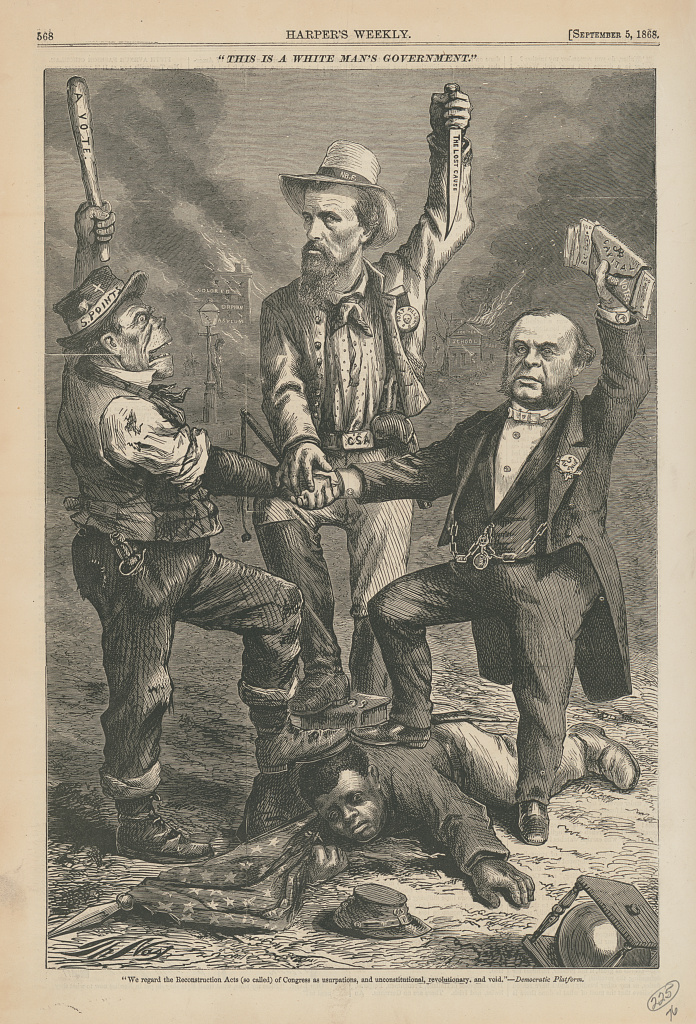
Thomas Nast's cartoon in Harper's Weekly of 5 September 1868 shows three men joining hands over a Black man on the ground, with a school burning behind them. The caption ties the scene to the 1868 Democratic platform's attack on the Reconstruction Acts.
What the cartoon shows
Content note: the cartoon shows violence against a Black man, who lies on the ground beneath the three main figures. This page describes it as the archive records it.
Three men clasp hands in the center of the page. One carries a club marked "A Vote" and wears a cap marked "5 Points," which the archive reads as a sign of city machine politics. One holds a knife marked "The Lost Cause" and wears a belt buckle lettered "CSA." The third wears a frock coat and holds a roll of money. Beneath them is a Black man. Behind them a school and another building are on fire. The title phrase is the slogan the three men share.
The archive does not supply a full transcription of the caption. It records that the caption quotes the 1868 Democratic platform calling the Reconstruction Acts "usurpations, and unconstitutional, revolutionary, and void," and presents that platform as the source of the title.
Who made it
Thomas Nast drew it for Harper's Weekly, where it ran on 5 September 1868, page 568, in the run-up to that year's presidential election. Andrew Johnson was president. Harper's was a private weekly, and the cartoon is an attack by a private paper on a political party, not a government product.
How to read it
The archive tags the cartoon for fear appeal, transfer, and card stacking, and its purpose as demonizing. Nast builds a coalition out of three types: the city machine's thug, the unreconstructed Confederate, and the money man. He then lays the victim at their feet. The claim is that a vote for this platform is a vote for this alliance, and that the alliance's real program is the man on the ground and the burning school.
Two judgments belong side by side. Nast's composition is propaganda, built to make readers feel rather than weigh, and it lumps every Democratic voter in with a knife and a club. It is also aimed at a real target. The phrase "white man's government" says what it means: a government in which Black citizens have no share. That aim was wrong, and Nast was right to say so. The burning school is what the cartoon alleges would follow; the archive's record does not document a specific incident behind this image.
For the same politics a generation later, drawn by its own side, see the 1900 North Carolina "Negro Rule" cartoon from a white-supremacy campaign.
Sources
- FRAME object record, This Is a White Man's Government. Thomas Nast; Harper's Weekly, 5 September 1868, p. 568.
- Library of Congress, Prints and Photographs Division. loc.gov/item/98513794, retrieved by the archive 2 October 2026. Rights as recorded: public domain, no known restrictions on publication.