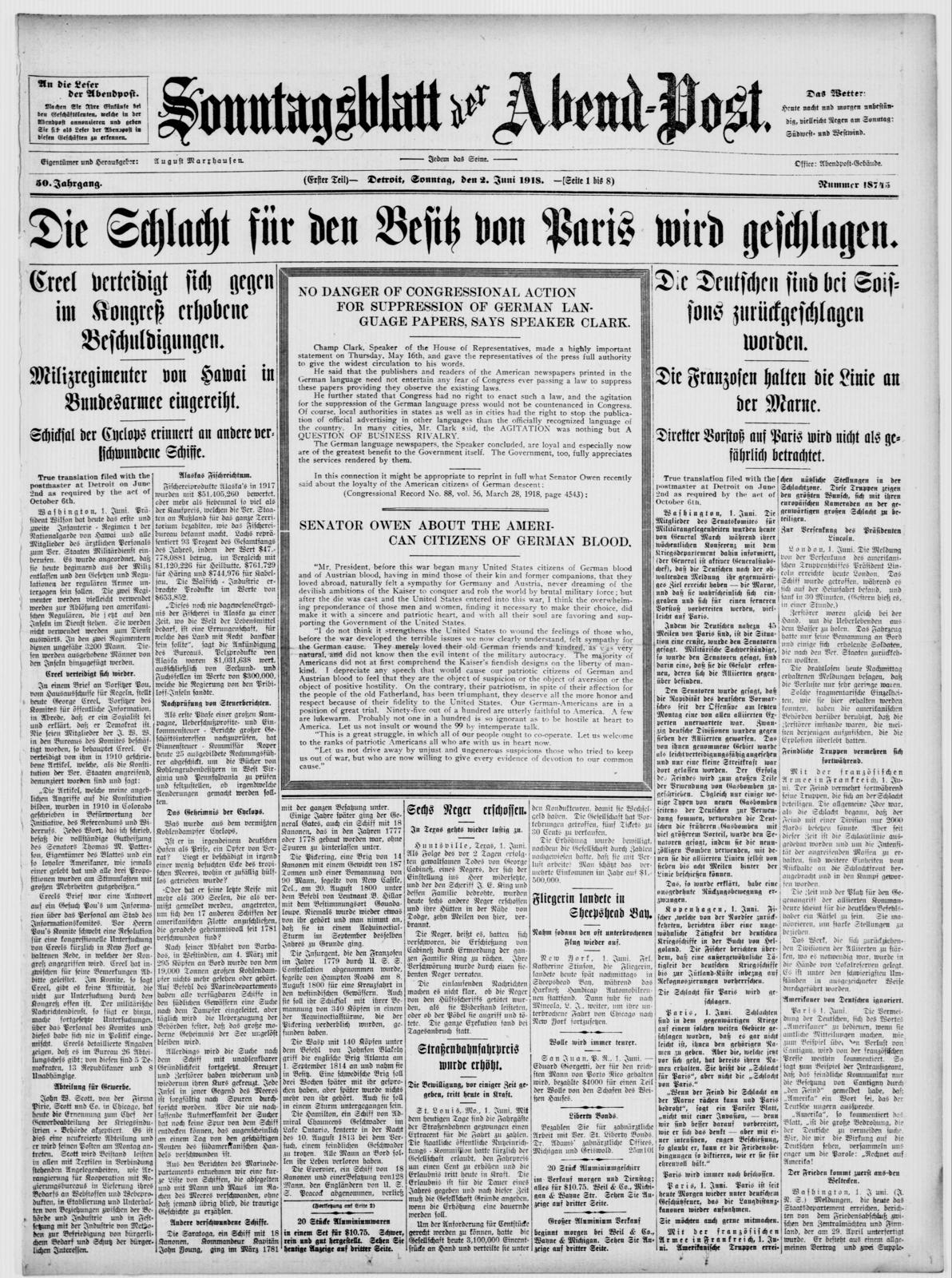
Sonntagsblatt der Abend-Post (Detroit), front page, 2 June 1918
Sonntagsblatt der Abend-Post, June 2, 1918, a German-language paper vouches for itself
The Detroit Abend-Post's front page of June 2, 1918 printed, in English, Speaker Champ Clark's assurance that Congress would not suppress German-language
Techniques named on the archive record
Testimonial
Date
June 2, 1918
Made by
Detroiter Abend-Post (owner and publisher August Marxhausen), Detroit
Medium
Newspaper pages
Country
United States
Regime
Wilson Administration
Source
Identified Openly sourced: the speaker is who they say they are
Source
Library of Congress, Chronicling America , retrieved October 2, 2026
Source
Public domain (US newspaper, 1918; LOC: public domain or no known copyright restrictions) Detroiter Abend-Post, 2 June 1918, via Library of Congress, Chronicling America (LCCN sn96076572)
Object, image, and catalog record from the FRAME archive. Text on this page is CC BY 4.0. Image rights are as the archive records.
The Sunday edition of the Detroiter Abend-Post for June 2, 1918 ran a boxed English item quoting House Speaker Champ Clark that Congress would not suppress German-language papers, followed by a reprinted Senate speech on German-American loyalty and a notice of a translation filed with the postmaster.
What the page prints
Most of the page is German blackletter: war news from Paris, Soissons, and the Marne, a lost ship, Hawaiian militia, and a headline that George Creel was defending himself against charges in Congress. In the center column, set off in a box and in English, is the item the paper most wanted its readers and its critics to see.
NO DANGER OF CONGRESSIONAL ACTION FOR SUPPRESSION OF GERMAN LANGUAGE PAPERS, SAYS SPEAKER CLARK.
He said that the publishers and readers of the American newspapers printed in the German language need not entertain any fear of Congress ever passing a law to suppress these papers providing they observe the existing laws.
He further stated that Congress had no right to enact such a law, and the agitation for the suppression of the German language press would not be countenanced in Congress.
True translation filed with the postmaster at Detroit on June 2nd as required by the act of October 6th.
Who published it
The Detroiter Abend-Post, owner and publisher August Marxhausen, in its Sunday paper, fiftieth year, number 18745. The scan is from the Library of Congress's Chronicling America (LCCN sn96076572), public domain as a 1918 U.S. newspaper. The page credits the Clark statement to Thursday, May 16, and the Owen speech to the Congressional Record of March 28, 1918, page 4543.
How to read it
This is a newspaper defending its own existence, and doing it by borrowing the voices of the Speaker of the House and a senator. That is a testimonial, and the FRAME record files it that way. Here the technique is on the side of the press, not the state.
Two lines show the pressure the paper was under. Clark's promise comes with a condition, "providing they observe the existing laws." And the bottom notice says a translation had been filed with the local postmaster, as an act of October 6 required. A paper that has to hand the government an English version of what it prints is not a fully free paper, whatever Congress declines to do next. The page does not name the act, so neither does this one.
Set it beside the Herald cartoon cheering the Sedition Act, the Food Administration's Yiddish poster, and the wartime speech record in the CPI case study. The constitutional point Clark made, that Congress had no right to suppress these papers, is the right one. The postmaster's filing is the reason it needed saying. The wartime censorship case study covers the 1917 rule that made foreign-language papers file sworn translations with the postmaster before commenting on the war.
Sources
FRAME object record, Sonntagsblatt der Abend-Post (Detroit), front page, 2 June 1918. Detroiter Abend-Post, August Marxhausen.
Library of Congress, Chronicling America, LCCN sn96076572, 2 June 1918, page 1, retrieved by the archive 2 October 2026. Rights as recorded: public domain.