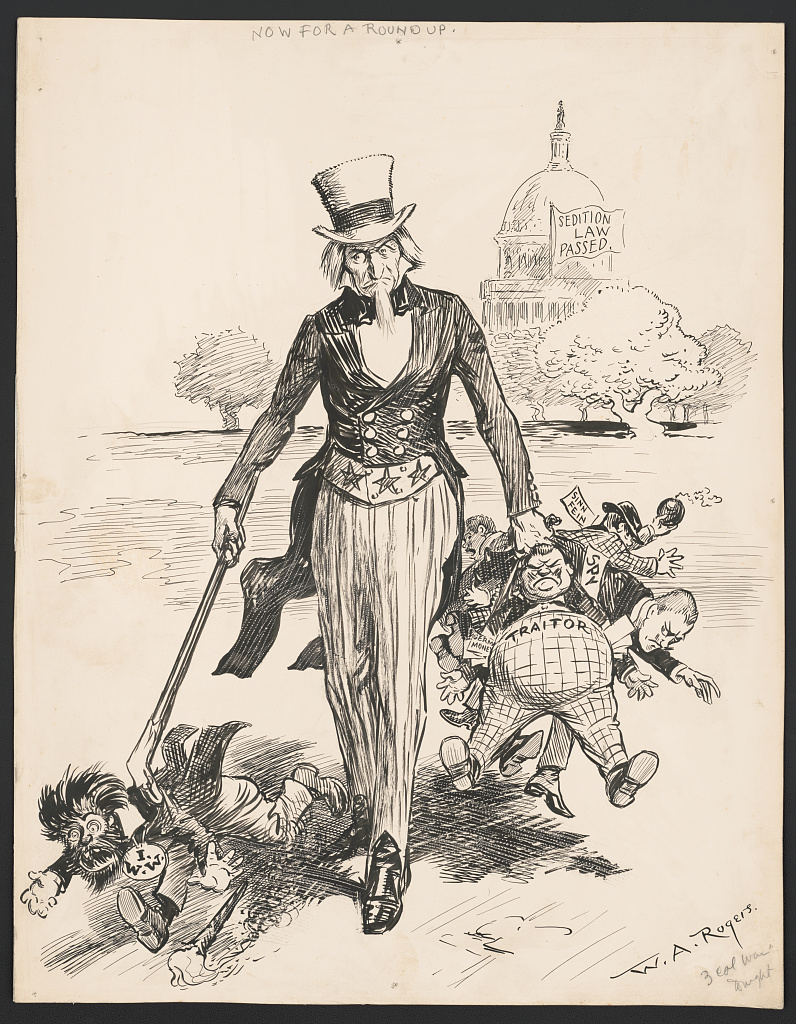
Now for a Round-Up (1918), the I.W.W. in Uncle Sam's bundle
W. A. Rogers's New York Herald cartoon of May 9, 1918 shows Uncle Sam hauling Spy, Traitor, I.W.W. and Sinn Fein away from a Capitol marked "Sedition law
Techniques named on the archive record
Name-callingTransfer
Date
May 9, 1918
Made by
W. A. Rogers, New York Herald
Medium
Cartoon
Country
United States
Regime
Wilson Administration
Source
Identified Openly sourced: the speaker is who they say they are
Source
Library of Congress , retrieved September 27, 2026
Source
Public domain (published 1918 in the New York Herald, before 1931; LoC: No known restrictions on publication) Library of Congress Prints and Photographs Division Washington, D.C. 20540 USA http://hdl.loc.gov/loc.pnp/pp.print
Object, image, and catalog record from the FRAME archive. Text on this page is CC BY 4.0. Image rights are as the archive records.
Now for a Round-Up is a W. A. Rogers cartoon in the New York Herald, May 9, 1918. Uncle Sam leaves a Capitol bannered "Sedition law passed," dragging small figures tagged Spy, Traitor, I.W.W., Sinn Fein, and a tag the Library of Congress reads as German money.
What the cartoon prints
Uncle Sam strides away from the Capitol with a fistful of little people. A banner on the building announces the law. The tags on the captives say who the law is for.
NOW FOR A ROUND UP.
SEDITION LAW PASSED
SPY
TRAITOR
SINN FEIN
I.W.W.
W.A. Rogers.
Who made it
W. A. Rogers drew it for the New York Herald, a private newspaper, on May 9, 1918. The Library of Congress holds the item, public domain as a 1918 publication with no known restrictions. This is a newspaper cheering a law, not a government notice.
What it gets wrong
The cartoon's argument is the bundle. A spy is someone who passes secrets to an enemy. A traitor, under the Constitution, is someone who levies war against the United States or gives its enemies aid and comfort, proved by two witnesses or a confession in open court. The Industrial Workers of the World was a labor union. Putting its initials in the same fist as "spy" and "traitor" convicts it by association, with no act named.
That is what the Sedition Act made dangerous. The amendments Congress passed in May 1918, covered in the CPI case study, reached speech, not just conduct. A law aimed at what people said, enforced in a climate where a union could be drawn as a traitor in a major paper, is a law that will catch dissent along with espionage. The cartoon does not hide that; it celebrates the "round-up" as a sweep.
Rogers had every right to draw it, and readers had every right to object. The cartoon is a free press arguing for less freedom of speech. Less than a month later, the German-language Detroit Abend-Post was printing the House Speaker's assurance that Congress would not suppress German-language papers. The case for a constitution that protects the union organizer and the foreign-language editor is the case against this drawing. The labor case study discusses this cartoon, and the First World War censorship case study covers the Sedition Act it greeted.
Sources
FRAME object record, Now for a round-up, May 9, 1918. W. A. Rogers, New York Herald.
Library of Congress, Prints and Photographs Division, item 2010717793, retrieved by the archive 27 September 2026. Rights as recorded: public domain (published 1918; no known restrictions on publication).
U.S. Constitution, Article III, Section 3 (definition of treason).