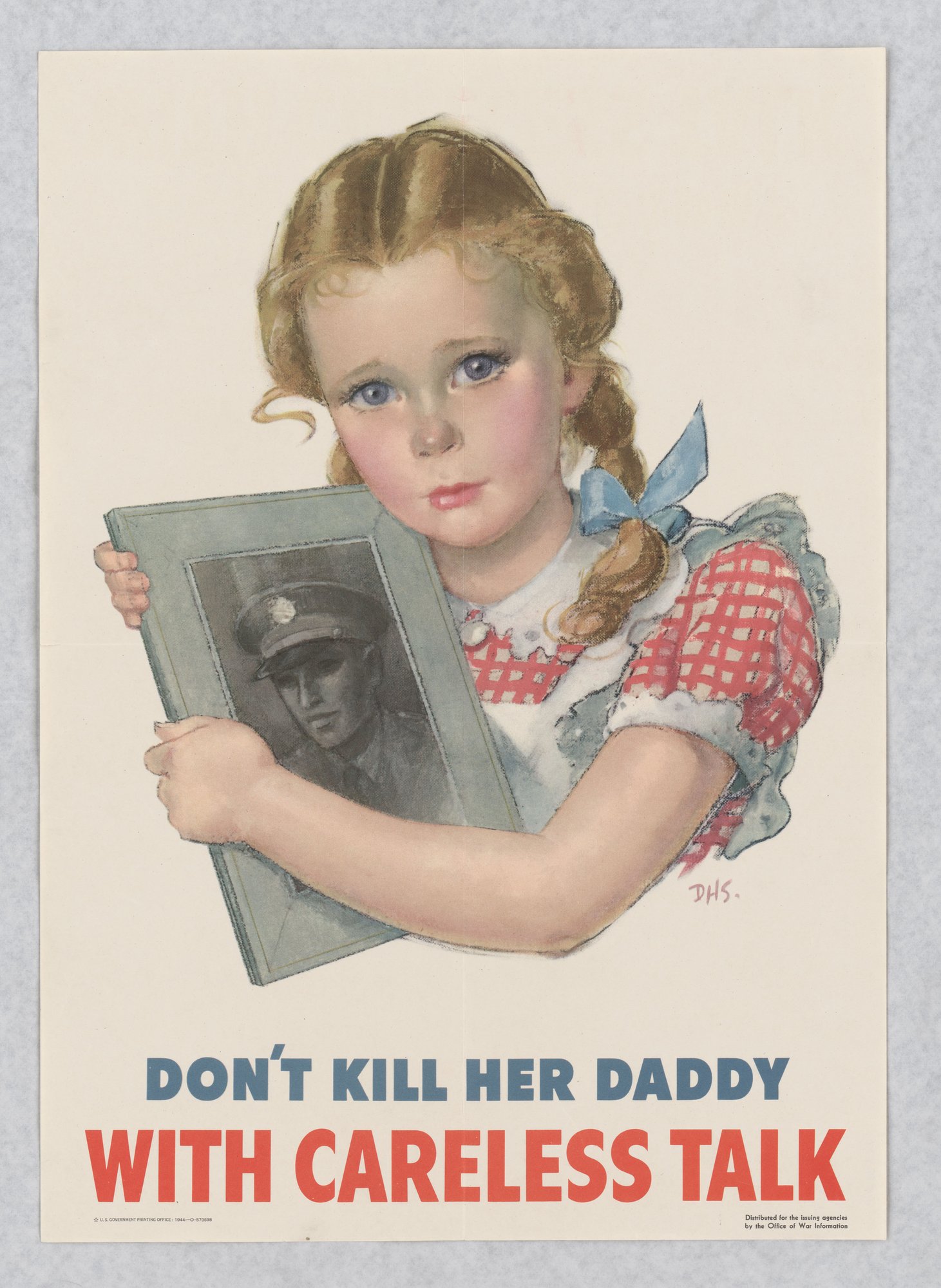
Don't Kill Her Daddy with Careless Talk is a 1944 security poster distributed by the Office of War Information for the issuing agencies, signed DHS. A small girl holds a framed photograph of a soldier (NAID 514149).
What the poster prints
A blond girl in braids and a gingham dress holds a framed photograph of a man in Army uniform against her chest. Her eyes are wide. The sheet has one sentence of text and two lines of credit.
DON'T KILL HER DADDY
WITH CARELESS TALK
[signature: DHS.]
[imprint: U.S. GOVERNMENT PRINTING OFFICE : 1944—O—570698]
Distributed for the issuing agencies
by the Office of War Information
Who issued it
The sheet says the Office of War Information distributed it "for the issuing agencies" and does not say which agencies those were. The artist signed only with initials, DHS. The archive does not expand the initials, so this page does not.
How to read it
The verb is the point. Most security posters say that talk helps the enemy. This one says the reader can kill a particular man, and puts his daughter in front of the reader to make it personal. The archive tags it fear appeal and transfer, and those are accurate.
The underlying rule was reasonable. Ship movements, unit locations, and sailing dates were real secrets, and a country at war may ask its people not to repeat them. The question a free-speech reader asks is about scope. The poster does not say what counts as careless. It leaves the line to the listener's conscience and to the neighbor's suspicion. A rule that vague can chill ordinary talk about the war, which citizens had every right to discuss. The sheet asks for silence about secrets; its emotional force pushes toward silence in general.
One of the best-known security slogans appears on a sheet published by a distiller, not the government; see the Seagram sheet. A German-helmet version of the warning is He's Watching You. The OWI's domestic work is examined in the domestic-branch case study, and its posters are indexed on the Office of War Information hub. The FRAME archive keeps a separate case study of the Writers' War Board. The rumor clinics case study treats the newspaper columns that answered rumors as a separate campaign from security posters like this one.
Sources
- FRAME object record, Don't kill her daddy with careless talk, 1944. Office of War Information (distributor for the issuing agencies); artist DHS. U.S. National Archives and Records Administration, Record Group 44, World War II Posters, NAID 514149, 44-PA-670, retrieved by the archive 4 October 2026. Rights as recorded: public domain (U.S. government work).