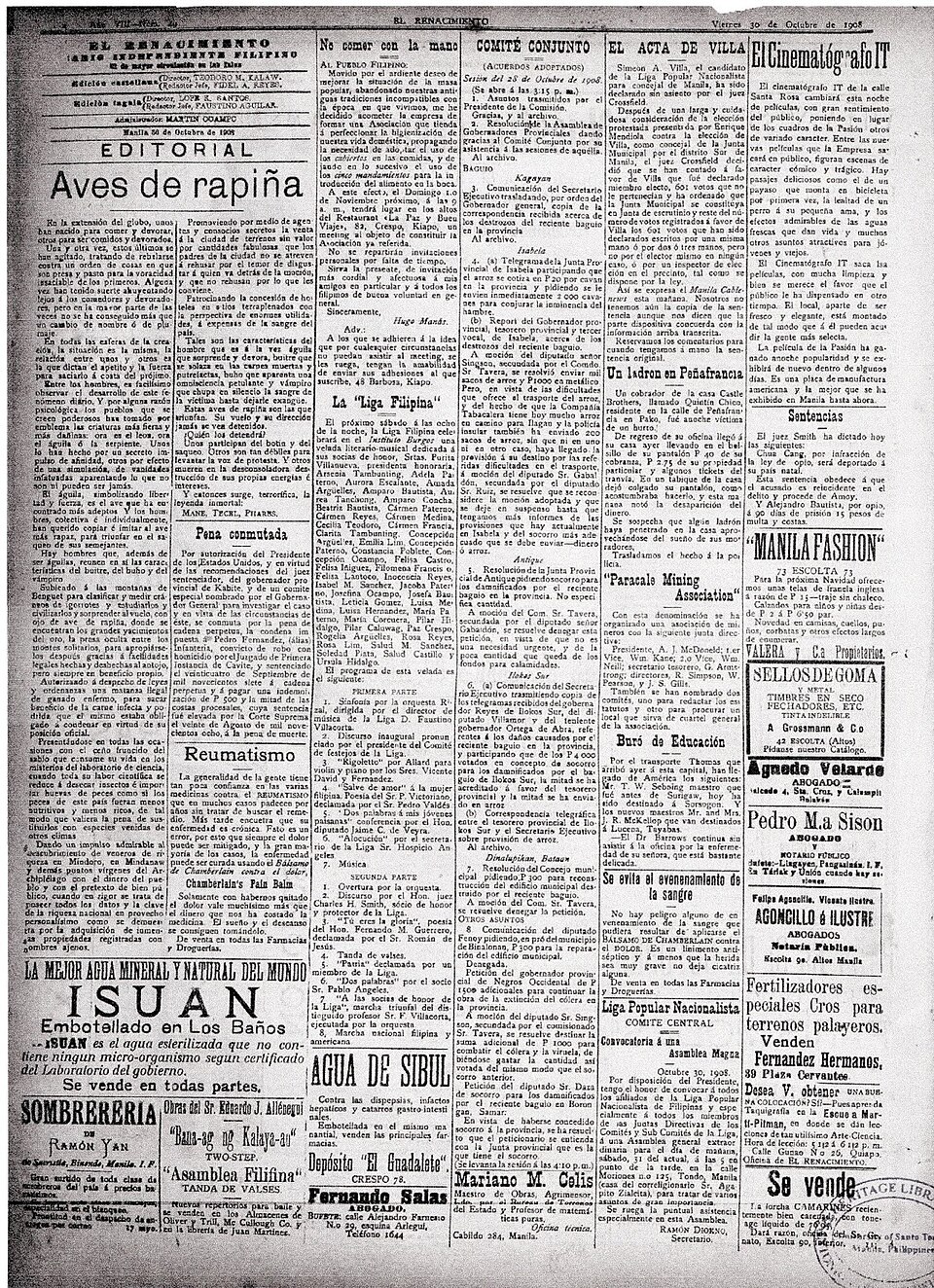
El Renacimiento, daily, p. 4 article (Manila, 30 October 1908): 'Aves de rapiña' (Birds of Prey)
Aves de rapiña, the 1908 Manila editorial that ended in a libel case
El Renacimiento's 30 October 1908 editorial Aves de rapiña called an unnamed official an eagle, vulture, owl and vampire. Filed under the libel case.
Techniques named on the archive record
Name-calling
Date
October 30, 1908
Made by
El Renacimiento, Manila (Spanish-Tagalog daily; directors Teodoro M. Kalaw and Lope K. Santos)
Medium
Newspaper pages
Country
United States
Regime
Theodore Roosevelt Administration
Source
Identified Openly sourced: the speaker is who they say they are
Source
Wikimedia Commons (scan courtesy of the Antonio Vivencio del Rosario Heritage Library, University of Santo Tomas) , retrieved October 2, 2026
Source
Public domain in the US: published 1908, before 1931; Commons scan, no rights statement (tag PD-US-expired) El Renacimiento, Manila, 30 October 1908; scan courtesy of the Antonio Vivencio del Rosario Heritage Library, University of Santo Tomas, via Wikimedia Commons
Object, image, and catalog record from the FRAME archive. Text on this page is CC BY 4.0. Image rights are as the archive records.
Aves de rapiña ("Birds of Prey") is an editorial in the Manila daily El Renacimiento of 30 October 1908. It never names its target, but lists one official's alleged acts in Benguet, Mindoro and Mindanao and calls him at once an eagle, a vulture, an owl and a vampire. The archive files it under the Worcester v. el Renacimiento libel case.
The editorial
Content note: the editorial likens an unnamed official to a vulture, an owl and a vampire and accuses him of corruption. The archive records that a court found it libelled a named official.
El Renacimiento was a Manila daily with a Spanish edition directed by Teodoro M. Kalaw and a Tagalog edition directed by Lope K. Santos, according to its masthead. The editorial opens with a reflection on those born to devour and those born to be devoured, and then turns to one man. It does not give his name. It describes his trips to the mountains of Benguet, a slaughter of diseased cattle, his scientific work, and the search for mineral wealth in Mindoro and Mindanao, and it ends with the words "Mane, Thecel, Phares."
Hay hombres que, además de ser águilas, reunen en sí las características del buitre, del buho y del vámpiro
[...]
Tales son las características del hombre que es á la vez águila que sorprende y devora, buitre que se solaza en las carnes muertas y putrefactas, buho que aparenta una omnisciencia petulante y vámpiro que chupa en silencio la sangre de la victima hasta dejarle exangüe.
[...]
¿Quién los detendrá?
[...]
MANE, THECEL, PHARES.
The archive gives an English translation, which it labels a machine translation not verified by a fluent reader. In that version, the second passage reads: "Such are the characteristics of the man who is at once an eagle that surprises and devours, a vulture that delights in dead and putrefying flesh, an owl that feigns a petulant omniscience and a vampire that silently sucks the blood of the victim until it is left bloodless." The closing question reads "Who will stop them?"
Name-calling and the charge
The archive tags the piece for name-calling, and the tell is plain: four animal epithets in one sentence, stacked on a man the paper chose not to name. Beside the epithets are specific charges, among them profit from condemned meat and land held under other people's names. Those charges were either true or false, and the epithets add nothing to deciding which.
The archive's purpose field for this record is "demonize." It also files the editorial under the libel case that followed. The record available here does not set out the trial, the parties' evidence, or the sentence, and this page does not supply them. What it shows is a newspaper in a territory governed by the United States, printing a fierce attack on an official, and a court then finding that attack libellous. A free reader can hold two thoughts at once: that the editorial traded in insult rather than proof, and that a libel case over a newspaper's attack on a public official is the kind of case where free speech most needs watching.
FRAME object record, El Renacimiento, daily, p. 4 article (Manila, 30 October 1908): 'Aves de rapiña' (Birds of Prey). El Renacimiento, Manila (Spanish-Tagalog daily; directors Teodoro M. Kalaw and Lope K. Santos). English translation as given by the archive, labelled unverified.
Wikimedia Commons, scan courtesy of the Antonio Vivencio del Rosario Heritage Library, University of Santo Tomas, file page, retrieved by the archive 2 October 2026. Rights as recorded: public domain in the US (published 1908).
,_p.4._(30_October_1908).jpg)