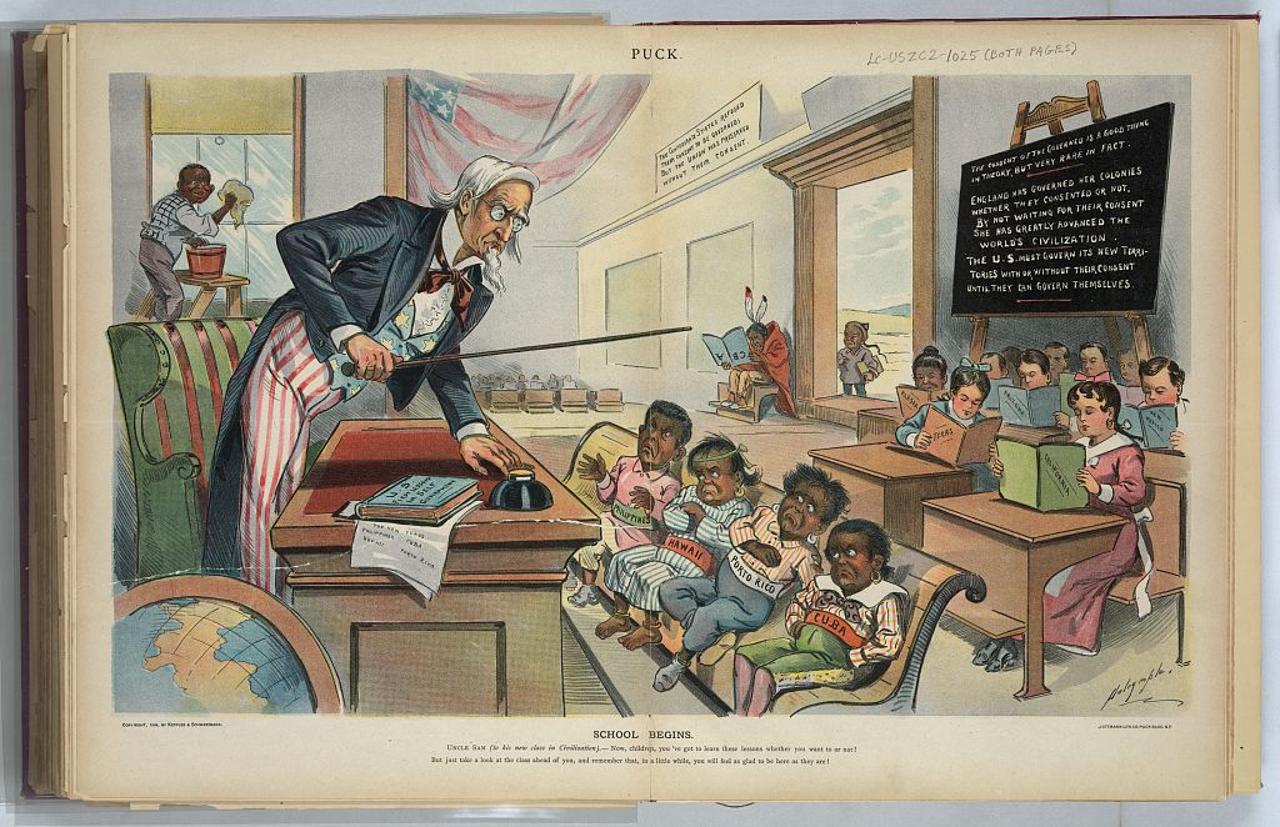
School Begins, Puck's 1899 lesson that new territories need not consent
Puck's School Begins (1899) puts "with or without their consent" on Uncle Sam's blackboard over pupils labelled Philippines, Hawaii, Porto Rico and Cuba.
Techniques named on the archive record
Name-callingGlittering generalities
Date
January 25, 1899
Made by
Puck magazine (Keppler & Schwarzmann)
Medium
Cartoon
Country
United States
Regime
Mckinley Administration
Source
Identified Openly sourced: the speaker is who they say they are
Source
Library of Congress, Prints and Photographs Division , retrieved September 27, 2026
Source
Public domain (published in the U.S. in 1899; LOC: no known restrictions on publication) Louis Dalrymple, "School Begins", Puck v. 44 no. 1142, 25 January 1899, centerfold (Keppler & Schwarzmann); LC-DIG-ppmsca-28668
Object, image, and catalog record from the FRAME archive. Text on this page is CC BY 4.0. Image rights are as the archive records.
School Begins, Louis Dalrymple's Puck centerfold of 25 January 1899, draws Uncle Sam teaching new pupils labelled Philippines, Hawaii, Porto Rico and Cuba under a blackboard that says the United States "must govern its new territories with or without their consent until they can govern themselves."
The classroom
Content note: the cartoon draws racial caricatures of Filipino, Hawaiian, Puerto Rican, Cuban, Black, Native American and Chinese children. They are described here, not reproduced in words.
Uncle Sam stands at the front of a schoolroom. In the front row sit four new pupils wearing sashes for Philippines, Hawaii, Porto Rico and Cuba; the archive describes them as drawn ragged and sullen. Older pupils behind them hold books marked Texas and California. A hand-lettered sign at upper left and a blackboard at upper right carry the lesson.
[hand-lettered sign, upper left] THE CONQUERED STATES REFUSED THEIR CONSENT TO BE GOVERNED; BUT THE UNION WAS PRESERVED WITHOUT THEIR CONSENT.
[blackboard, upper right] THE CONSENT OF THE GOVERNED IS A GOOD THING IN THEORY, BUT VERY RARE IN FACT.
ENGLAND HAS GOVERNED HER COLONIES WHETHER THEY CONSENTED OR NOT. BY NOT WAITING FOR THEIR CONSENT SHE HAS GREATLY ADVANCED THE WORLD'S CIVILIZATION.
THE U.S. MUST GOVERN ITS NEW TERRITORIES WITH OR WITHOUT THEIR CONSENT UNTIL THEY CAN GOVERN THEMSELVES.
[...]
SCHOOL BEGINS.
Uncle Sam (to his new class in Civilization).— Now, [illegible], you've got to learn these lessons whether you want to or not! But just take a look at the class ahead of you, and remember that, in a little while, you will feel as glad to be here as they are!
The argument on the wall
The archive tags the cartoon for name-calling and glittering generalities. The generality is "Civilization," the subject Uncle Sam is teaching, which is never defined and always assumed. The name-calling is in the drawing: the new subjects are pictured as children, and children do not get a vote.
What makes this cartoon worth reading closely is that it states the argument out loud. The blackboard does not pretend the Philippines consented. It says consent is "a good thing in theory, but very rare in fact," and it cites England's colonies as the model. That is a plain rejection of government by consent, and it is the wrong answer. A republic founded on the consent of the governed cannot make an exception for people it has decided are not ready, and then reserve to itself the judgment of when they are.
The sign about the Union is a sharper move. It points to the "conquered states" and the preserved Union to say consent was set aside once, so it can be set aside again. That treats a war fought to keep states in the Union as the same thing as ruling distant peoples who were never part of it. The cartoon does not argue the comparison; it simply hangs it on the wall.
Related on this site
In April 1899 Judge printed Victor Gillam's "White Man's Burden", with Uncle Sam and John Bull hauling colonial peoples uphill. In 1902 a New York Evening Journal cartoon quoted General Jacob H. Smith's order to "kill every one over ten". The benevolent assimilation case study covers the war the classroom picture leaves out.
Sources
FRAME object record, "School Begins" (Puck, 1899). Puck magazine (Keppler & Schwarzmann); Louis Dalrymple, Puck v. 44 no. 1142, 25 January 1899, centerfold.
Library of Congress, Prints and Photographs Division, LC-DIG-ppmsca-28668, catalog record, retrieved by the archive 27 September 2026. Rights as recorded: public domain (published in the U.S. in 1899; LOC: no known restrictions on publication).