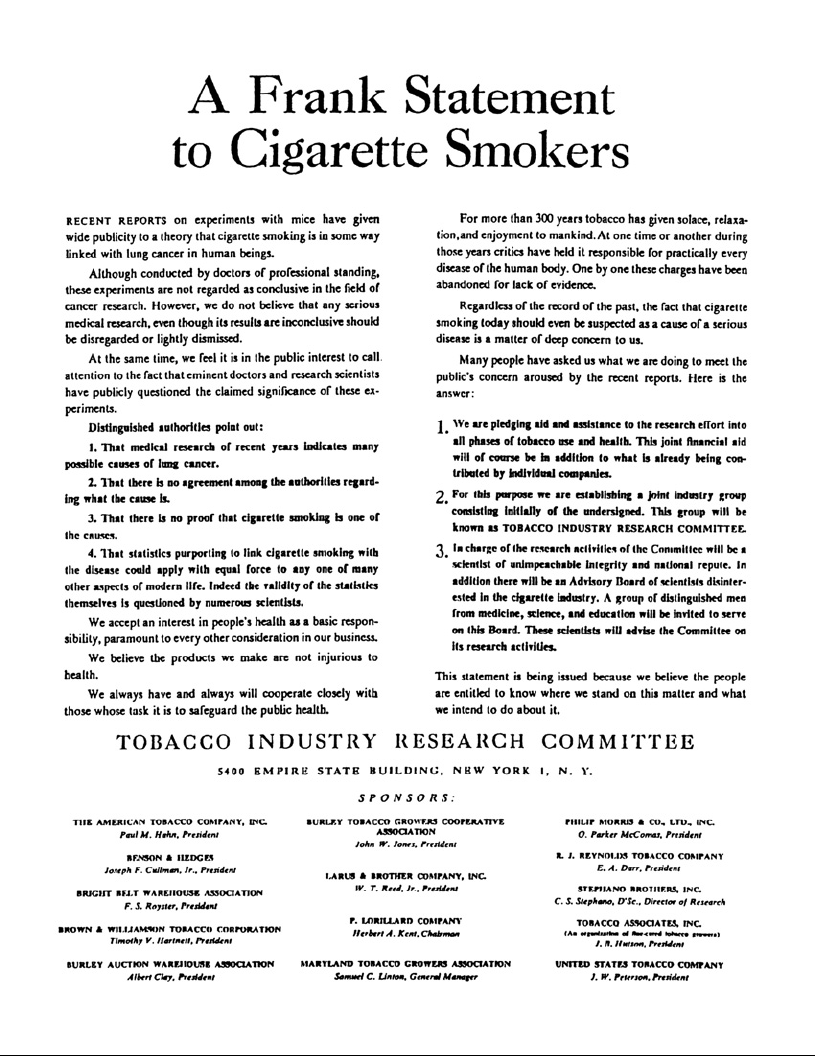
A Frank Statement to Cigarette Smokers was a full-page newspaper advertisement of 4 January 1954 in which cigarette makers, warehouse associations and growers' groups said there was "no proof" smoking caused lung cancer and announced the Tobacco Industry Research Committee.
What the ad says
The advertisement runs as a single block of text under its headline, with the sponsors listed at the foot. It opens by calling recent mouse experiments a "theory," numbers four points attributed to unnamed "distinguished authorities," states the companies' own position, and ends with a three-part plan. Excerpts from the FRAME transcription:
Distinguished authorities point out:
[...]
2. That there is no agreement among the authorities regarding what the cause is.
3. That there is no proof that cigarette smoking is one of the causes.
[...]
We accept an interest in people's health as a basic responsibility, paramount to every other consideration in our business.
We believe the products we make are not injurious to health.
[...]
3. In charge of the research activities of the Committee will be a scientist of unimpeachable integrity and national repute. In addition there will be an Advisory Board of scientists disinterested in the cigarette industry.
Who signed it
The signer is the Tobacco Industry Research Committee, at the Empire State Building in New York. Fourteen sponsors follow, each with an officer's name: cigarette makers including the American Tobacco Company, Philip Morris, R. J. Reynolds, P. Lorillard and Brown & Williamson, along with warehouse associations and growers' cooperatives. The archive took the image from Wikimedia Commons on 27 September 2026 and records it as public domain, published without a copyright notice.
How to read it
The ad is openly signed, which is to its credit; nobody hid who was talking. Its technique is balance where the evidence was not balanced. Every authority it cites is a doubter, none is named, and the reader is left with an even split between two camps. Then it offers a fix that keeps the question inside the industry: a committee paid for by the sponsors, staffed by scientists the sponsors would choose and call disinterested.
A company may defend its product in print, and a free country lets it. The freedom to say it does not make it so. "We believe the products we make are not injurious to health" was a statement of fact about the product, and it was wrong. The site's case study The cigarette makers' long argument that the jury was still out follows this ad to the Surgeon General's committee of January 1964, which found cigarette smoking causally related to lung cancer in men.
The earlier tobacco campaign in A cigarette account staged a women's freedom gesture points readers to this record.
Sources
- FRAME object record, "A Frank Statement to Cigarette Smokers," 4 January 1954. Tobacco Industry Research Committee (U.S. tobacco manufacturers and growers' associations). Wikimedia Commons, retrieved by the archive 27 September 2026. Rights as recorded: public domain (U.S., published 1954 without a copyright notice).