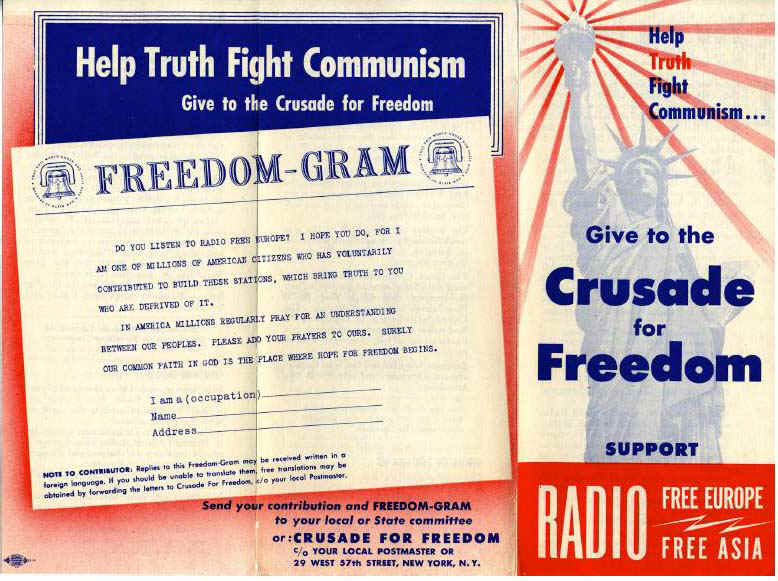
The 1952 Freedom-Gram asked Americans to give to the Crusade for Freedom and sign a message to listeners behind the Iron Curtain saying they had voluntarily paid to build Radio Free Europe. The stations were mainly funded through the CIA until 1971.
What the sheet prints
The mailer has two parts. One is a fund-raising appeal, with the Statue of Liberty and the slogan. The other is the Freedom-Gram itself, a short message in capitals with blanks for the donor's occupation, name, and address, meant to be sent abroad. Excerpts from the FRAME transcription:
Help Truth Fight Communism
Give to the Crusade for Freedom
FREEDOM-GRAM
DO YOU LISTEN TO RADIO FREE EUROPE? I HOPE YOU DO, FOR I AM ONE OF MILLIONS OF AMERICAN CITIZENS WHO HAS VOLUNTARILY CONTRIBUTED TO BUILD THESE STATIONS, WHICH BRING TRUTH TO YOU WHO ARE DEPRIVED OF IT.
[...]
Send your contribution and FREEDOM-GRAM to your local or State committee or: CRUSADE FOR FREEDOM c/o YOUR LOCAL POSTMASTER OR 29 WEST 57th STREET, NEW YORK, N.Y.
Who issued it
The issuer on the sheet is the Crusade for Freedom. The archive's maker line pairs it with the National Committee for a Free Europe and adds what the sheet does not: the effort was covertly funded by the CIA. The archive classes the source as blurred, a cutout between the real funder and the public. It took the image from Wikimedia Commons, via the Cold War Radios collection, on 27 September 2026.
How to read it
Every gift was voluntary, and nothing here forced anyone to give. The problem is the sentence the donor was asked to sign. It tells a listener abroad that American citizens built the stations, when, according to the archive record, the U.S. government was the main funder through the CIA until 1971. The donor became the spokesman for a funding story that left out the largest payer, and nothing on the sheet would have told him so.
That matters for the same reason the stations claimed to matter. A broadcaster whose case was "truth" to people denied it owed the same candor about its own backing to the Americans who paid twice, once in taxes they did not know about and once at the post office. The note even routed replies through the local postmaster, a federal office in plain sight carrying a message whose sponsor was hidden.
The case study Americans were asked to chip in for a private radio quotes this mailer. The same campaign produced the Truth Dollar and a 1951 donor stamp; a parallel covert-funding story is told in the Congress for Cultural Freedom case study.
Sources
- FRAME object record, "Freedom-Gram: Help Truth Fight Communism," 1952. Crusade for Freedom / National Committee for a Free Europe (covertly funded by the CIA). Wikimedia Commons (via Cold War Radios), retrieved by the archive 27 September 2026. Rights as recorded: public domain (U.S. government work).