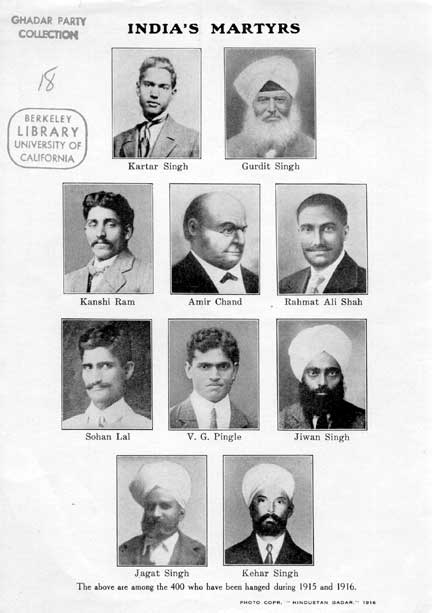
India's Martyrs (Ghadar Party handbill, San Francisco, 1916)
India's Martyrs (1916), a Ghadar Party handbill from San Francisco
A 1916 Ghadar Party handbill from San Francisco: ten named portraits under "INDIA'S MARTYRS," said to be among 400 hanged in 1915 and 1916.
Techniques named on the archive record
Transfer
Date
1916
Made by
Ghadar Party (Hindustan Ghadar), San Francisco
Medium
Leaflet
Country
United States
Regime
Wilson Administration
Source
Identified Openly sourced: the speaker is who they say they are
Source
Wikimedia Commons (scan from the Ghadar Party Collection, Berkeley Library, University of California) , retrieved September 29, 2026
Source
Public domain (published in San Francisco, 1916, before 1931; Commons tag PD-1923) Hindustan Ghadar (Ghadar Party), San Francisco, 1916; Ghadar Party Collection, Berkeley Library, University of California, via Wikimedia Commons
Object, image, and catalog record from the FRAME archive. Text on this page is CC BY 4.0. Image rights are as the archive records.
India's Martyrs is a 1916 handbill of the Ghadar Party in San Francisco. Ten named portraits sit in a grid under the heading, and one line calls them "among the 400 who have been hanged during 1915 and 1916." Berkeley Library copy via Wikimedia Commons.
Ten faces and one footnote
The handbill is a portrait gallery. Ten head-and-shoulders photographs are set in four rows, two, three, three and two, each captioned with a name. One sentence at the foot gives the context, and a copyright line credits the photographs to "HINDUSTAN GADAR."
INDIA'S MARTYRS
Kartar Singh / Gurdit Singh / Kanshi Ram / Amir Chand / Rahmat Ali Shah / Sohan Lal / V. G. Pingle / Jiwan Singh / Jagat Singh / Kehar Singh
The above are among the 400 who have been hanged during 1915 and 1916.
PHOTO COPR. "HINDUSTAN GADAR." 1916
What the record says
The maker is the Ghadar Party (Hindustan Ghadar), San Francisco, and the date 1916. The issuer type is a movement, the audience "Diaspora or minority," and the purpose "Commemorate." The themes are empire and colonialism, and war and the military. The archive tags transfer: calling executed men martyrs lends the honor of martyrdom to the party's cause.
The figure of 400 is the handbill's own. The sheet names ten men and gives no list, court, or place for the rest, and the record offers no check of the number. A reader can see the ten faces; the 400 has to be taken on the party's word.
A cause abroad, printed in California
The handbill was made in the United States for a cause in another country, by people who signed it. The record does not say how it was handed out or who read it. In March 1914 the Ghadar Press in San Francisco put out Ghadar di Gunj, a pamphlet of Punjabi patriotic verse whose cover banners read, in the archive's machine translation (marked not verified by a fluent reader), "First death" and "Afterwards freedom." The two pieces are consistent: the earlier cover calls for sacrifice, and this sheet names men the party says made it.
The archive files the handbill under the Wilson administration, the government in office when it was printed. Another diaspora sheet from the war years, Czechoslovaks! Join Our Free Colors!, was printed in Boston for a Czechoslovak recruiting office in New York.
Sources
FRAME object record, India's Martyrs (Ghadar Party handbill, San Francisco, 1916). Source classed as openly identified.
Ghadar Party Collection, Berkeley Library, University of California, via Wikimedia Commons, retrieved by the archive 29 September 2026. Rights as recorded: public domain (published in San Francisco, 1916, before 1931; Commons tag PD-1923).