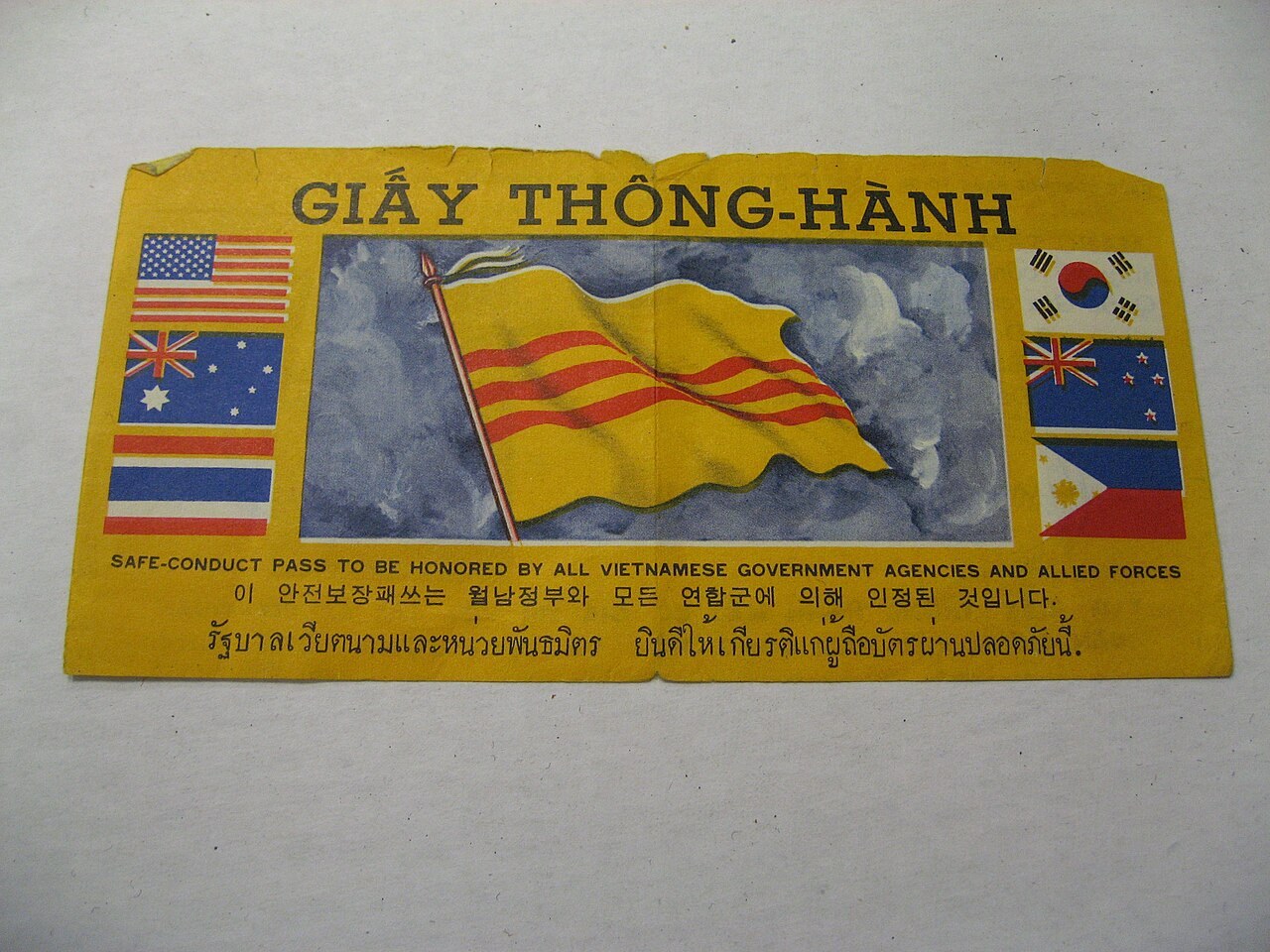
A 1967 Chieu Hoi safe-conduct pass with seven allied flags promises it will be honored by all Vietnamese government agencies and allied forces.
Techniques named on the archive record
Transfer
Date
1967
Made by
Chieu Hoi programme safe-conduct pass produced for the Government of Vietnam and allied forces; NHHC catalogues it as issued by American forces and air-dropped
Naval History and Heritage Command (accession 2009-7-32), via Flickr and Wikimedia Commons , retrieved October 2, 2026
Source
CC BY 2.0 (Commons cc-by-2.0, Flickr-reviewed); object also a U.S. Navy collection item Naval History and Heritage Command, accession 2009-7-32; Flickr user navalhistory, CC BY 2.0.
Object, image, and catalog record from the FRAME archive. Text on this page is CC BY 4.0. Image rights are as the archive records.
A yellow Chieu Hoi safe-conduct pass from 1967 shows the South Vietnamese flag flanked by the flags of the United States, Australia, Thailand, South Korea, New Zealand, and the Philippines. It says in English, Korean, and Thai that it is to be honored by all Vietnamese government agencies and allied forces.
What it prints
The pass is yellow. The flag of South Vietnam sits in the center. Around it are six more: the United States, Australia, Thailand, South Korea, New Zealand, and the Philippines. The heading is in Vietnamese. The promise is in English, then repeated in Korean and Thai.
GIẤY THÔNG-HÀNH
SAFE-CONDUCT PASS TO BE HONORED BY ALL VIETNAMESE GOVERNMENT AGENCIES AND ALLIED FORCES
FRAME describes it as a Chieu Hoi program pass produced for the Government of Vietnam and its allies. The Naval History and Heritage Command, which holds it as accession 2009-7-32, catalogs it as issued by American forces and dropped from the air. The image is the obverse, shared on Flickr and Wikimedia Commons under CC BY 2.0, retrieved 2 October 2026. FRAME classes the source as blurred; the pass does not name the office that printed it.
How to read it
A safe-conduct pass is an offer. The holder, an enemy fighter, is told that if he comes over with this paper he will be received rather than shot. The pass works only if he believes it. FRAME tags it transfer, and points to the row of flags as the device: the promise is staged as if every army he might meet had signed it. Printing the promise in Korean and Thai, the languages of two allied contingents, makes the same point to the soldiers who might be the ones receiving him.
The offer itself was a humane one. A war that gives the other side a way to stop fighting without dying is better than one that does not. What the pass cannot show is whether every unit behind those flags kept the promise every time; that is a question for the record of the war, not for the paper. The pass deserves to be judged by how it was honored.
FRAME object record, Giấy thông-hành (Safe-Conduct Pass, seven-flag version), 1967. Chieu Hoi program. Naval History and Heritage Command, accession 2009-7-32, via Flickr and Wikimedia Commons, retrieved 2 October 2026. Rights as recorded: CC BY 2.0; also a U.S. Navy collection item.