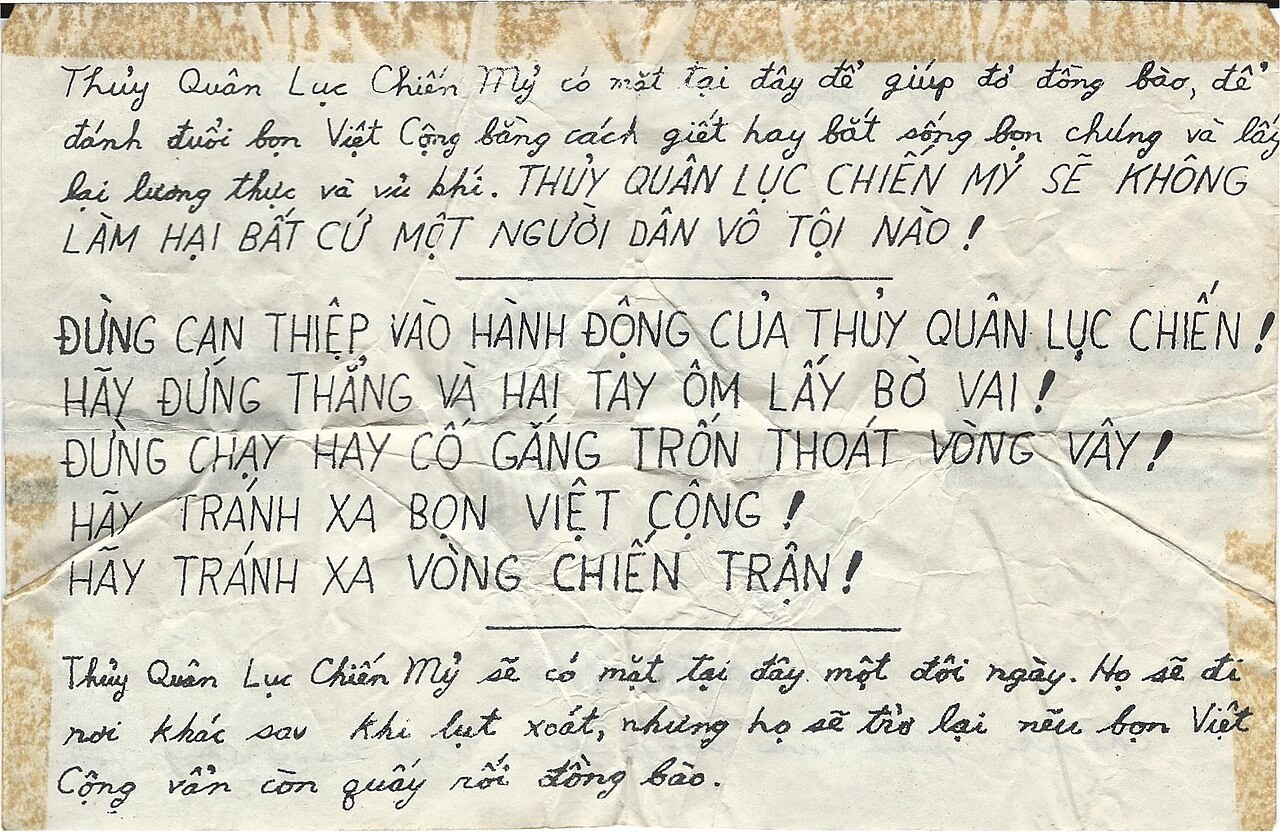
Thủy Quân Lục Chiến Mỹ có mặt tại đây để giúp đỡ đồng bào (U.S. Marines Are Here to Help the Villagers)
Orders for villagers inside a Marine cordon, on a hand-lettered 1966 leaflet
A 1966 Vietnamese leaflet from a U.S. Marine unit tells villagers inside a cordon to stand still, not run, and keep away from the Viet Cong.
Techniques named on the archive record
Name-calling
Date
1966
Made by
U.S. Marine Corps unit in Vietnam (leaflet names the U.S. Marines; unit and printer not stated)
Medium
Leaflet
Country
United States
Regime
Johnson Administration
Source
Identified Openly sourced: the speaker is who they say they are
Source
Marine Corps Archives & Special Collections (Gary Carlson Collection RF2014-46), via Flickr and Wikimedia Commons , retrieved October 2, 2026
Source
CC BY 2.0 (Marine Corps Archives & Special Collections on Flickr; Commons cc-by-2.0, Flickr-reviewed) Gary Carlson Collection (RF2014-46), Marine Corps Archives and Special Collections, Quantico; Flickr user usmcarchives, CC BY 2.0.
Object, image, and catalog record from the FRAME archive. Text on this page is CC BY 4.0. Image rights are as the archive records.
A hand-lettered Vietnamese leaflet from 1966 says U.S. Marines are in the village to help the people and to drive off the Viet Cong by killing or capturing them, promises no harm to innocent civilians, and gives five orders, including "Do not run or try to escape the cordon."
What it says
The leaflet is lettered by hand, not typeset. It opens with a statement of purpose, follows with five orders in capitals, and closes with a promise and a warning.
THỦY QUÂN LỤC CHIẾN MỸ SẼ KHÔNG LÀM HẠI BẤT CỨ MỘT NGƯỜI DÂN VÔ TỘI NÀO!
ĐỪNG CAN THIỆP VÀO HÀNH ĐỘNG CỦA THỦY QUÂN LỤC CHIẾN!
HÃY ĐỨNG THẲNG VÀ HAI TAY ÔM LẤY BỜ VAI!
ĐỪNG CHẠY HAY CỐ GẮNG TRỐN THOÁT VÒNG VÂY!
HÃY TRÁNH XA BỌN VIỆT CỘNG!
HÃY TRÁNH XA VÒNG CHIẾN TRẬN!
The opening line, in FRAME's rendering, says the Marines are there to help the villagers and to drive off the Viet Cong "by killing or capturing them and taking back food and weapons." The close says they will stay a day or two, move on after searching, and come back if the Viet Cong "still harass" the people.
Who made it
The maker line is a U.S. Marine Corps unit in Vietnam; the leaflet names the Marines, but not the unit or a printer. The copy is in the Gary Carlson Collection (RF2014-46) of the Marine Corps Archives and Special Collections at Quantico, shared on Flickr and Wikimedia Commons under CC BY 2.0, retrieved 2 October 2026.
How to read it
FRAME tags the leaflet name-calling for the word "bọn," a collective that reads as "gang," applied to the Viet Cong. That is the propaganda element. Most of the sheet is something else: instructions to civilians about how to survive an armed search of their homes. Stand still, hands on shoulders, do not run. Orders like these could protect people from being mistaken for fighters, and giving them in the villagers' own language was the decent thing to do.
It is also worth reading the orders as what they were. A foreign force was telling people in their own village that they could not leave, could not interfere, and must hold a posture of surrender while their houses were searched. The promise that no innocent person would be harmed was a promise, not a fact the leaflet could guarantee. Americans would recognize every one of those orders as a serious use of power if it were applied to them. That recognition is the right lens here too.
A different kind of leaflet from the same war, a pass promising safe treatment to anyone who came over, is the seven-flag safe-conduct pass.
Sources
FRAME object record, Thủy Quân Lục Chiến Mỹ có mặt tại đây để giúp đỡ đồng bào (U.S. Marines Are Here to Help the Villagers), 1966. U.S. Marine Corps unit in Vietnam. Marine Corps Archives and Special Collections, Gary Carlson Collection (RF2014-46), via Flickr and Wikimedia Commons, retrieved 2 October 2026. Rights as recorded: CC BY 2.0.