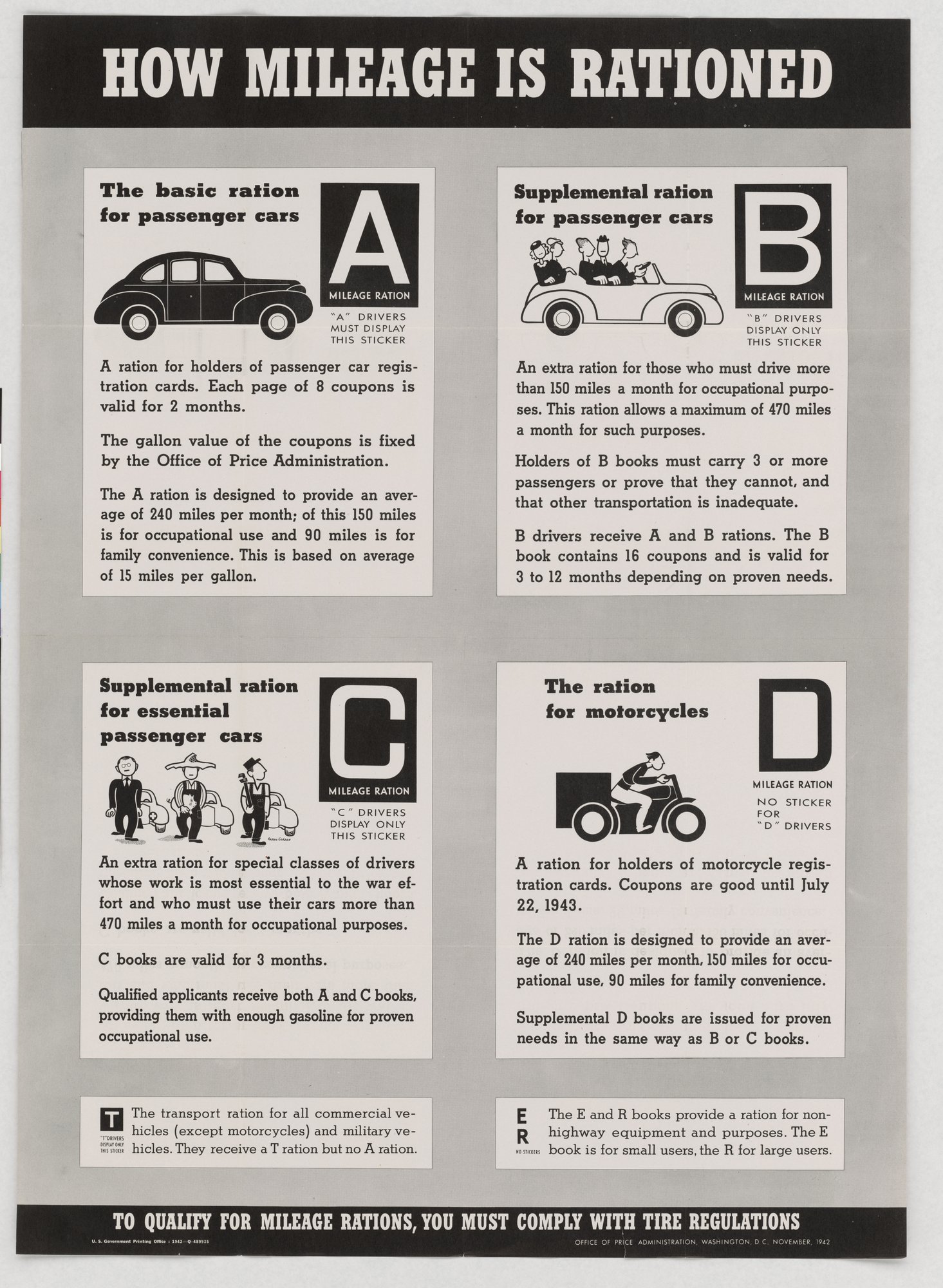
A November 1942 Office of Price Administration chart explains gasoline rationing by letter: A for basic driving, B and C for proven work driving, D for motorcycles, T for commercial vehicles, and E and R for off-highway use. It ends by tying every ration to the tire regulations (NAID 514538).
What the chart sets out
Four large boxes carry the main rations, each with a drawing of a car or a motorcycle and, for the car rations, the sticker its driver had to show. Smaller boxes below cover trucks and machinery. Nothing on the sheet is a picture of a soldier or a ship. It is a table in poster form.
HOW MILEAGE IS RATIONED
The basic ration for passenger cars [...]
"A" DRIVERS MUST DISPLAY THIS STICKER
A ration for holders of passenger car registration cards. Each page of 8 coupons is valid for 2 months.
The gallon value of the coupons is fixed by the Office of Price Administration.
The A ration is designed to provide an average of 240 miles per month; of this 150 miles is for occupational use and 90 miles is for family convenience. This is based on average of 15 miles per gallon.
[...]
Holders of B books must carry 3 or more passengers or prove that they cannot, and that other transportation is inadequate.
[...]
An extra ration for special classes of drivers whose work is most essential to the war effort and who must use their cars more than 470 miles a month for occupational purposes.
[...]
TO QUALIFY FOR MILEAGE RATIONS, YOU MUST COMPLY WITH TIRE REGULATIONS
[imprint: OFFICE OF PRICE ADMINISTRATION, WASHINGTON, D. C., NOVEMBER, 1942]
The issuer
The Office of Price Administration printed its name and the month, November 1942, in the imprint, with a Government Printing Office job number. The National Archives copy is in Record Group 44, World War II Posters, local identifier 44-PA-1012 (NAID 514538).
Reading the letters
The archive tags glittering generalities and calls the technique faint, pointing to one phrase: the C ration is for drivers "whose work is most essential to the war effort." The rest is arithmetic. A reader in 1942 could learn from this sheet how many coupons a book held, how long it lasted, and what the basic ration was meant to cover. As public notice of a rule, it is clear.
The same clarity shows how much the rule decided. The basic A book assumed 90 miles a month for "family convenience." Anything above the average required the driver to prove a need, and a B driver had to carry three passengers or prove that he could not. Someone other than the driver decided whose work counted as "most essential." The gallon value of each coupon was the agency's to fix, so the miles on the chart were an average, and the gallons behind them could change without a new chart.
FRAME object record, How mileage is rationed, 1942. Office of Price Administration. Rights as recorded: public domain (U.S. government work).
U.S. National Archives and Records Administration, Record Group 44, World War II Posters, 44-PA-1012, NAID 514538, retrieved by the archive 4 October 2026.