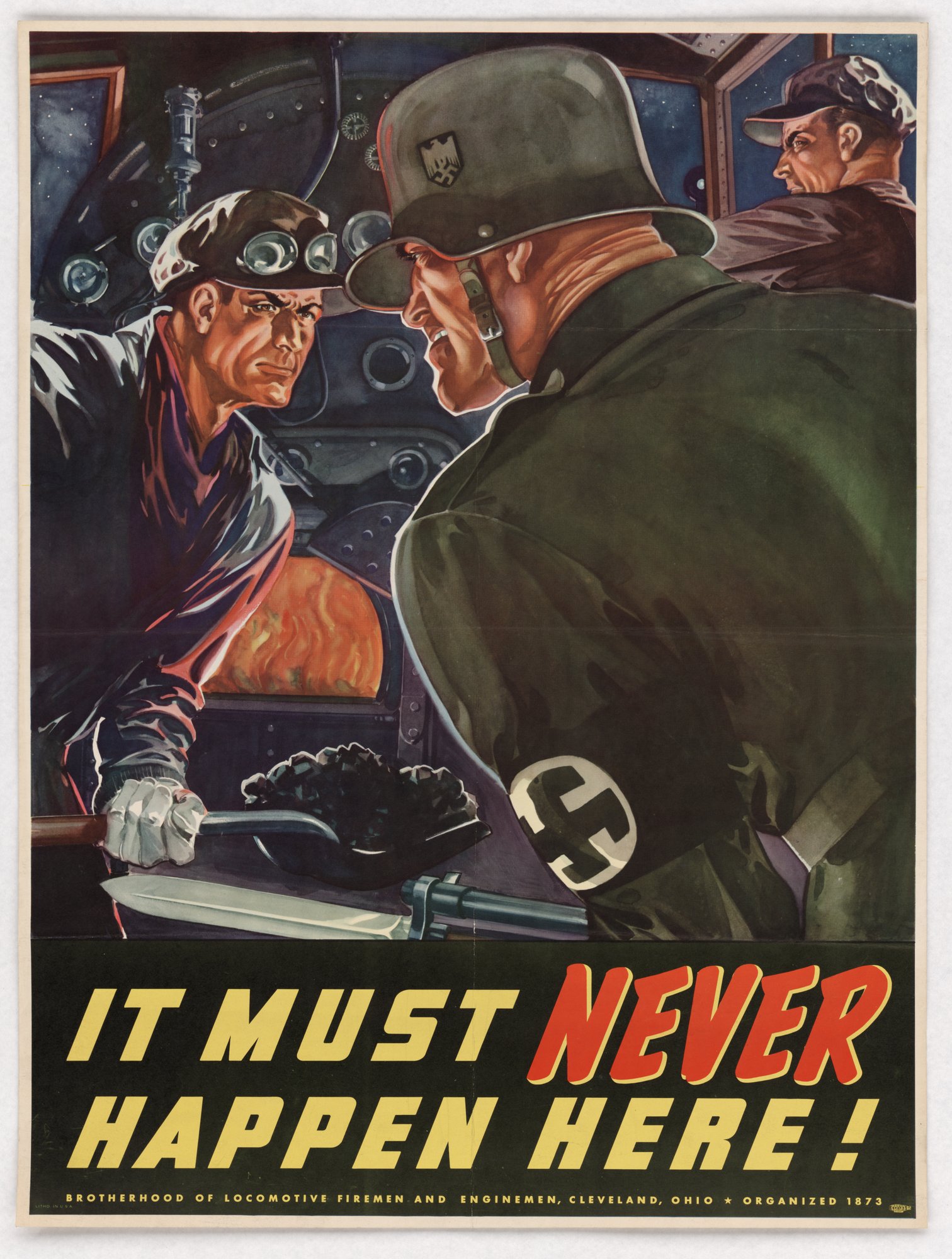
It must never happen here! is a poster from the Brotherhood of Locomotive Firemen and Enginemen of Cleveland, Ohio, catalogued at 1941. In a locomotive cab, a German soldier with a steel helmet, swastika armband and bayonet confronts a fireman holding a coal shovel while the engineer looks on (NAID 514641).
The cab
A warning first: the poster shows a German soldier threatening American railwaymen with a bayonet. The scene is the inside of a locomotive cab, the workplace of the men the union is named for. The fireman holds his coal shovel. The soldier, in a steel helmet and a swastika armband, confronts him with a bayonet. The engineer watches. The text is one line and the union's name.
IT MUST NEVER
HAPPEN HERE !
BROTHERHOOD OF LOCOMOTIVE FIREMEN AND ENGINEMEN, CLEVELAND, OHIO ★ ORGANIZED 1873
[imprint: LITHO IN U.S.A.]
What "it" means
The slogan never says what "it" is. The picture says it for the reader: an armed enemy standing over working men at their own post. The FRAME catalog tags fear appeal and lists the purpose as "Demonize." The enemy is drawn as a menace, and the threat is placed in the members' own workplace.
Fear is the tool here. The Roosevelt administration essay describes the Nazi regime as one that had earned the hatred such posters asked for, and a union saying so to its members is free speech doing its work. What the poster does not offer is any instruction. It does not ask for a bond, a pledge or a report. It asks the reader to feel the threat and to resolve against it.
A union speaks for itself
The issuer is a labor organization, which the archive types as an NGO, and it prints its founding year, 1873, beside its name. No federal office appears on the sheet. That matters for reading the period. The war effort on the home front was not only a government voice; private bodies, from unions to distillers, issued their own sheets and signed them. The archive's rights line still records this one as a public-domain U.S. government work, and the National Archives holds it with the World War II posters.
The case study of union and open-shop campaigns covers labor's own publicity in the years up to 1941. The anti-Nazi hub holds other American sheets aimed at the Nazi regime, and Seagram's Free Speech Doesn't Mean Careless Talk! is a company's signed contribution from the same file.
Sources
- FRAME object record, It must never happen here!, catalogued at 1941. Brotherhood of Locomotive Firemen and Enginemen, Cleveland, Ohio.
- U.S. National Archives and Records Administration, Record Group 44, World War II Posters, 44-PA-1114, NAID 514641, retrieved by the archive 4 October 2026. Rights as recorded: public domain (U.S. government work).