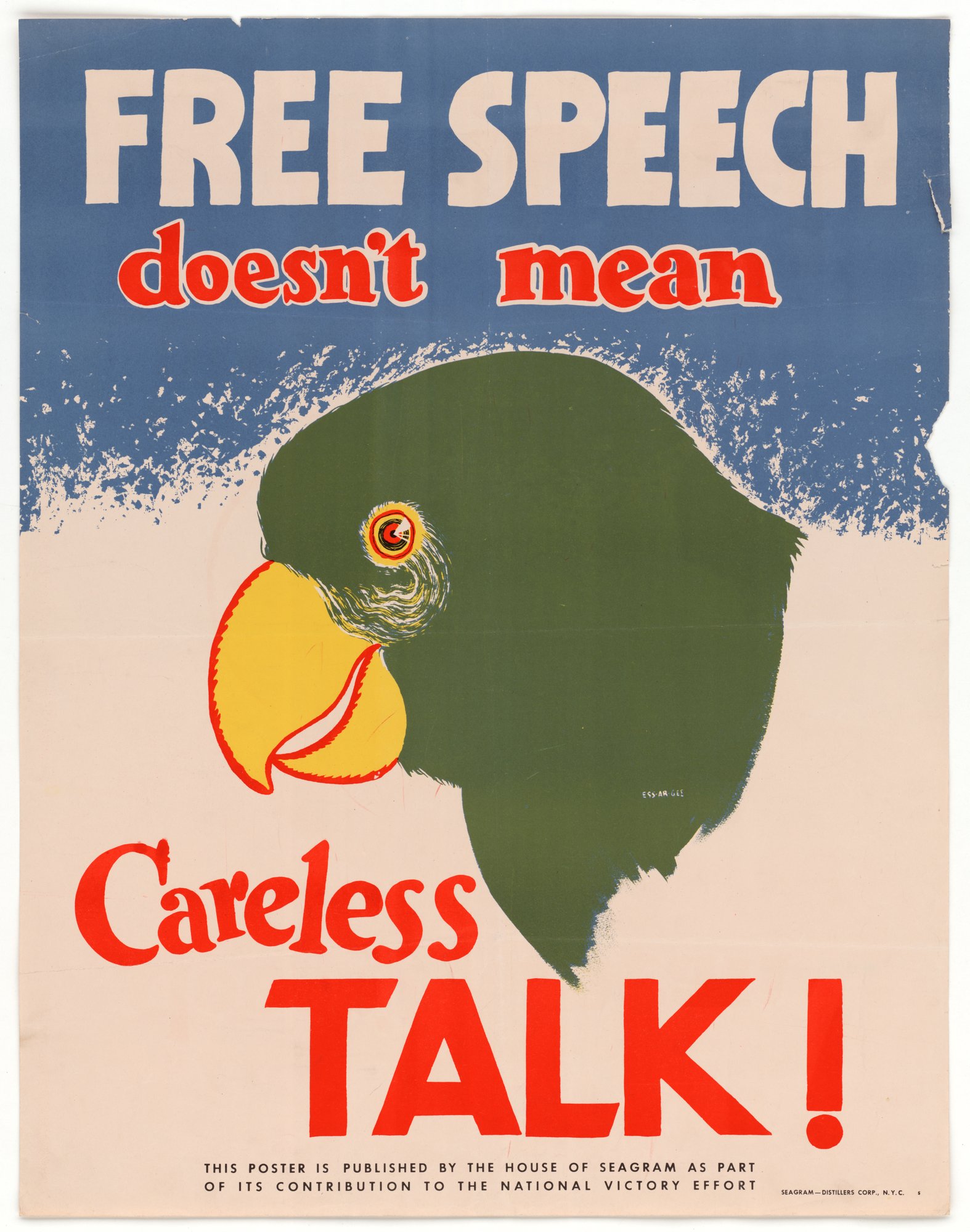
Free Speech Doesn't Mean Careless Talk! is a security poster published by the House of Seagram and signed Ess-Ar-Gee, catalogued at 1941. A large green parrot head fills the sheet under the slogan, and the sponsor's name appears only in small print at the foot (NAID 513606).
The parrot
Almost the whole sheet is one green parrot's head. A parrot repeats what it hears, and that is the joke: the careless talker is the bird who passes things on without thinking. Above it the slogan runs in four lines that mix capitals and lower case.
FREE SPEECH
doesn't mean
Careless
TALK!
THIS POSTER IS PUBLISHED BY THE HOUSE OF SEAGRAM AS PART
OF ITS CONTRIBUTION TO THE NATIONAL VICTORY EFFORT
[imprint:] SEAGRAM—DISTILLERS CORP., N.Y.C.
[signature:] ESS-AR-GEE
The right and the request
Seagram's Loose Lips sheet, as this site reads it, made silence the whole of patriotism. This one names the right first. It concedes that Americans have free speech and then asks them to use it with care. The FRAME catalog tags a single technique, transfer, and its reading is that the slogan separates a protected right from a wartime duty.
That is a fair line to draw, as far as it goes. Choosing not to repeat a ship's sailing date is self-restraint, and no one loses a liberty by exercising it. The sheet cites no statute and threatens no penalty. It is a request from a private company, and the reader may weigh it.
The weakness is the one shared by the whole genre. "Careless talk" is never defined. A parrot repeats everything, so the image does not separate a troop movement from a complaint about the war or a rumor about a neighbor. A citizen who took the poster at its widest could decide that any repeated story was suspect. The right named in the first two words is worth more than that.
Who published it
The House of Seagram, a distiller, published the sheet and says so at the foot; the artist signed as Ess-Ar-Gee. The archive's rights line records it as a public-domain U.S. government work, and the National Archives holds it with the World War II posters. Seagram's Loose Lips Might Sink Ships has its own page. The rumor clinics case study treats newspaper columns that answered rumors in print, a different approach from security posters that warned against talk of any kind. Norman Rockwell's Freedom of Speech is the period's picture of the right itself.
Sources
- FRAME object record, Free Speech Doesn't Mean Careless Talk!, catalogued at 1941. House of Seagram, Seagram-Distillers Corp., New York; art Ess-Ar-Gee.
- U.S. National Archives and Records Administration, Record Group 44, World War II Posters, 44-PA-159, NAID 513606, retrieved by the archive 4 October 2026. Rights as recorded: public domain (U.S. government work).