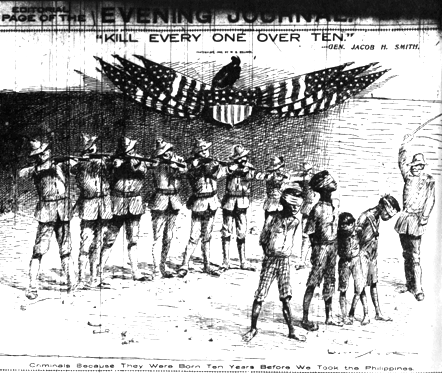
A New York Evening Journal editorial-page cartoon of May 5, 1902, credited in the rights line to Homer Davenport, quotes General Jacob H. Smith's order to "kill every one over ten" and shows blindfolded Filipino children before a firing squad, captioned as criminals because they were born ten years before the United States took the Philippines.
What the cartoon prints
Content note: the drawing shows blindfolded children awaiting execution.
The quotation sits at the top like a headline. Below, the picture shows what the words would mean: small Filipino children, blindfolded, on an American flag, with a U.S. Marine standing over them. The caption supplies the charge against the children, in bitter irony.
EDITORIAL PAGE OF THE EVENING JOURNAL
"KILL EVERY ONE OVER TEN."
—GEN. JACOB H. SMITH.
Criminals Because They Were Born Ten Years Before We Took the Philippines.
Who made it
The New York Evening Journal printed it on its editorial page on May 5, 1902; the rights line in the FRAME record credits Homer Davenport. It is public domain as a 1902 U.S. publication, and the scan is from Wikimedia Commons. The archive places it in the Theodore Roosevelt administration. The FRAME description ties the quotation to General Smith's order after the attack at Balangiga.
How to read it
Most objects in this archive are a government persuading its people. This one is a newspaper turning a general's own words against the government's war. The FRAME record tags it with name-calling and card stacking, and that is fair: the caption's "Criminals" is sarcasm aimed at the general, and the picture shows the order carried out rather than reporting what was done.
The heart of it is still accurate, and it is accurate in the way that counts. An order to kill everyone over ten is an order to kill children and noncombatants. That was wrong, and a free press that put it on the editorial page in plain words was doing what a free press is for. The cartoon uses the flag the way a citizen should be able to: as a standard the army was failing to meet.
The war and the official language around it, "benevolent assimilation" and "insurrection," are covered in the case study on the Philippine-American War. The newspaper habits that made such pages possible, sensational and partisan as they were, are in the yellow-press case study. Here those habits pointed at the right target.
Sources
- FRAME object record, "Kill Every One Over Ten" (New York Evening Journal, 1902), May 5, 1902. Rights line credits Homer Davenport, editorial page.
- Wikimedia Commons, retrieved by the archive 27 September 2026. Rights as recorded: public domain (published in the U.S. in 1902).