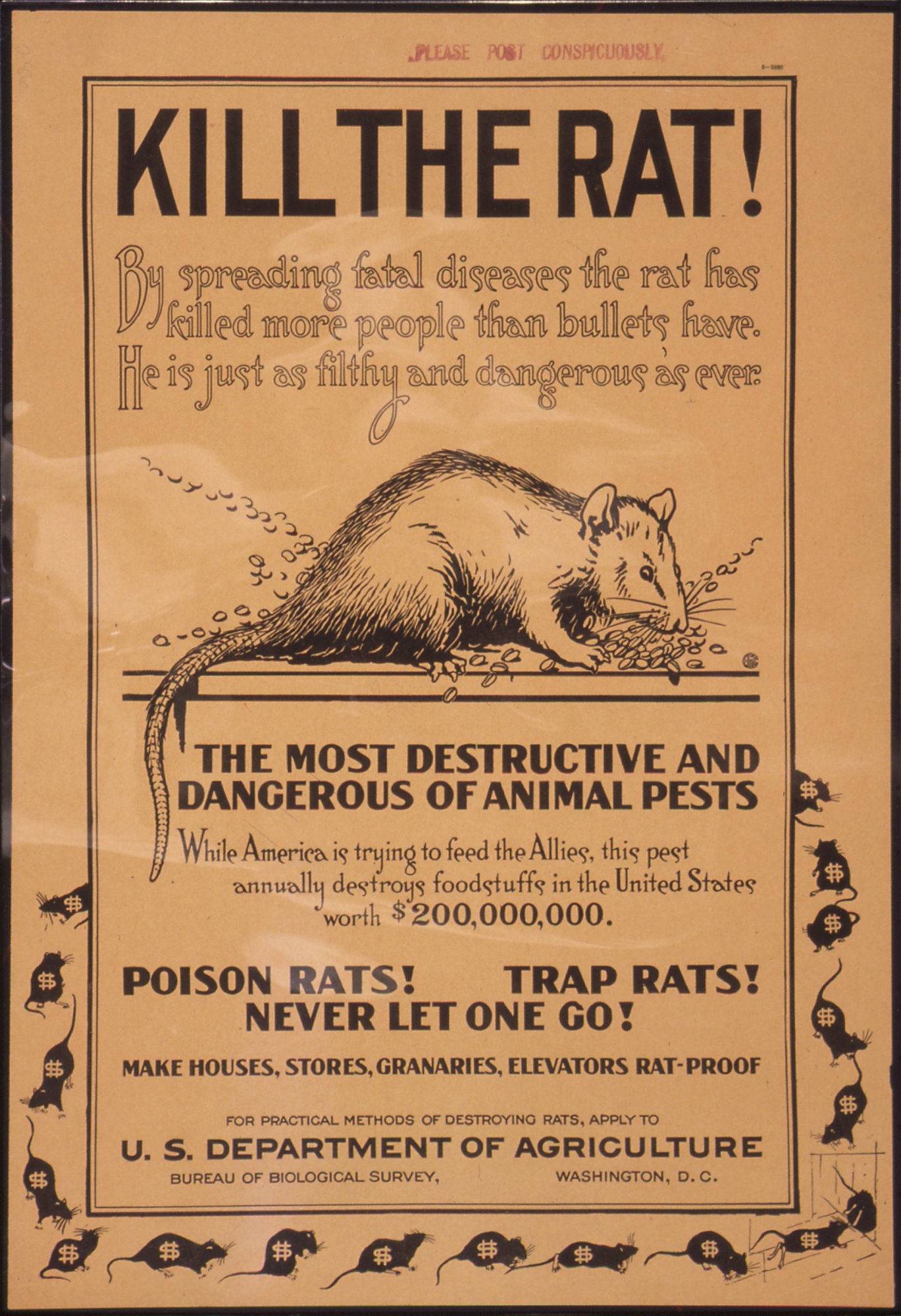
A 1917 notice from the Department of Agriculture's Bureau of Biological Survey shows a rat gnawing grain over a border of rats marked with dollar signs. It says the rat "has killed more people than bullets have," puts its yearly damage at $200,000,000, and tells readers to poison, trap and rat-proof.
The notice
A single rat, drawn large, crouches on a ledge over spilled grain. Below it runs a frieze of smaller black rats, each stamped with a dollar sign. The top line asks the reader to post the sheet where it will be seen, and the rest is set in short commands.
PLEASE POST CONSPICUOUSLY.
KILL THE RAT!
By spreading fatal diseases the rat has killed more people than bullets have. He is just as filthy and dangerous as ever.
THE MOST DESTRUCTIVE AND DANGEROUS OF ANIMAL PESTS
While America is trying to feed the Allies, this pest annually destroys foodstuffs in the United States worth $200,000,000.
POISON RATS! TRAP RATS!
NEVER LET ONE GO!
MAKE HOUSES, STORES, GRANARIES, ELEVATORS RAT-PROOF
The foot of the sheet sends readers who want "practical methods" to the Bureau of Biological Survey in Washington.
Who made it
The Department of Agriculture's Bureau of Biological Survey printed its name at the bottom. The National Archives copy sits in the World War I Posters series of Record Group 4 (series NAID 512439, catalog item 512723, local identifier 4-P-286). Record Group 4 belongs to the Food Administration, so the filing reflects where the poster was kept, not a second author.
Two numbers and a command
FRAME tags fear appeal and name-calling. The name-calling is aimed at an animal, "filthy and dangerous," and nobody needs to defend the rat. The two figures deserve more care. The claim that rats have killed more people than bullets is offered with no source, period or place, and the $200,000,000 of yearly damage is given without a method. They may be roughly right; the sheet does not let a reader check.
The war line does the persuading. It turns a farm and warehouse pest into a drain on the food the country had promised its allies, the same argument the Food Administration made about wasted wheat and sugar in these years. That framing recurs a generation later in the Public Health Service's Saboteur, where a rat stands over the word for an enemy agent.
The practical part is plain instruction: poison, traps and rat-proofed buildings, with more from the bureau on request. The sheet names no penalty and no inspector; acting on it was left to the reader.
The sheet's neighbors are in US public health messaging, 1917–1969, which also takes in the department's 1917 notice on tuberculosis in hogs.
Sources
- FRAME object record, Kill the Rat! The Most Destructive and Dangerous of Animal Pests, 1917. U.S. Department of Agriculture, Bureau of Biological Survey.
- U.S. National Archives, RG 4, World War I Posters, series NAID 512439, catalog item 512723, local identifier 4-P-286, retrieved by the archive 3 October 2026. Rights as recorded: NARA unrestricted.