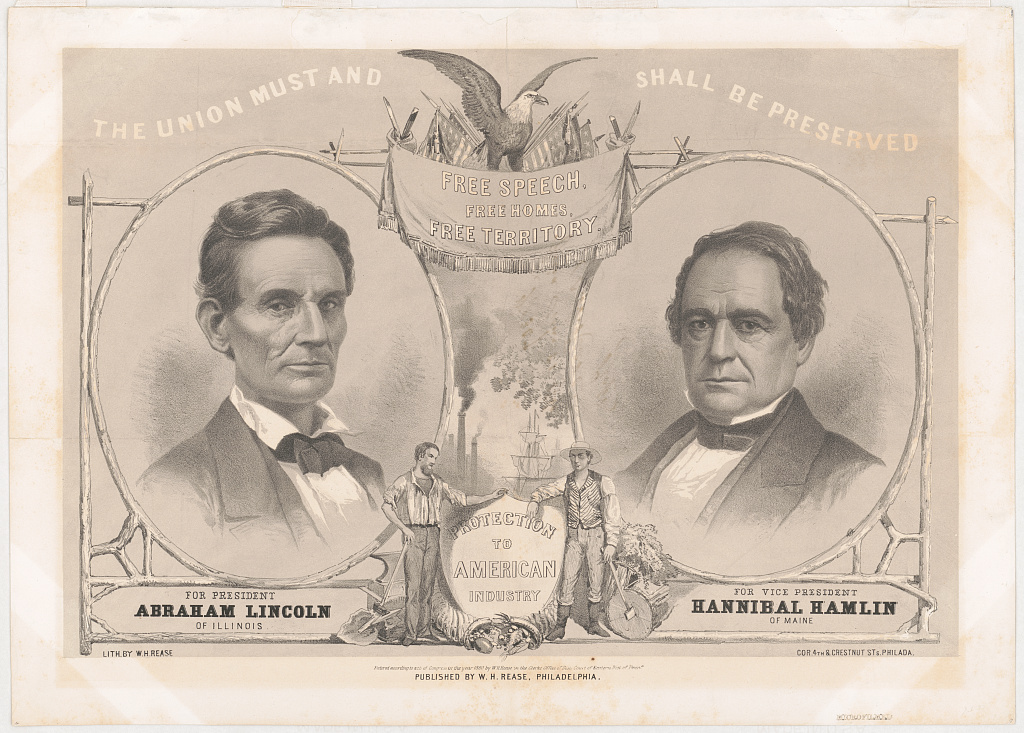
"The Union must and shall be preserved. For President Abraham Lincoln of Illinois. For Vice President Hannibal Hamlin of Maine" (W. H. Rease, 1860)
The Union Must and Shall Be Preserved, a Rease banner for Lincoln and Hamlin
W. H. Rease's 1860 Philadelphia banner for Lincoln and Hamlin prints "The Union must and shall be preserved" beside free-speech and tariff slogans.
Techniques named on the archive record
Glittering generalitiesTransfer
Date
1860
Made by
W. H. Rease, Philadelphia (lithographer and publisher), for the Republican Lincoln-Hamlin ticket
Medium
Print
Country
United States
Regime
Buchanan Administration
Source
Identified Openly sourced: the speaker is who they say they are
Source
Library of Congress, Prints & Photographs Division (Popular Graphic Arts) , retrieved October 2, 2026
Source
Public domain: published 1860, US. LOC reuse note: "No known restrictions on publication." Library of Congress, Prints and Photographs Division, "The Union must and shall be preserved. For President Abraham Lincoln of Illinois. For Vice President Hannibal Hamlin of
Object, image, and catalog record from the FRAME archive. Text on this page is CC BY 4.0. Image rights are as the archive records.
W. H. Rease of Philadelphia lithographed and published this 1860 banner for the Republican ticket. It pairs portraits of Abraham Lincoln and Hannibal Hamlin with "Free Speech, Free Homes, Free Territory" and "Protection to American Industry."
What the banner prints
Lincoln and Hamlin look out from oval frames made of rough twigs, a backwoods touch. Between them, a draped banner carries a three-part slogan. Below, two workingmen stand on either side of a shield about the tariff. An eagle and a mass of flags fill the background. The headline runs above it all.
THE UNION MUST AND SHALL BE PRESERVED
FREE SPEECH, FREE HOMES, FREE TERRITORY.
PROTECTION TO AMERICAN INDUSTRY
FOR PRESIDENT ABRAHAM LINCOLN OF ILLINOIS
FOR VICE PRESIDENT HANNIBAL HAMLIN OF MAINE
Who made it
Rease was a Philadelphia lithographer who both lithographed and published the sheet, from an address at Fourth and Chestnut. The archive credits it to him for the Republican ticket and dates it to the 1860 election, during James Buchanan's term. Pencil notes in the margin of the Library of Congress copy are not part of the print.
How to read it
The archive tags the banner for glittering generalities and transfer. The eagle and flags do the transfer, as they do on many campaign banners. What sets this one apart is the mix. "The Union must and shall be preserved" is a vow with no program in it. "Free Speech, Free Homes, Free Territory" names three things a voter could ask about. "Protection to American Industry" is a tariff plank, an economic policy with costs and winners, printed in the same register as the vow.
That blending is the technique to watch. A policy that helps some industries at others' expense is given the moral weight of the Union. A voter who doubted the tariff is left to wonder whether he doubted the country. Fair argument would separate the two. The banner joins them.
Still, "Free Speech" on a Republican banner in 1860 was a promise with content, and citizens could hold the ticket to it. The words were not new to banners: twelve years earlier the Free Soil banner had printed "Free Soil.-Free Labor.-Free Speech." Four years later a Democratic songster sheet answered Lincoln with "Little Mac".
Sources
FRAME object record, "The Union must and shall be preserved. For President Abraham Lincoln of Illinois. For Vice President Hannibal Hamlin of Maine" (W. H. Rease, 1860).
Library of Congress, Prints and Photographs Division (Popular Graphic Arts). loc.gov/pictures/item/2003690790, retrieved by the archive 2 October 2026. Rights as recorded: public domain, no known restrictions on publication.