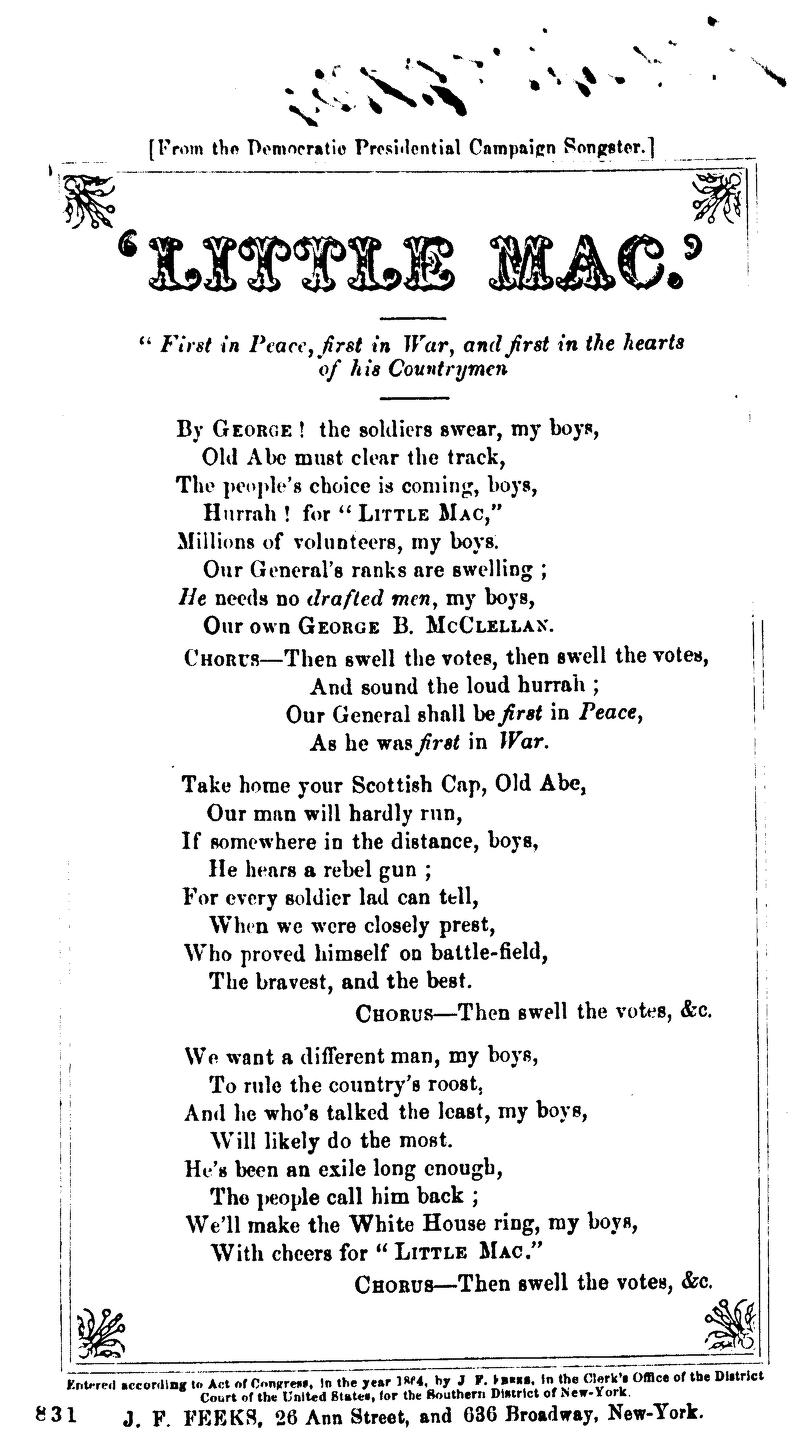
J. F. Feeks of New York published this 1864 song sheet from the Democratic Presidential Campaign Songster. Its verses cast George B. McClellan as the soldiers' choice, mock Lincoln's Scotch cap, and boast that McClellan "needs no drafted men."
What the sheet prints
A single song, three verses and a chorus, set under a borrowed line of praise. The epigraph adapts the words long used of George Washington, "First in Peace, first in War," and hands them to General George B. McClellan, the Democratic candidate against a sitting wartime president.
By GEORGE! the soldiers swear, my boys, Old Abe must clear the track, The people's choice is coming, boys, Hurrah! for "LITTLE MAC," Millions of volunteers, my boys, Our General's ranks are swelling; He needs no drafted men, my boys, Our own GEORGE B. McCLELLAN.
CHORUS—Then swell the votes, then swell the votes, And sound the loud hurrah; Our General shall be first in Peace, As he was first in War.
Take home your Scottish Cap, Old Abe, Our man will hardly run, If somewhere in the distance, boys, He hears a rebel gun; [...]
Who published it
Feeks was a New York publisher; the imprint gives addresses on Ann Street and Broadway. He registered the copyright and printed the song as an extract from a Democratic campaign songster. The archive files it under the Lincoln administration and the 1864 election. The Library of Congress holds it among its American song sheets.
How to read it
The archive tags the sheet for bandwagon and plain folks. The bandwagon is the soldiers: "the soldiers swear" that Lincoln must go, and "the people's choice is coming." No count of soldiers is offered. A song cannot poll an army, and this one does not try. The plain-folks register is the "my boys" refrain and the jab at Lincoln's cap, a costume joke that asks a voter to laugh at the man rather than weigh his record.
The line worth stopping on is "He needs no drafted men." In a war fought partly with conscripts, the song turns the draft into a campaign issue and pins it on the incumbent. That is a real question about state power over citizens, and voters were entitled to have it argued. The verse argues it with a boast instead of a plan. How McClellan would fill the ranks without a draft, the song does not say.
What is worth admiring is the setting. In the middle of a civil war, an opposition party printed and sold songs mocking the commander in chief, and an election went ahead. Compare the Republican banner of four years earlier, The Union Must and Shall Be Preserved. The Civil War print case study covers the 1864 campaign prints on both sides and the election the North held in the middle of the war.
Sources
FRAME object record, "Little Mac." (from the Democratic Presidential Campaign Songster), 1864. Published by J. F. Feeks, New York.
Library of Congress, Rare Book and Special Collections Division, American Song Sheets. loc.gov/item/amss-as108310, retrieved by the archive 2 October 2026. Rights as recorded: public domain.