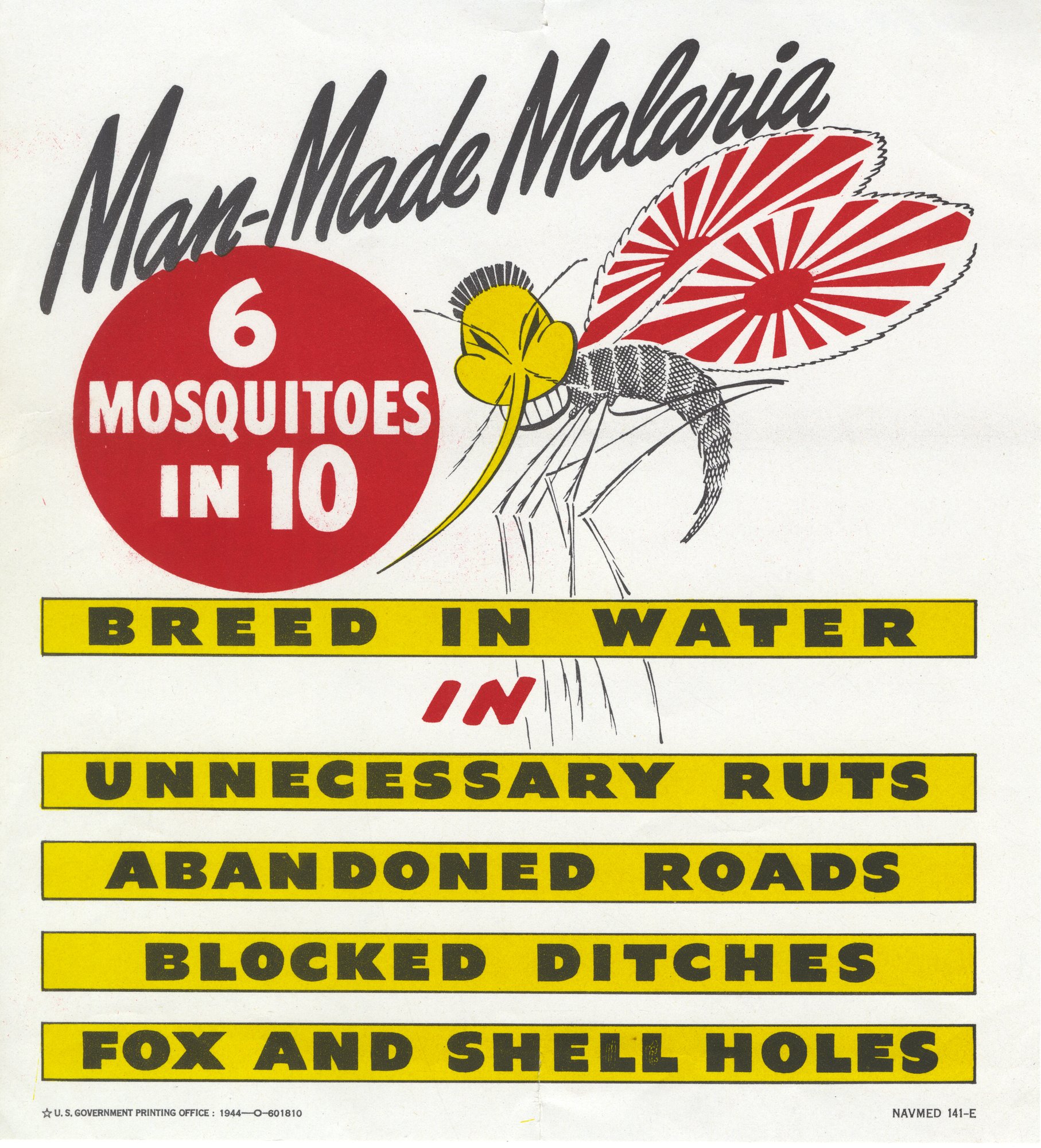
Man-Made Malaria is a 1944 Navy sheet, NAVMED 141-E. It tells troops that "6 mosquitoes in 10" breed in ruts, abandoned roads, blocked ditches and fox and shell holes, beside a cartoon mosquito drawn with rising-sun wings and a caricatured Japanese face (NAID 514974).
What is printed
The text is a list. A large numeral 6, the words "in 10," and four places where standing water collects after men and vehicles have been through. Beside it sits the cartoon. FRAME describes the insect's wings in a rising-sun pattern and its face drawn yellow, with buck teeth and slanted eyes: the stock wartime caricature of a Japanese man, put on a mosquito.
Man-Made Malaria
6
MOSQUITOES
IN 10
BREED IN WATER
IN
UNNECESSARY RUTS
ABANDONED ROADS
BLOCKED DITCHES
FOX AND SHELL HOLES
U. S. GOVERNMENT PRINTING OFFICE : 1944-O-601810
NAVMED 141-E
Who made it
The form number NAVMED 141-E marks it as a Navy medical publication, and the Government Printing Office printed it in 1944. The National Archives holds it in Record Group 44, World War II Posters, as 44-PA-1327 (NAID 514974). Two neighbors in the same NAVMED 141 run make the pairing explicit. Enemies Both! (141-D, artist Frank Mack) has Uncle Sam holding a caricatured Japanese officer in one hand and a malaria mosquito in the other. Is Your Organization Prepared to Fight Both Enemies? (141-F) sets a card reading "Japs casualties one" against one reading "Malaria casualties eight."
Two messages on one sheet
The first message is practical. The title makes its point in two words: on the sheet's account, much of the breeding water around a base was made by the people stationed there. Fill the ruts, clear the ditches, drain the holes. A sailor could act on it the same day, and it treats him as someone able to fix the problem. The ratio, six in ten, has no source on the sheet; it is the Navy's figure, and the sheet does not say how it was reached.
The second message is the face. FRAME tags transfer and fear appeal: the enemy's flag and a racial caricature are placed on the insect so that hatred of one becomes energy against the other. A government asking its own men to drain ditches had no need to teach them to picture a people as insects. It did so anyway, on an official Navy medical sheet. That was wrong, and saying so takes nothing away from the drainage advice next to it.
Not every malaria sheet in the file used the device. The Public Health Service's Keep Out Malaria Mosquitoes drew a comic mosquito with no nationality, and the War Department's Don't Strip Tease for Anopheles made its point with a joke about a towel. The full set, home front and overseas, is in US public health messaging, 1917–1969.
Sources
- FRAME object record, Man-Made Malaria, 1944. U.S. Navy (sheet marked NAVMED 141-E).
- U.S. National Archives and Records Administration, Record Group 44, World War II Posters, NAID 514974, local id 44-PA-1327, catalog record, retrieved by the archive 4 October 2026. Rights as recorded: public domain (U.S. government work).
- FRAME object records, Enemies both! It's your job to help eliminate them (NAVMED 141-D, NAID 514207) and Is your organization prepared to fight both enemies? (NAVMED 141-F, NAID 514636), U.S. Navy, 1944.