U.S. National Archives (NARA), RG 306, Psychological Warfare Posters, Vietnam War (NAID 561393) , retrieved October 3, 2026
Source
NARA Unrestricted; hosted by owner decision Joint U.S. Public Affairs Office (JUSPAO) printing section, Saigon, for the South Vietnamese government. National Archives and Records Administration, 306-VP-5-1720.
Object, image, and catalog record from the FRAME archive. Text on this page is CC BY 4.0. Image rights are as the archive records.
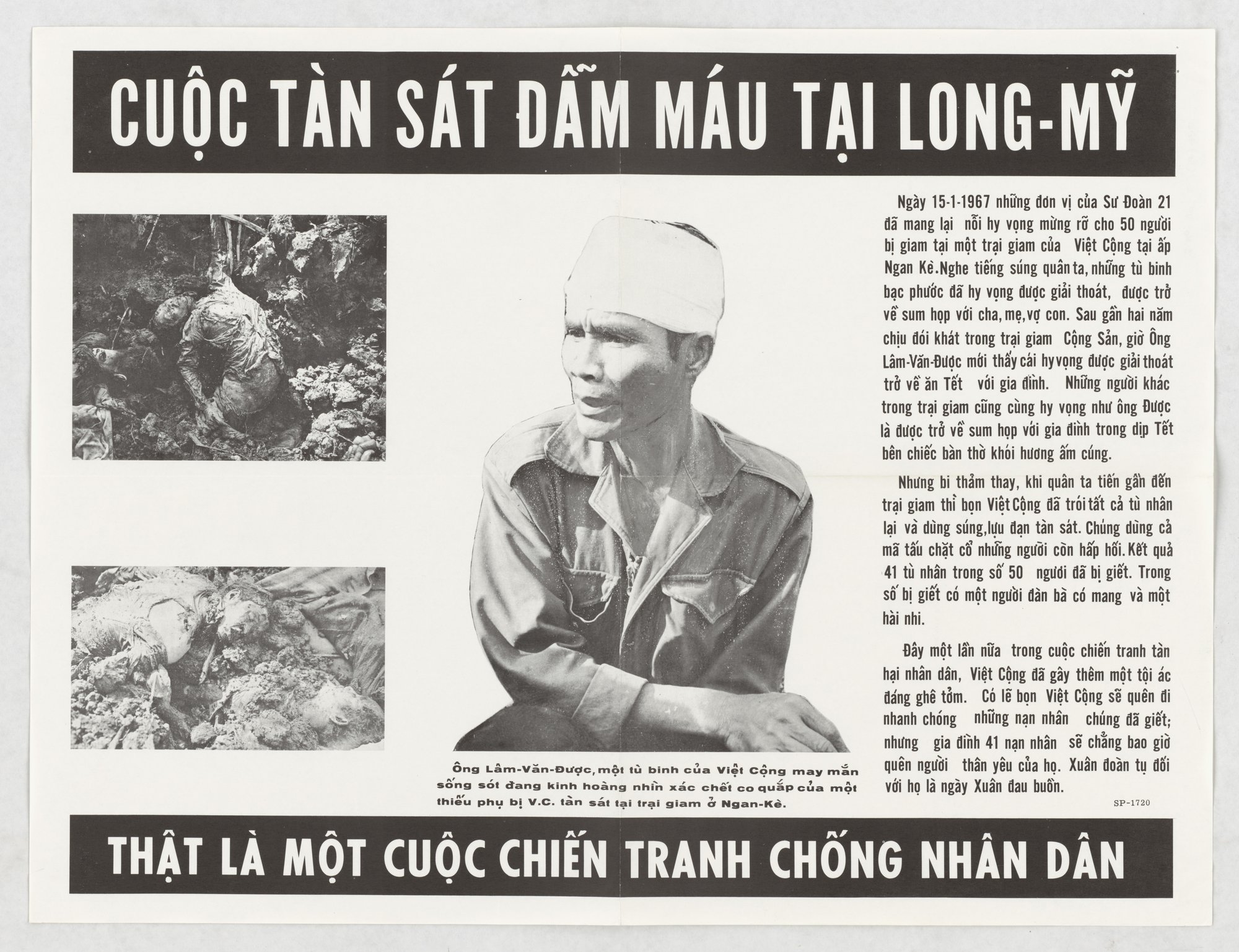
The Massacre of Long My is sheet SP-1720, printed by the JUSPAO printing section in Saigon for the South Vietnamese government in 1967. It says the Viet Cong bound and killed 41 of 50 prisoners at Ngan Kè on 15 January 1967 as the 21st Division approached, and shows a survivor, Lâm Văn Được, beside photographs of the dead.
What it says
Content note: the sheet shows photographs of corpses and describes the killing of prisoners, including a pregnant woman and an infant.
A black headline runs across a wide sheet. Below it are a photograph of a bandaged former prisoner, Lâm Văn Được, two small uncaptioned photographs of bodies in earth, and a block of text. A closing banner gives the moral.
CUỘC TÀN SÁT ĐẪM MÁU TẠI LONG-MỸ
Ngày 15-1-1967 những đơn vị của Sư Đoàn 21 đã mang lại nỗi hy vọng mừng rỡ cho 50 người bị giam tại một trại giam của Việt Cộng tại ấp Ngan Kè. [...]
Nhưng bi thảm thay, khi quân ta tiến gần đến trại giam thì bọn Việt Cộng đã trói tất cả tù nhân lại và dùng súng, lựu đạn tàn sát. [...] Kết quả 41 tù nhân trong số 50 người đã bị giết. [...]
THẬT LÀ MỘT CUỘC CHIẾN TRANH CHỐNG NHÂN DÂN
SP-1720
Who printed it
The maker line is the Joint U.S. Public Affairs Office printing section, Saigon, for the South Vietnamese government. The National Archives item is 306-VP-5-1720, in the Psychological Warfare Posters series of Record Group 306. The audience is coded as the domestic public, the purpose as demonizing, and the source as "Source blurred: contractors, cutouts, buried disclosure." The text speaks as "our troops" (quân ta), in the South Vietnamese voice; no American office is named.
How to read it
FRAME tags fear appeal, testimonial, scapegoating and atrocity propaganda, and says the tell is the combination: a named survivor, photographs of the dead, and a count, all pointing at one side. It gives a date, a hamlet, a division, a prisoner count and a survivor's name. The archive has not checked those details against other records.
A specific atrocity report can be true and still be propaganda, because the label describes how a report is used. What a reader can fairly note is the voice. A U.S. public affairs office's print shop produced a sheet that speaks as the Vietnamese government's army, and the sheet does not tell its Vietnamese reader who printed it. Compare the private, signed American poster Liberated by the Viet Cong, which makes similar charges with no named sources but under its own name. The Vietnam War messaging hub has more of the JUSPAO series.
Sources
FRAME object record, The Massacre of Long My (Cuộc tàn sát đẫm máu tại Long-Mỹ), SP-1720, 1967. Joint U.S. Public Affairs Office (JUSPAO) printing section, Saigon, for the South Vietnamese government. English translation in the record is machine-assisted and not verified by a fluent reader.
U.S. National Archives, Record Group 306, Psychological Warfare Posters, Vietnam War (NAID 561393), catalog record, item 306-VP-5-1720, retrieved by the archive 3 October 2026. Rights as recorded: NARA Unrestricted.