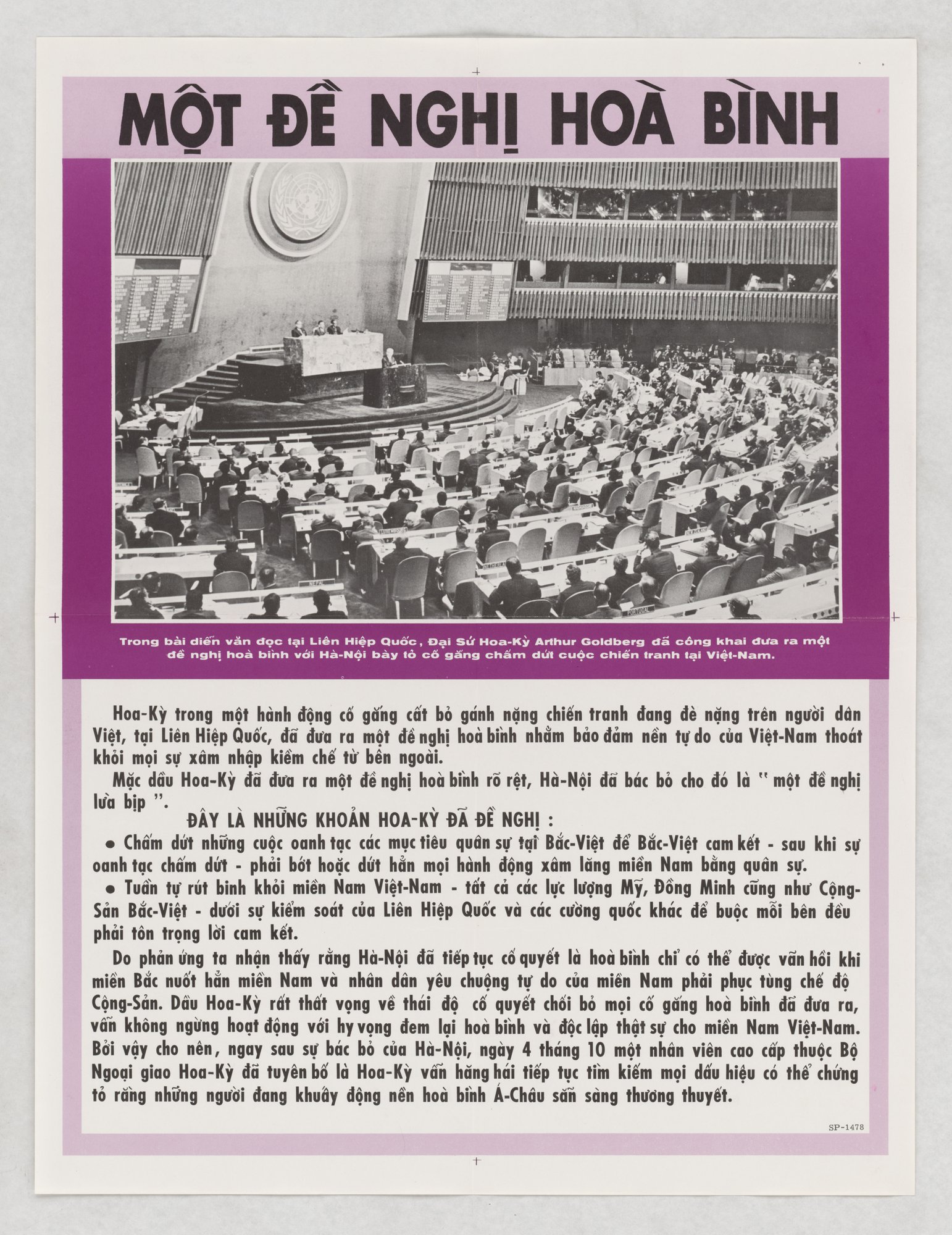
Goldberg's UN peace terms, retold for Vietnamese readers on a 1966 JUSPAO sheet
A 1966 Vietnamese-language JUSPAO sheet, SP-1478, sets out the peace terms Ambassador Goldberg offered at the UN and Hanoi's refusal. NARA RG 306.
Techniques named on the archive record
Card stackingTransfer
Date
1966
Made by
U.S. Information Agency, Joint U.S. Public Affairs Office (JUSPAO) printing section
Medium
Poster
Country
United States
Regime
Johnson Administration
NARA
NAID 561393
Source
Identified Openly sourced: the speaker is who they say they are
Source
U.S. National Archives (NARA), RG 306, Psychological Warfare Posters, Vietnam War (NAID 561393) , retrieved October 3, 2026
Source
NARA Unrestricted; hosted by owner decision U.S. Information Agency, Joint U.S. Public Affairs Office (JUSPAO) printing section. National Archives and Records Administration, 306-VP-01-1478.
Object, image, and catalog record from the FRAME archive. Text on this page is CC BY 4.0. Image rights are as the archive records.
Sheet SP-1478, printed in 1966 by the JUSPAO printing section of the U.S. Information Agency, tells Vietnamese readers what Ambassador Arthur Goldberg offered Hanoi at the United Nations, lists two terms, and reports that Hanoi called the offer a trick.
The sheet
A photograph of the United Nations General Assembly hall sits beside a block of Vietnamese text. Two bulleted terms are set apart in the middle. The code SP-1478 is printed at the foot. These are the lines that carry the argument:
MỘT ĐỀ NGHỊ HOÀ BÌNH
[...]
Mặc dầu Hoa-Kỳ đã đưa ra một đề nghị hoà bình rõ rệt, Hà-Nội đã bác bỏ cho đó là " một đề nghị lừa bịp ".
ĐÂY LÀ NHỮNG KHOẢN HOA-KỲ ĐÃ ĐỀ NGHỊ :
In FRAME's rendering, the two terms are these. First, the United States would stop bombing military targets in the North, and the North would then reduce or end its military action against the South. Second, every foreign force would leave the South in stages, American, allied, and North Vietnamese alike, with the United Nations and other powers checking that each side kept its word. The text closes by saying that on 4 October a senior State Department official declared that Washington was still looking for any sign that "those who are disturbing the peace of Asia" were ready to negotiate.
Who printed it
The catalog credits the U.S. Information Agency and the printing section of the Joint U.S. Public Affairs Office. The National Archives holds the sheet in the series Psychological Warfare Posters, Vietnam War, Record Group 306 (series NAID 561393, item 306-VP-01-1478). The sheet names the United States as the actor throughout, and FRAME files its source as openly identified.
Reading it
This is a government reporting its own diplomacy to a foreign public. The sheet says the offer was made in a speech at the UN; the archive holds the sheet, not the speech, so this page gives the terms only as the sheet states them. FRAME tags it card stacking and transfer. The transfer is the General Assembly photograph: the hall lends the American offer the standing of the world body. The stacking is in the quoting. The American side gets several paragraphs and two bulleted terms; Hanoi gets three words, "a deceitful proposal," and a summary of its position written by the other side.
A reader in Saigon was given no way to weigh Hanoi's reasons, only its refusal. That is ordinary for wartime messaging and it would be ordinary in the other direction too. The useful habit for a citizen of the country that printed it is the same one this site applies to the Why Viet Nam pamphlet: when a government tells you what its opponent said, find the opponent's own words before you decide who blocked the peace.
FRAME object record, Một đề nghị hòa bình (A Proposal for Peace), 1966. U.S. Information Agency, Joint U.S. Public Affairs Office (JUSPAO) printing section. Code SP-1478.
U.S. National Archives, RG 306, Psychological Warfare Posters, Vietnam War (NAID 561393), catalog record, 306-VP-01-1478, retrieved by the archive 3 October 2026. Rights as recorded: NARA Unrestricted.