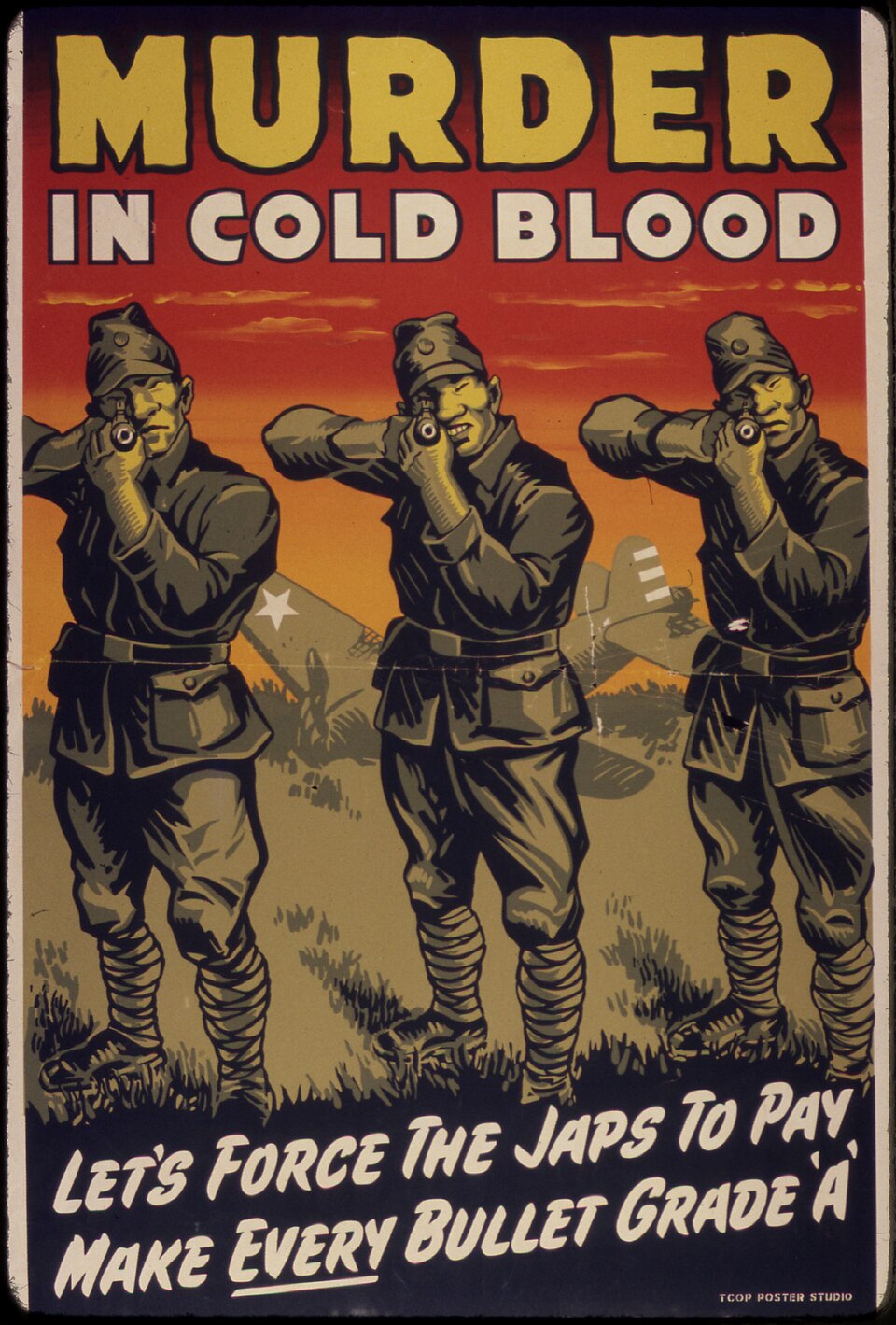
Murder in Cold Blood: Let's Force the Japs to Pay (TCOP Poster Studio)
Murder in Cold Blood: Let's Force the Japs to Pay (1942), a war-plant ammunition poster
"LET'S FORCE THE JAPS TO PAY": a 1942 TCOP Poster Studio war-plant poster turns a racial caricature into a drive for grade A bullets. NARA 534789.
Techniques named on the archive record
Name-callingFear appeal
Date
1942
Made by
TCOP Poster Studio (credit as printed); war-plant ammunition-quality poster, sponsor not otherwise stated
Medium
Poster
Country
United States
Regime
Roosevelt Administration
NARA
NARA 534789
Source
Identified Openly sourced: the speaker is who they say they are
Source
U.S. National Archives and Records Administration (NARA 534789, local id 179-WP-938), via Wikimedia Commons , retrieved October 2, 2026
Source
Public domain in the US (published 1942 without a copyright notice); NARA: No Copyright - United States U.S. National Archives and Records Administration (NARA 534789, 179-WP-938)
Object, image, and catalog record from the FRAME archive. Text on this page is CC BY 4.0. Image rights are as the archive records.
Murder in cold blood is a 1942 war-plant poster credited to TCOP Poster Studio. Three soldiers drawn with yellow-green faces and squinting eyes aim rifles at the viewer in front of a wrecked plane marked with a white star, above the lines "LET'S FORCE THE JAPS TO PAY. MAKE EVERY BULLET GRADE 'A'" (NARA 534789).
Rifles at the reader
Content note: the slogan uses the slur "Japs," and the soldiers are drawn as racial caricatures. Both appear here as the record gives them.
The guns point out of the sheet. Three soldiers in Japanese-style caps and puttees aim their rifles straight at whoever is looking, and the archive describes their faces as yellow-green with squinting eyes. Behind them lies a wrecked aircraft bearing a white star. The headline is an accusation; the base line turns it into a job instruction.
MURDER
IN COLD BLOOD
LET'S FORCE THE JAPS TO PAY.
MAKE EVERY BULLET GRADE 'A'
TCOP POSTER STUDIO
An unnamed sponsor
The only credit printed is "TCOP Poster Studio." The record's maker line calls the sheet a war-plant ammunition-quality poster whose sponsor is not otherwise stated, and the issuer type is "Mixed." Its purpose field reads "Mobilize or secure compliance," for a domestic audience, and its themes are labor, war, and race and ethnicity. The archive took the image from Wikimedia Commons, where it is a National Archives file (NARA 534789, local id 179-WP-938). The rights line says it was published in 1942 without a copyright notice. Where the record leaves the sponsor blank, so does this page.
Quality control by hatred
The request is reasonable on its own terms. Defective ammunition fails the men who carry it, and a plant that wanted every round to pass inspection had cause to say so. The archive tags name-calling and fear appeal for the way the poster says it.
The rifles are aimed at the viewer, and the remedy on offer is better ammunition. The enemy is drawn as a skin color and a squint. The demand is to "FORCE THE JAPS TO PAY," a debt charged to a people, while the evidence in the picture is a wrecked aircraft, the work of an armed force. The poster asks for careful work and supplies a racial grudge as the motive, when the men who would fire the bullets were reason enough.
The same appeal ran through other plant posters. They're Closer Than You Think!, a 1942 Army Ordnance sheet, sets a caricatured German soldier and a caricatured Japanese soldier over a machinist at his lathe. The Tokio Kid series did it with a cartoon character, and the anti-Japanese propaganda hub gathers the rest.
Sources
FRAME object record, Murder in Cold Blood: Let's Force the Japs to Pay (TCOP Poster Studio), 1942. TCOP Poster Studio (credit as printed); war-plant ammunition-quality poster, sponsor not otherwise stated. Rights as recorded: public domain in the US (published 1942 without a copyright notice); NARA: No Copyright - United States.
U.S. National Archives and Records Administration, NARA 534789, local id 179-WP-938, via Wikimedia Commons, retrieved by the archive 2 October 2026.