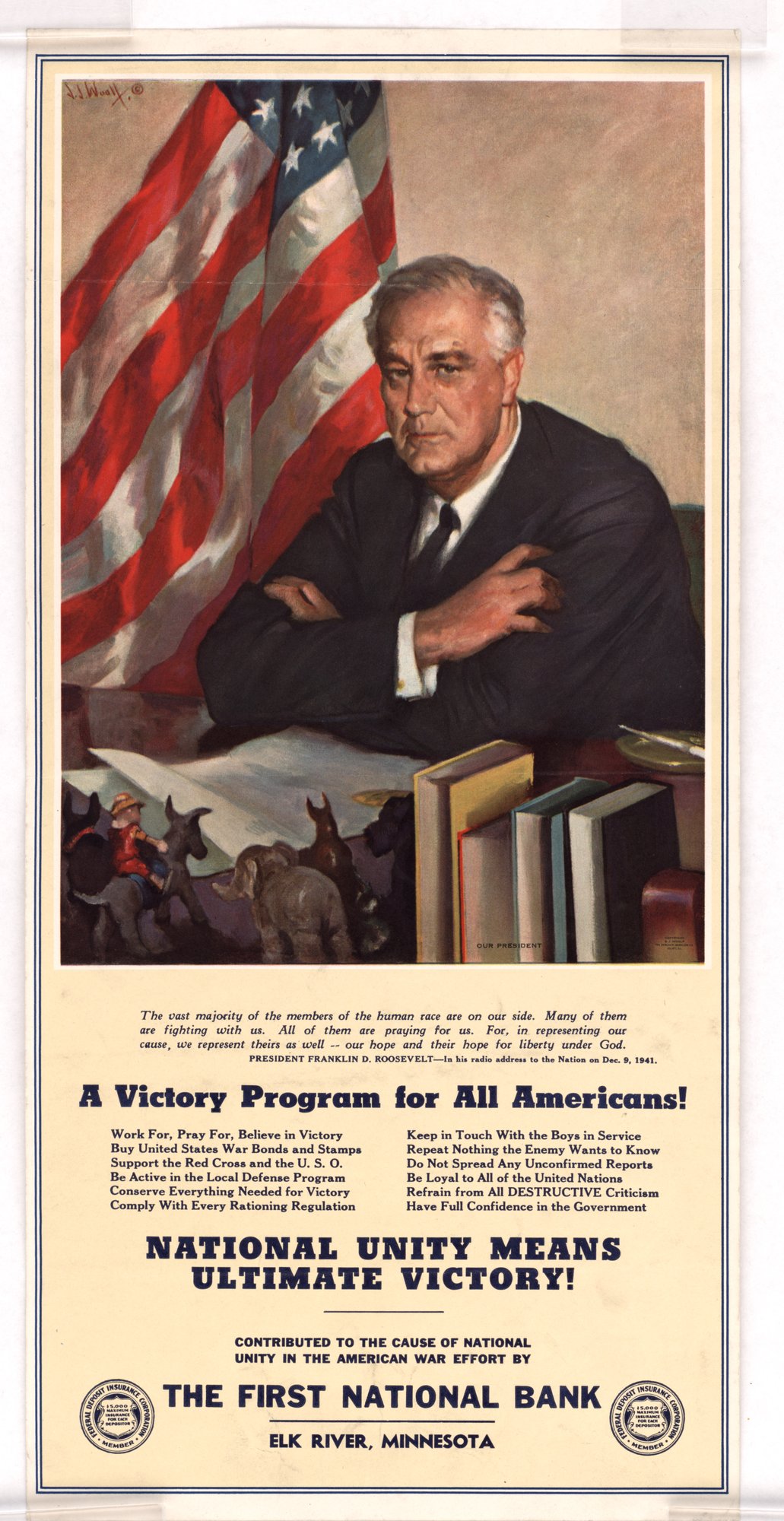
A 1942 sheet contributed by the First National Bank of Elk River, Minnesota, sets a portrait of Franklin D. Roosevelt over a twelve-point "Victory Program for All Americans" that runs from war bonds and rationing compliance to "Refrain from All DESTRUCTIVE Criticism" and "Have Full Confidence in the Government" (NAID 515046).
Portrait and program
A painted Roosevelt sits with folded arms at a desk before the flag, captioned "OUR PRESIDENT." Below him is a passage from his radio address of 9 December 1941, then a list of twelve duties in two columns, one to a line, and at the foot the bank that paid for the sheet.
[...] in representing our cause, we represent theirs as well -- our hope and their hope for liberty under God.
PRESIDENT FRANKLIN D. ROOSEVELT—In his radio address to the Nation on Dec. 9, 1941.
A Victory Program for All Americans!
Work For, Pray For, Believe in Victory
Buy United States War Bonds and Stamps
Support the Red Cross and the U. S. O.
Be Active in the Local Defense Program
Conserve Everything Needed for Victory
Comply With Every Rationing Regulation
Keep in Touch With the Boys in Service
Repeat Nothing the Enemy Wants to Know
Do Not Spread Any Unconfirmed Reports
Be Loyal to All of the United Nations
Refrain from All DESTRUCTIVE Criticism
Have Full Confidence in the Government
NATIONAL UNITY MEANS ULTIMATE VICTORY!
CONTRIBUTED TO THE CAUSE OF NATIONAL UNITY IN THE AMERICAN WAR EFFORT BY THE FIRST NATIONAL BANK ELK RIVER, MINNESOTA
Who paid for it
The sheet names its contributor: the First National Bank of Elk River, Minnesota, and the transcription records a Federal Deposit Insurance Corporation member seal on the sheet. The portrait is signed J. J. Woolf with a copyright mark. No federal agency is named. The archive's rights line nonetheless records it as a U.S. government work; the sheet itself credits only the bank. The National Archives holds it in Record Group 44, World War II Posters, 44-PA-1387 (NAID 515046). FRAME tags testimonial, transfer and glittering generalities.
Reading the twelve lines
This is private speech. A country bank chose to print a list of what it thought citizens owed the war effort, and it had every right to. That is worth saying first, because the list itself is less careful about other people's rights.
The twelve lines are not one kind of thing. Some are requests anyone could take or leave: pray, write to the boys, give to the Red Cross. One points to law: "Comply With Every Rationing Regulation," and rationing regulations carried penalties. Two concern security and rumor, the territory of the newspaper rumor clinics. The last two ask for something different, a state of mind: no destructive criticism, and full confidence in the government.
Those two lines are the ones a republic should read twice. Criticism of the government in wartime, destructive or not, is the speech the First Amendment exists to protect, and a citizen's confidence is something a government earns, not something its supporters can assign. The sheet's capital letters on DESTRUCTIVE suggest its authors meant to leave room for criticism of another kind; give them that. The list still files rationing compliance, a legal duty, beside full confidence in the government, which no law could require, and asks for both in the same type.
The same Roosevelt years on this site include elections won against most editorial pages and the reading of private mail at the border; the Roosevelt administration essay sets the two side by side. Government sheets on rationing itself are on the rationing and price control hub.
Sources
- FRAME object record, National unity means ultimate victory!, 1942. The First National Bank, Elk River, Minnesota (sponsor); portrait signed J. J. Woolf. Rights as recorded: public domain (U.S. government work).
- U.S. National Archives and Records Administration, Record Group 44, World War II Posters, 44-PA-1387, NAID 515046, retrieved by the archive 4 October 2026.