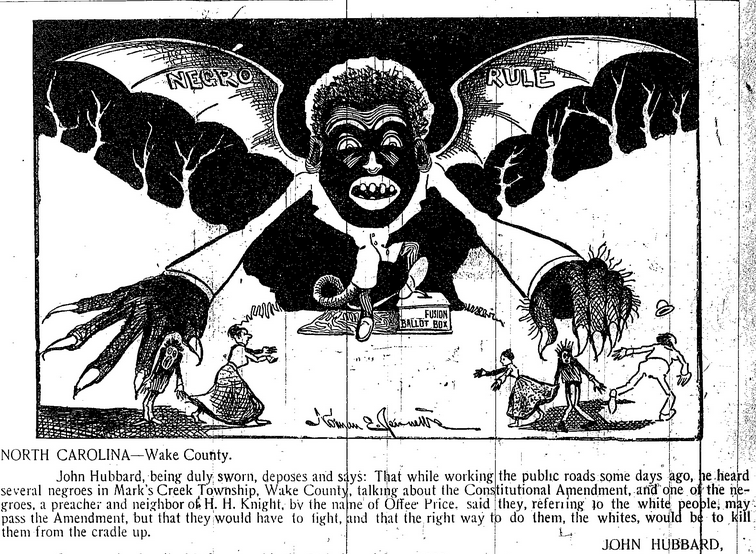
A racist cartoon by Norman E. Jennett, printed in the Raleigh News & Observer on 4 July 1900, shows a bat-winged Black figure labeled "Negro Rule" rising from a "Fusion ballot box," above a sworn statement accusing a Black preacher of urging the killing of whites.
What the page prints
Content note: this is a racist caricature, and the affidavit printed under it repeats an accusation of planned murder. Both are quoted below as the archive transcribed them, because the wording is the evidence.
A bat-winged figure drawn as a Black man spreads over the scene. One wing reads "Negro," the other "Rule." It rises out of a box marked "Fusion Ballot Box" and reaches with clawed hands for white people running away. Under the picture is a sworn statement.
NEGRO RULE / FUSION BALLOT BOX
NORTH CAROLINA—Wake County.
John Hubbard, being duly sworn, deposes and says: That while working the public roads some days ago, he heard several negroes in Mark's Creek Township, Wake County, talking about the Constitutional Amendment, and one of the negroes, a preacher and neighbor of H. H. Knight, by the name of Offee Price, said, referring to the white people, may pass the Amendment, but that they would have to fight them, and that the right way to do them, the whites, would be to kill them from the cradle up.
JOHN HUBBARD,
Who made it
Norman E. Jennett drew the cartoon for the News & Observer of Raleigh. The archive's rights line gives an 1898 drawing date and a 1900 printing; the record's date is 4 July 1900. It credits the work to the Democratic Party's white-supremacy and disfranchisement campaigns in North Carolina, and its stated purpose is to demonize. The scan is from the University of North Carolina at Chapel Hill, via Wikimedia Commons.
What it did, and why it was wrong
The "Constitutional Amendment" in the affidavit was a measure on voting, and the campaign behind this cartoon sought to take the ballot from Black citizens. The cartoon's job was to make that look like self-defense. It draws Black political power as a monster feeding on whites, then backs the picture with one man's report of another man's words, overheard on a road and set down as sworn fact. No answer from the accused preacher appears on the page.
The archive tags the cartoon for accusation in a mirror, and the record explains why. Two years earlier the same white-supremacy campaign had ended in the Wilmington coup of November 1898, in which armed white men killed Black residents, a finding the record attributes to a 2006 state commission. The page accuses Black North Carolinians of planning exactly the kind of killing its own side had done.
This was wrong without qualification. Taking the vote by race violates the equal protection and voting guarantees the Constitution had already written down. Nast had drawn the earlier version of this politics in 1868, from the other side, in This Is a White Man's Government.
Sources
- FRAME object record, "Negro Rule" vampire cartoon with sworn affidavit, 4 July 1900. The News & Observer (Raleigh, N.C.); cartoonist Norman E. Jennett. Event as recorded: North Carolina White Supremacy Campaign.
- University of North Carolina at Chapel Hill, via Wikimedia Commons, File:Negro Rule Vampire over NC 1898.png, retrieved by the archive 27 September 2026. Rights as recorded: public domain.
- The FRAME record cites a 2006 state commission for the Wilmington killings of November 1898.