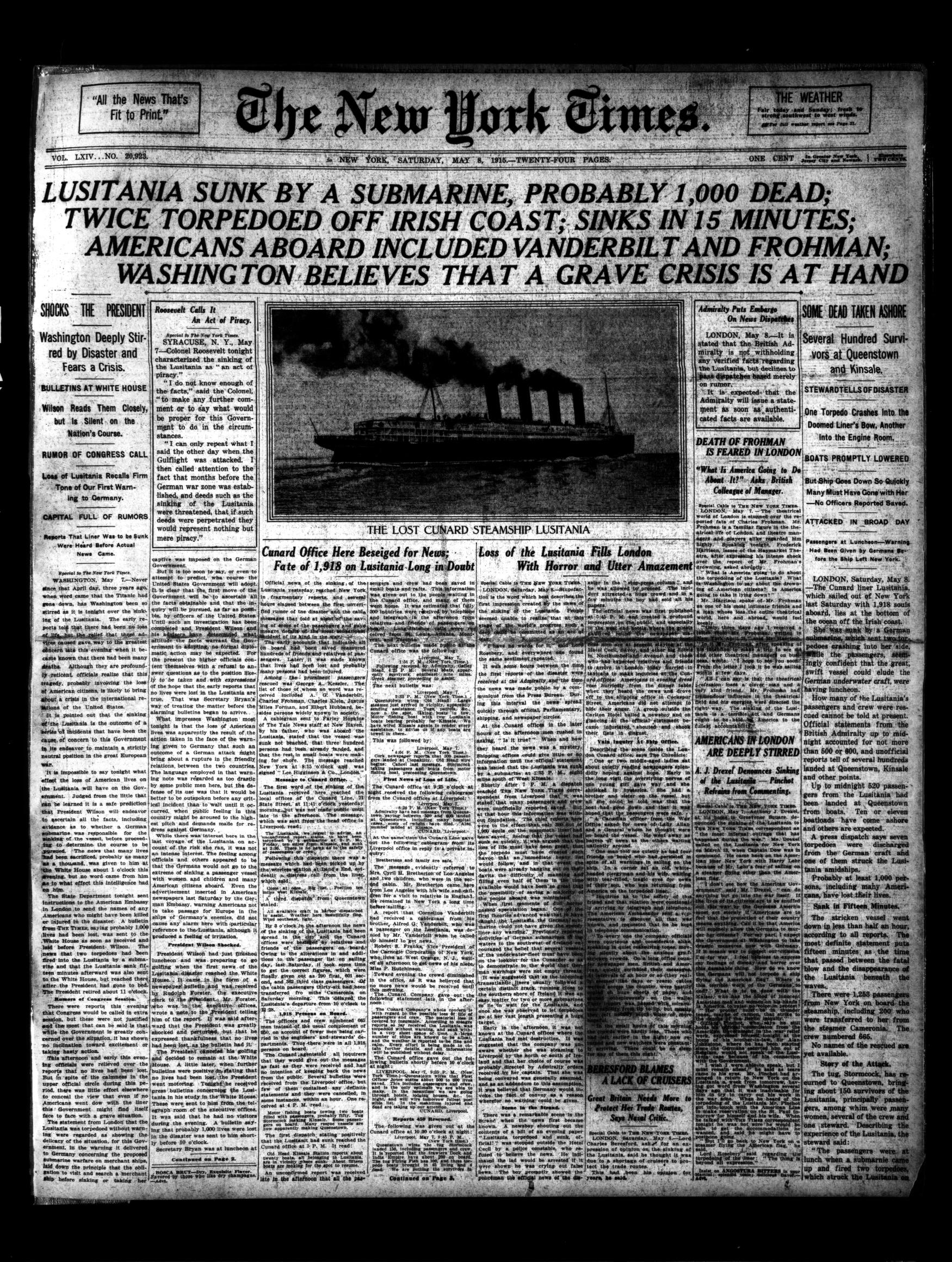
The New York Times front page for Saturday, 8 May 1915. A four-deck headline reports the Lusitania sunk by a submarine with "probably 1,000 dead," Americans aboard, and Washington fearing "a grave crisis," above a photograph of the ship. Internet Archive scan of the microfilm.
The headlines
The front page is mostly headline. Four decks run across the top, followed by bylined dispatches from Washington, Syracuse, and London and a photograph of the ship. The archive transcribed the masthead, dateline, and headlines; it did not transcribe the body text.
The New York Times. 'All the News That's Fit to Print.' NEW YORK, SATURDAY, MAY 8, 1915.—TWENTY-FOUR PAGES. ONE CENT.
LUSITANIA SUNK BY A SUBMARINE, PROBABLY 1,000 DEAD;
TWICE TORPEDOED OFF IRISH COAST; SINKS IN 15 MINUTES;
AMERICANS ABOARD INCLUDED VANDERBILT AND FROHMAN;
WASHINGTON BELIEVES THAT A GRAVE CRISIS IS AT HAND
SHOCKS THE PRESIDENT / Washington Deeply Stirred by Disaster and Fears a Crisis.
Roosevelt Calls It An Act of Piracy.
Admiralty Puts Embargo On News Dispatches
[...]
Cunard Office Here Beseiged for News; Fate of 1,918 on Lusitania Long in Doubt
News under pressure
The archive tags the page with one technique, testimonial: the headlines lean on named voices and authorities, from "the President" and "Washington" to Roosevelt calling the sinking "An Act of Piracy." That is how a newspaper reports a disaster on the first day. It quotes whoever will speak.
Read closely, the page is also honest about its own limits. "Probably 1,000 dead" is an estimate and says so. The fate of 1,918 people was "Long in Doubt." One headline reports that the Admiralty had put an embargo on news dispatches, which tells the reader that a government was holding back some of the news. A careful reader in 1915 could see, on the front page, both the scale of the event and the gaps in what was known.
Press and government
This is a private newspaper, not a government sheet. Its headlines are strong, but the page reports what officials said rather than speaking for them. When a recruiting poster used the same event that year, it was making its own argument with its sponsor's name on it. The Boston Public Safety Committee's 1915 poster Enlist, which the archive connects to the sinking, uses one word and a drowning mother.
The Wilson administration essay places the Lusitania among the events that preceded the war message of April 1917. For a private press at its most reckless, see the site's case study on the yellow press of 1898; this front page is a useful contrast.
Sources
- FRAME object record, The New York Times, daily edition, front page (New York, May 8, 1915). The New York Times (private newspaper, New York).
- Internet Archive, Serials in Microfilm, The New York Times, 8 May 1915, digitized from microfilm, retrieved by the archive 2 October 2026. Rights as recorded: public domain (US; published before 1 January 1931).