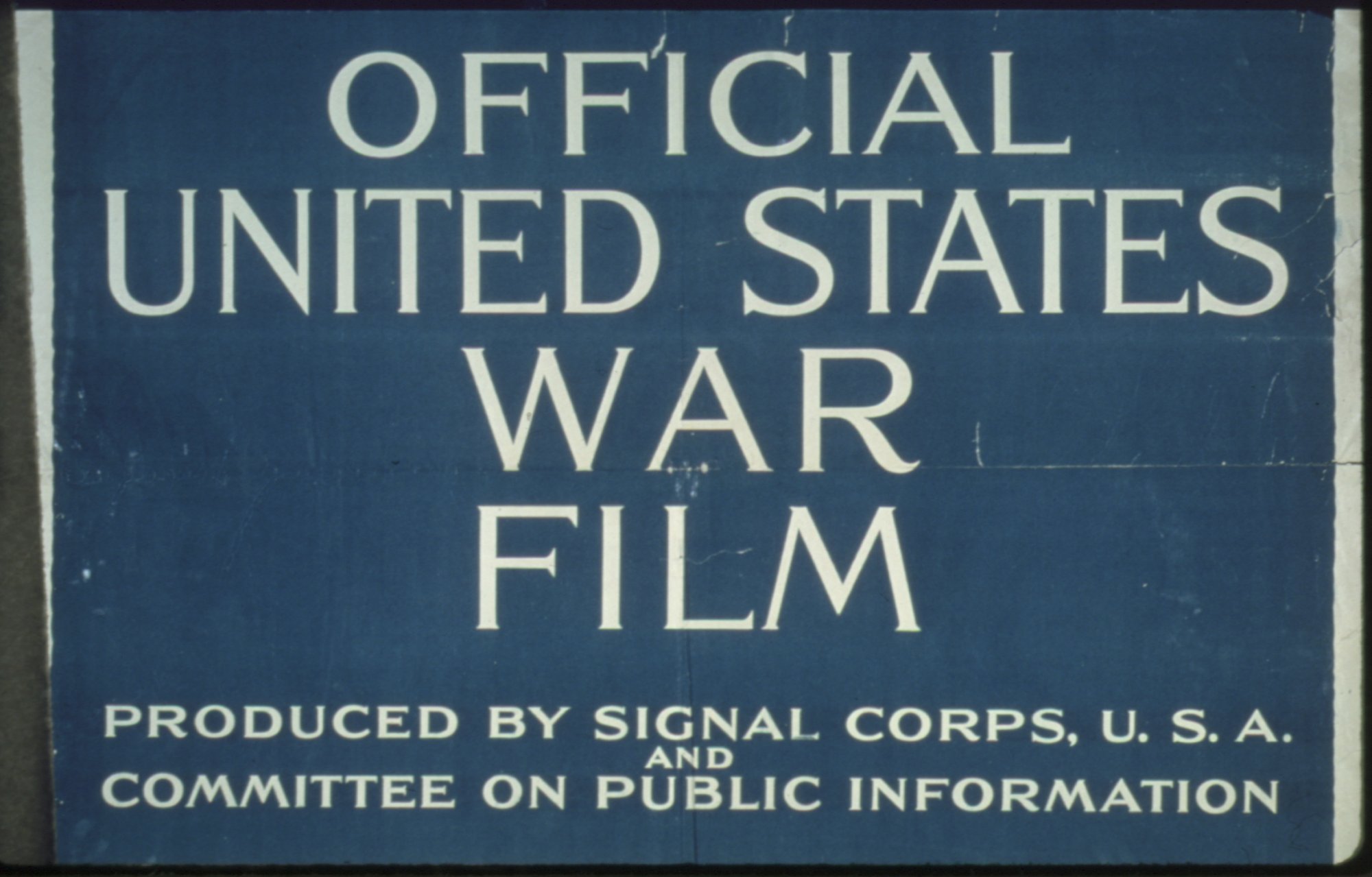
A 1917 blue sheet in white capitals announces an official United States war film produced by the Army Signal Corps and the Committee on Public Information. It has no picture and no slogan beyond those words.
What the sheet prints
Seven short lines in white on blue. That is the whole object. It names no battle, no title, no star, and no theater. It tells an audience only who made what they are about to watch.
OFFICIAL
UNITED STATES
WAR
FILM
PRODUCED BY SIGNAL CORPS, U. S. A.
AND
COMMITTEE ON PUBLIC INFORMATION
Who issued it
The maker line credits the U.S. Army Signal Corps and the Committee on Public Information. The National Archives copy is in Record Group 4, World War I Posters (series NAID 512439), local identifier 4-P-20. The FRAME record dates it 1917 and says no more about which film it introduced.
How to read it
A film made by the Army's camera units and released by the government's publicity office is a primary source of real value. A viewer in 1917 was right to want that footage, and a historian today is glad it exists.
The card also does something before the first frame. "Official" is a claim of authority, not a description of content. It asks the audience to trust the reel because of its source, and it leaves out what the source chose not to film or not to release. A government that controls the camera on the front and the distribution at home has edited the war twice. That is not a reason to call the footage false. It is a reason to ask who cut it.
The same committee put an older costume on its speakers' program in the Four Minute Men poster, and a crusade on its feature film in Pershing's Crusaders. This card is the plain version, with the persuasion reduced to one word. Its sibling in print is the Official Bulletin notice. The office behind all of them is covered in the CPI case study. The Wilson administration essay places the committee's bulletin, films, and posters beside the statutes and the mails that ran alongside them.
Sources
- FRAME object record, Official United States War Film (Signal Corps and Committee on Public Information), 1917.
- U.S. National Archives, RG 4, World War I Posters, series NAID 512439, catalog item 512459, local identifier 4-P-20, retrieved by the archive 3 October 2026. Rights as recorded: NARA unrestricted.