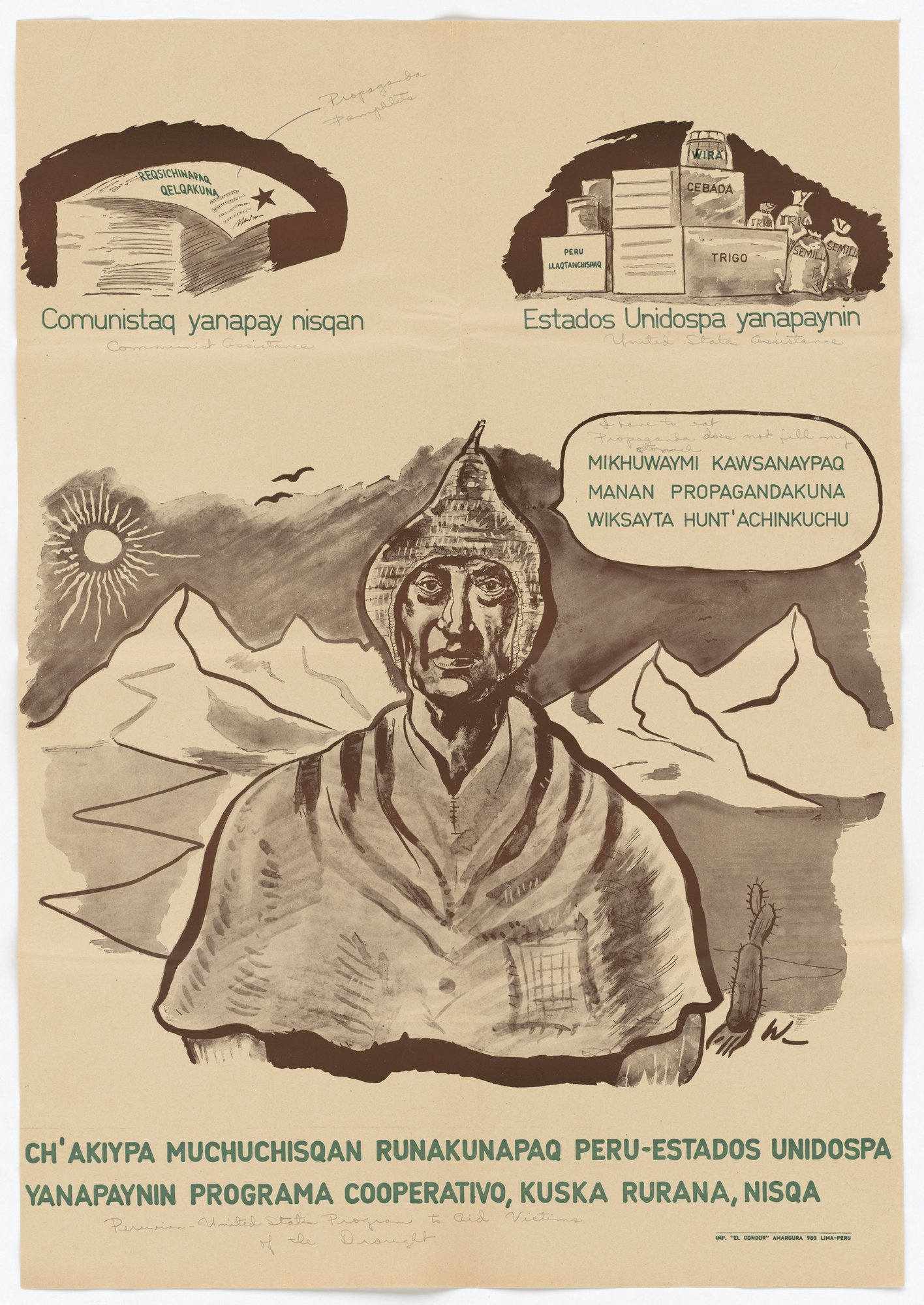
"Propaganda does not fill the stomach": a 1958 Quechua poster from Lima
Poster No. 66 (1958, Quechua): Communist pamphlets versus U.S. sacks of grain for Peru's drought victims, printed by El Condor, Lima. NARA RG 306, NAID
Techniques named on the archive record
Plain folksCard stacking
Date
January 1, 1958
Made by
U.S. Information Agency (USIS post), Propaganda Posters Distributed in Asia, Latin America and the Middle East series; printed by El Condor, Lima
Medium
Poster
Country
United States
Regime
Eisenhower Administration
NARA
NAID 6948889; Record Group 306
Source
Identified Openly sourced: the speaker is who they say they are
Source
U.S. National Archives (NARA), RG 306, Propaganda Posters Distributed in Asia, Latin America and the Middle East , retrieved October 4, 2026
Source
Public domain (U.S. government work; NARA RG 306) U.S. Information Agency / Department of State, 1958. National Archives, Record Group 306 (NAID 6948889, 306-PPB-66).
Object, image, and catalog record from the FRAME archive. Text on this page is CC BY 4.0. Image rights are as the archive records.
A Quechua-language poster, No. 66, printed by El Condor in Lima and filed with U.S. Information Agency posters, catalog date 1958. A stack of star-marked pamphlets labeled Communist assistance faces sacks of fat, barley and wheat labeled United States assistance, and a highland man says propaganda does not fill his stomach (NAID 6948889).
What the sheet shows
Two kinds of "assistance" face each other on this sheet. At top left is a stack of pamphlets marked with a star. At top right are crates and sacks marked fat, barley, wheat and seed. Below, a man from the highlands speaks. Pencil notes in English, written on the sheet and not printed, label the parts.
CH'AKIYPA MUCHUCHISQAN RUNAKUNAPAQ PERU-ESTADOS UNIDOSPA YANAPAYNIN PROGRAMA COOPERATIVO, KUSKA RURANA, NISQA
IMP. "EL CONDOR" AMARGURA 983 LIMA-PERU
[Archive's English translation:] Writings for publicity. / What the Communist calls assistance. [...] The United States' assistance. / I have to eat to live; propaganda does not fill the stomach. / The Peru-United States cooperative aid program for the people stricken by drought, 'working together'.
One of the signed sheets
This is one of the sheets in the file that says who sent it. The text names a Peru-United States cooperative aid program for drought victims, and FRAME classes the source as identified. The maker line names the U.S. Information Agency's post, and the archive's title calls it USIS Lima. The printer was El Condor, Amargura 983, Lima. The National Archives files it in Record Group 306 with a catalog date in 1958.
Paper against grain
FRAME tags it plain folks and card stacking. A villager's voice carries the argument, and the argument is a two-item comparison: paper from one side, food from the other. The archive files the purpose as persuade or win support, and the themes as the economy and elections.
The joke is obvious once seen. A printed poster tells its readers that printed propaganda does not feed anyone. The sheet is propaganda in the plain sense, and the archive's title for it uses the word, as does a pencil note in English on the sheet.
The comparison still lands, because it rests on something a hungry reader could check. Grain either arrived or it did not. If the program delivered the seed and wheat the sheet shows, it did something a pamphlet cannot do, and the sheet says so under the program's own name. What the sheet does not give is any quantity or date for the aid, so its reader had to take the scale on trust.
FRAME object record, Propaganda Pamphlets poster, No. 66 (Quechua, USIS Lima). Catalog date 1958. Printed by El Condor, Lima.
U.S. National Archives, RG 306, Propaganda Posters Distributed in Asia, Latin America and the Middle East, item NAID 6948889, 306-PPB-66, catalog.archives.gov, retrieved by the archive October 4, 2026. Rights as recorded: public domain (U.S. government work).